






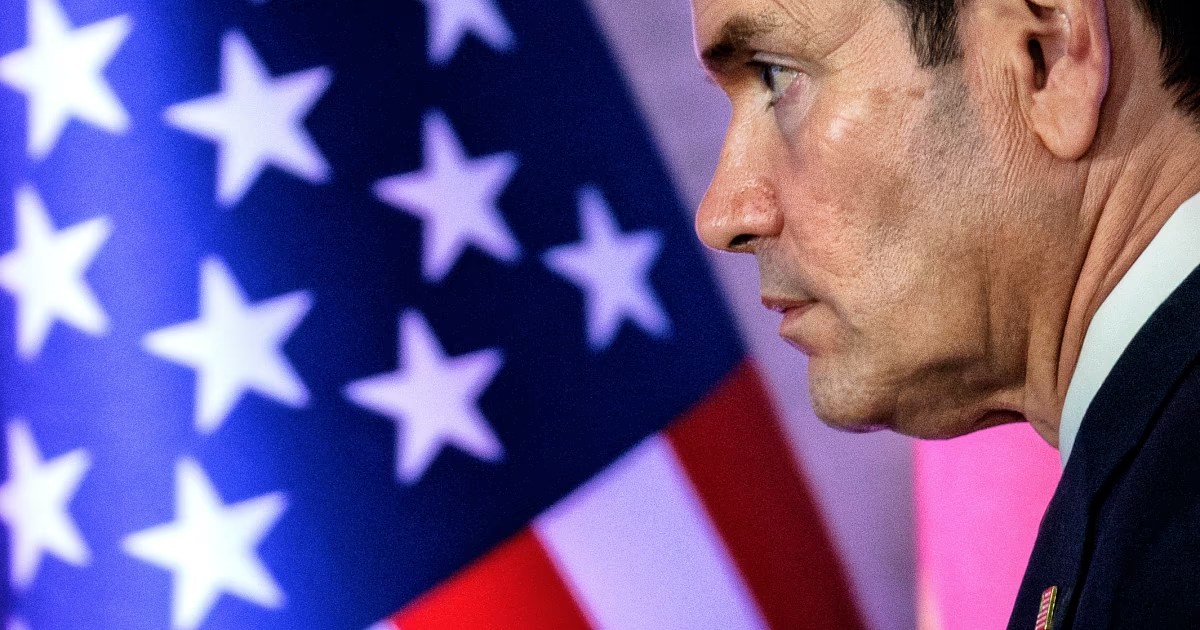
US Secretary of State Marco Rubio launched a sharp attack on Tehran, accusing it of continuing to evade commitments and agreements made with Washington. Rubio explained during a press conference in the Philippine capital, Manila, that the Iranian side is currently incurring heavy losses as a result of its escalatory policies in the region.
The head of American diplomacy considered that Iran is trying to beg for a new agreement with the United States, whether through direct or indirect channels. He indicated that the opportunity to reach a deal is still available if 'Tehran comes to its senses' and stops its practices that led to the recent strikes.
Rubio stressed that the Iranians will pay a heavy price if they insist on continuing the state of war and confrontation. He added that many international parties speaking on behalf of Tehran are trying to communicate with Washington, but the problem lies in Iran's attempt to change the terms after every understanding.
Regarding the current American strategy, Rubio affirmed that President Donald Trump's administration adopts the principle of 'an eye for an eye' in dealing with threats. He expected that leaders in Tehran would change their positions in the coming days as a result of the continuous military and economic pressures they face.
The American minister touched on the issue of the Houthis in Yemen, considering that the group was far from direct confrontation before Iranian intervention. Rubio claimed that Tehran 'deceived' the Houthis and pushed them to target ships and Saudi interests to serve its own agenda in the Red Sea.
In contrast, the Iranian army responded with an official statement confirming that military operations in the region would not stop. The Iranian military command linked the halt of its strikes to the cessation of American attacks targeting Iranian territory and coastal areas of the sea.
Official sources quoted the spokesman for the Iranian army, Mohammed Akrami Nia, as saying that the armed forces are ready for all possible scenarios. He affirmed that retaliatory attacks would continue as long as the United States continued to target the country's vital infrastructure.
Reports from Tehran indicate that Iranian officials have formulated two equations to respond to recent American threats. The first equation is that any targeting of Iranian facilities will be immediately met with a strike on vital energy facilities throughout the region.
The second equation relates to the Strait of Hormuz, where Tehran insists that the waterway will not be opened to international navigation except according to arrangements in which it participates. This response comes after American threats to strike power stations and bridges inside Iran if ships in the strait are targeted.
On the diplomatic front, sources reported that international mediators are awaiting an Iranian response to a Qatari-Pakistani proposal for de-escalation. The proposal aims to bring the parties back to the negotiating table and halt the accelerating military escalation that threatens global energy security.
Tehran adheres to the previous memorandum of understanding as a basic reference for any future dialogue with the American administration. Iran also continues its consultations with the Sultanate of Oman regarding the management of the Strait of Hormuz, emphasizing that any security arrangements there must be made in full coordination with it.
The region is experiencing a state of anticipation amid the exchange of harsh military and political messages between Washington and Tehran. While diplomatic moves continue behind the scenes, the field remains the judge, given the insistence of both sides on establishing new deterrence equations.
President Donald Trump's policy is based on the principle of an eye for an eye, and Iran will pay a heavy price for continuing the war.
שתף את דעתך
Rubio warns Tehran of 'heavy price' and Iranian army conditions halt of strikes on end of American attacks