






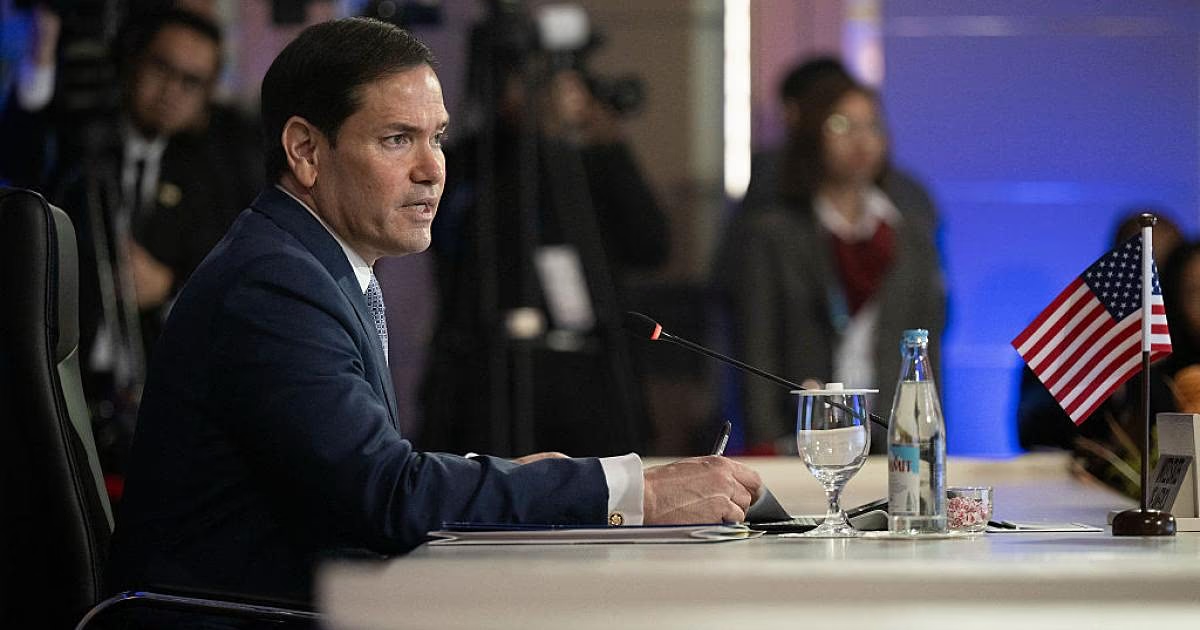
US Secretary of State Marco Rubio announced that the United States continues to keep the doors of diplomacy ajar to resolve the escalating conflict with Iran. Rubio clarified during his participation in a meeting with foreign ministers of the Association of Southeast Asian Nations (ASEAN) in Manila that engaging in positive and constructive dialogue requires full commitment from Tehran to international pledges.
The US chief diplomat criticized what he described as the Iranian side's lack of seriousness in dealing with the proposed de-escalation paths so far. He pointed out that the failure to respect previous commitments led to dire consequences on the ground, stressing that Washington will not hesitate to take protective measures for its interests and the interests of its allies if Iranian procrastination continues.
Rubio revealed the existence of direct and indirect communication channels to discuss the possibility of de-escalating the current situation and avoiding the expansion of the confrontation. These statements come at a sensitive time when the region is witnessing intensive diplomatic moves to save the temporary ceasefire agreement, which appears to be facing the risk of complete collapse.
In the context of diplomatic efforts, informed sources reported that Tehran received a proposal from mediators for a ten-day ceasefire. This proposal aims to preserve the gains of the temporary agreement signed last June, which came to replace previous understandings reached in April of the same year.
On the regional mediation front, Iranian Interior Minister Eskandar Momeni visited the Pakistani capital, Islamabad, to convey messages related to the current situation. Tehran asked the Pakistani side to continue its efforts aimed at bridging views and preventing the region from sliding into a comprehensive and undesirable confrontation.
The US minister linked the political crisis with Iran to the safety of international navigation, stressing Washington's absolute rejection of any attempts to control the Strait of Hormuz. Rubio considered that imposing conditions or fees on ships passing through international waterways represents a dangerous precedent whose effects could extend to other regions such as Southeast Asia.
Rubio warned that allowing threats to commercial ships in waterways would disrupt global supply chains and energy security. He explained that ASEAN countries are among the most affected by these tensions due to their high dependence on oil and gas imports coming from the Middle East through the threatened waterways.
These warnings coincided with escalating threats in the Red Sea, where the Houthis announced a naval blockade on Saudi ports. These threats led to the rerouting of three giant oil tankers that were heading to China and India, as they preferred to pass through the Suez Canal instead of passing alongside the Yemeni coast.
Riyadh seeks to secure its oil exports by using pipelines that reach the port of Yanbu on the Red Sea to avoid the risks of the Strait of Hormuz. However, Houthi threats at the Bab al-Mandab Strait are narrowing the available alternatives, putting additional pressure on energy prices, which have recently seen significant increases.
In global markets, Brent crude prices jumped to over $91 per barrel due to fears of supply disruptions. Analysts believe that the continued tension in the Straits of Hormuz and Bab al-Mandab will lead to instability in the global economy, which has prompted ASEAN countries to express their grave concern.
On the ground, sources reported that the US Central Command continued its airstrikes on targets inside Iranian territory for the eleventh consecutive night. The strikes included areas in Tabriz, Sirik, and Chabahar, while Iranian authorities activated air defense systems in the capital, Tehran, to counter the attacks.
For his part, US President Donald Trump announced that the ongoing four-month conflict with Iran has resulted in the deaths of 18 American soldiers. Trump threatened to take decisive military action against the Houthis if they carry out their threats to completely close the Bab al-Mandab Strait to international navigation.
This escalation on the ground reflects the collapse of the memorandum of understanding for a cessation of hostilities signed last June, which brings the crisis back to square one. Diplomatic options appear limited given the wide divergence in positions between Washington and Tehran regarding the conditions for returning to the negotiating table and adhering to previous agreements.
ASEAN foreign ministers concluded their meeting by calling for the need to ensure the safe passage of ships and aircraft through the Strait of Hormuz without any obstacles. The ministers warned that any disruption to energy security would lead to severe economic repercussions for Southeast Asian countries, which are already suffering from regional conflicts in the South China Sea.
If they are serious about negotiations, we are serious, and if not, we will take the necessary measures to protect our interests and the interests of our allies.
שתף את דעתך
Rubio conditions dialogue with Iran on seriousness and warns against threatening international navigation