






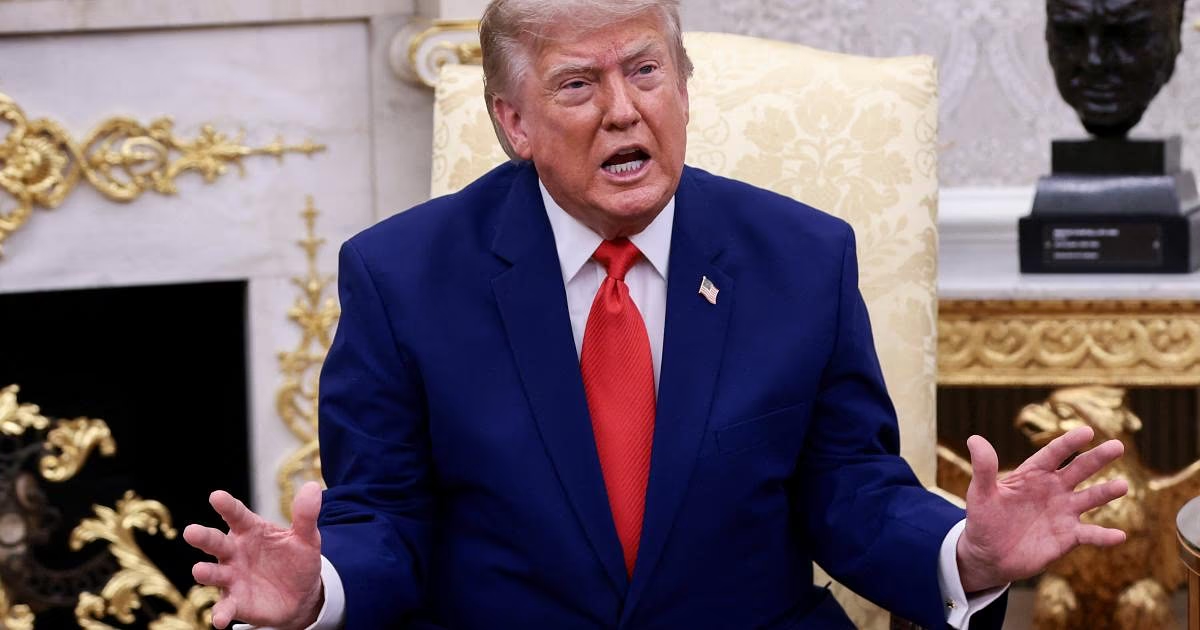
US President Donald Trump affirmed that the United States has not yet completed its military objectives in confronting Iran, emphasizing that withdrawal from the region is not an option at present. Trump clarified in statements from the White House that stopping now would give Tehran an opportunity to rebuild its capabilities within two decades, which Washington seeks to prevent through continued military pressure.
In a notable escalation, Trump revealed his country's intention to target the 'Jabal Fas' nuclear facility, located deep underground near the Natanz region. The US President described the anticipated strike as very powerful and imminent, noting that Western intelligence is monitoring this site, which is suspected of being used for undeclared uranium enrichment.
On the ground, US forces continued intensive airstrikes for the tenth consecutive night, targeting military infrastructure within Iranian territory. These strikes are part of a US strategy aimed at undermining Tehran's offensive capabilities and preventing it from threatening international navigation and military bases in the region.
For his part, US Secretary of Defense Pete Hegseth issued a stern warning to the Iranian leadership against harming commercial or military vessels in the Strait of Hormuz. Hegseth affirmed that any attempt to disrupt navigation would be met with a US military response ten times the size of the attack, to ensure the security of vital waterways.
In the context of regional escalation, Kuwait, Bahrain, and Jordan were subjected to new attacks on Tuesday, attributed to Iranian forces. Field sources reported that air defenses in these countries were activated to counter missiles and drones that targeted vital sites and bases where US forces are stationed.
The Jordanian army announced its success in intercepting and shooting down three missiles and five drones launched from Iranian territory towards its targets. At the same time, authorities in Kuwait and Bahrain activated their defense systems to counter aerial threats, amidst Kuwaiti calls for rationalizing energy consumption in anticipation of any emergencies resulting from the military escalation.
Diplomatically, Pakistan re-entered the crisis, with Prime Minister Shehbaz Sharif calling on all parties to exercise maximum restraint. During his reception of the Iranian Interior Minister, Sharif affirmed that Islamabad would continue its mediation efforts to prevent the region from sliding into a full-scale war whose repercussions cannot be controlled.
The Pakistani Prime Minister indicated that his country is seeking to revive the understandings reached last June, despite the current lack of a political horizon. He stressed the need to return to the negotiating table to end the state of hostility that has been escalating dangerously since the beginning of July.
On other fronts, Trump warned the Houthi group in Yemen against carrying out any threats targeting US interests or Washington's allies. These statements came during his meeting with Lebanese President Joseph Aoun, where he affirmed that Washington is capable of dealing with any Houthi escalation as it has in previous confrontations.
The roots of the current confrontation date back to last February, when US and Israeli forces launched a widespread attack on Iranian targets, igniting an extended regional conflict. Despite the signing of a memorandum of understanding last June to establish a ceasefire, repeated violations led to the collapse of the truce and the resumption of hostilities.
Reports indicate that Iran has focused its recent attacks on countries hosting US military bases, in an attempt to pressure Washington to withdraw. However, the declared US position indicates an insistence on achieving 'full objectives' before discussing any comprehensive de-escalation or withdrawal from advanced positions.
Anticipation remains the dominant mood in the region as the deadline Trump hinted at for striking nuclear facilities approaches, amidst international fears of the conflict escalating into a major regional war. Global capitals are cautiously monitoring the extent to which regional mediations, especially Pakistani ones, can defuse the crisis before it is too late.
If we leave now, Iran will need 15 to 20 years to rebuild, but we have not finished our work at all.
שתף את דעתך
Trump Vows to Strike 'Jabal Fas' Nuclear Facility, Confirms Continued Military Operations Against Iran