






US President Donald Trump revealed new legislative directions within Congress aimed at expanding the scope of the sanctions bill targeting Russia to include both Iran and the Lebanese "Hezbollah." Trump affirmed from the White House that this step has a high chance of approval once the final details are drafted, noting that the inclusion of Tehran in this law is of paramount importance in the current US strategy.
In a related context, the first round of direct talks between delegations from Lebanon and Israel concluded in the Italian capital, Rome, under intense American patronage. Sources reported that the atmosphere was positive and fruitful, with discussions focusing on mechanisms for implementing the framework agreement reached last month to end the armed conflict in the border region.
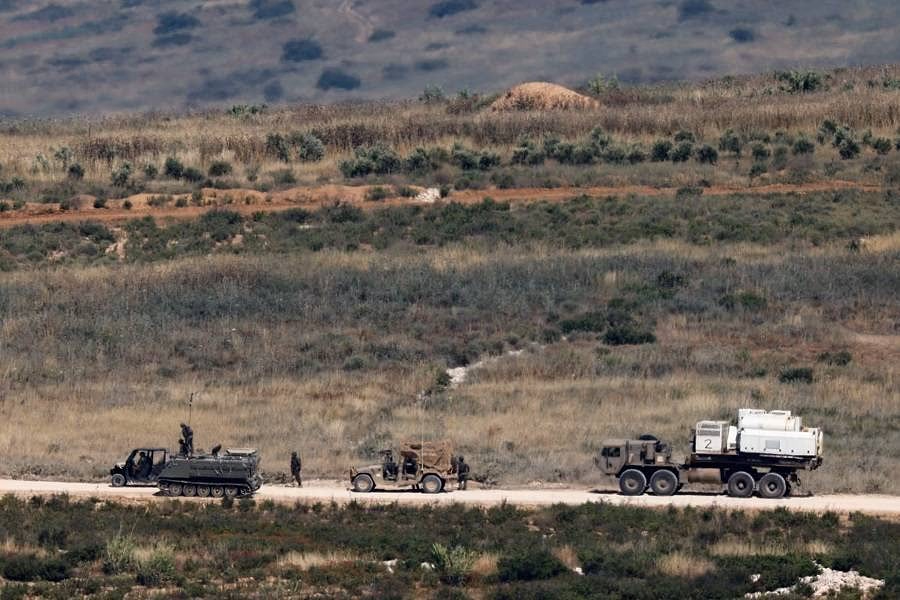
During these talks, Tel Aviv showed initial readiness to proceed with plans for withdrawal from two experimental areas in southern Lebanon, which Israeli Foreign Minister Gideon Sa'ar considered a step forward. Sa'ar expressed his hope that the current Rome round would lead to a real breakthrough that would end the military tension that has persisted for months.
For its part, the Lebanese presidency stressed that the negotiating delegation carries clear directives on the necessity of an immediate withdrawal of Israeli forces from the agreed-upon areas before moving on to any other issues. The Lebanese side insists on the necessity of implementing the agreement in stages, starting with enabling the Lebanese army to successively take over border towns to ensure national sovereignty.
The framework agreement sponsored by Washington stipulates the complete cessation of hostilities and the disarmament of "Hezbollah" in the southern regions, in preparation for the deployment of Lebanese army units. However, the party still declares its categorical rejection of surrendering its weapons or entering into direct negotiations with the Israeli side, relying on Iranian support in the face of international pressure.
Diplomatic sources indicate a gap in the final objectives of the negotiation, as Israel seeks to reach a comprehensive peace agreement, while Lebanon focuses on concluding a security treaty that guarantees a cessation of aggressions. These sources believe that Israel is trying to capitalize on the results of recent military operations to impose its conditions in the negotiation rooms as the stronger party on the ground.
On the ground, military escalation has not completely stopped despite the negotiation atmosphere, as Israeli forces carried out a series of bombings and raids in the towns of Nabatieh al-Fawqa and Kafr Tebnit. These attacks resulted in casualties among civilians, at a time when "Hezbollah" has committed to not carrying out new offensive operations since mid-June, while warning against violating the ceasefire.
These developments coincide with a widespread regional escalation, as President Trump announced the re-imposition of a naval blockade on Iranian ports in the strategic Strait of Hormuz region. This step comes after American strikes targeted Iranian sites, further complicating the political scene and linking the Lebanese file to the direct conflict between Washington and Tehran.
Political observers believe that the chances of achieving a decisive breakthrough in the Rome negotiations may remain limited in the foreseeable future, unless Washington exerts real pressure on the Israeli side. Analysts suggest that any substantial progress on the withdrawal issue may be postponed until after the anticipated visit of the Lebanese President to Washington next week.
Reports indicate that the Lebanese army has completed its readiness to take over security tasks in the border areas immediately after the withdrawal of Israeli forces, as coordination meetings were held with a US military delegation for this purpose. This coordination aims to establish precise mechanisms to prevent any security vacuum that could lead to a renewal of armed confrontations.
Regarding the Iranian position, Tehran is trying to link the path of de-escalation in Lebanon with the comprehensive regional escalation file, which Washington and Tel Aviv reject as they seek to separate the two paths. Research circles warn that Iran may resort to reactivating the southern Lebanon front again if it feels an existential threat to its regime due to US sanctions and blockade.
The war that erupted last March left widespread destruction of Lebanese infrastructure and led to the death of more than 4,300 people, according to Ministry of Health data. Intensive raids and the Israeli ground incursion caused widespread displacement, putting additional pressure on the Lebanese government to reach a quick political solution.
The issue of Hezbollah's disarmament remains the most prominent sticking point in the negotiations, as Israel stipulates not withdrawing from the 10-kilometer deep security zone before this condition is met. Analysts doubt the ability of the Lebanese state to implement this clause given the current political and military balances within the country.
With the resumption of talks in Rome, the Lebanese street awaits tangible results that will alleviate the burden of the security and economic crisis, amid fears that the new US-Iranian escalation could undermine mediation efforts. The coming days remain crucial in determining the path of the framework agreement and the extent of the parties' commitment to implementing its provisions on the ground.
They will add Iran, and that is very important. They may also add Hezbollah to the sanctions bill.
שתף את דעתך
Trump threatens sanctions on Iran and "Hezbollah" and Rome talks discuss Israeli withdrawal