






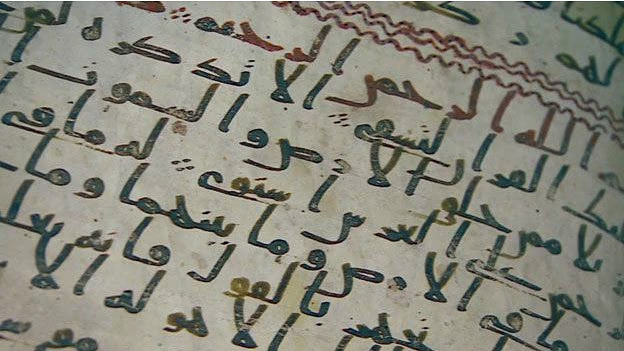
The Quran: Man's Mirror in the Divine Balance
The Divine Revelation as the ultimate definition of man by his Creator
Ever since man began to be aware of his existence, he has faced the most profound question on his journey: Who am I?
This question was not a search for a name, identity, or external description, but rather a search for the underlying truth of his existence: What is his nature? What are his capabilities? What are his limits? And what is the purpose that gives his life meaning?
Man has been able to discover much about the world around him. He understood the laws of nature, explored the depths of matter, built civilizations, and developed tremendous tools that enabled him to influence his surroundings. Yet, despite all this progress, he remained before the most difficult question: Has man been able to know himself as he has known the things around him?
Man tries to know himself while being a part of this self. He studies his mind with his mind, and analyzes himself with tools that are themselves part of his composition, and therefore his knowledge of himself remains limited no matter how much progress he makes. He can know some of his manifestations, but he cannot encompass all his dimensions; because he is not merely a material existence, but a complex being that combines body, mind, soul, will, and meaning.
Hence arises the need for knowledge that comes from outside the boundaries of man, knowledge emanating from the One who created man and knows his reality.
And here comes the Holy Quran.
The Quran is not just a book that offers man a set of rulings or directives, but it is a divine discourse that reveals to man who he is. It is not a definition of man issued by man, but a definition issued by the Creator of man.
For Allah Almighty is the Knower of what He created:
"Does He who created not know? And He is the Subtle, the All-Aware."
Therefore, the Quran represents the highest definition of man by his Creator; because it is a definition not based on limited human observation, but on the all-encompassing divine knowledge of man's reality.
The Quran reveals to man his origin, his nature, his weakness, his capabilities, his responsibility, and his purpose. It does not see him as merely a being living in the world, but as a being with a status and a mission; a being created capable of knowledge, choice, purification, and bearing the trust.
From this perspective, the Quran can be seen as man's mirror in the divine balance.
When man stands before the Quran, he does not see the image he has drawn for himself, nor the image society has made of him, but he sees the image revealed to him by his Creator. He sees that he is honored, yet responsible. Capable, yet limited. Free, yet accountable. He possesses the ability to ascend, but also carries the potential to fall.
But this mirror not only reveals man, but also reveals the nature of the relationship between the Creator and the created.
The Quran is a divine discourse absolute in its source, but descended to a limited human being in terms of his capacity to receive. Therefore, one of the characteristics of this revelation is that it came commensurate with man.
And here the meaning must be understood precisely; it is not meant that the Quran is limited by human boundaries, for Allah Almighty and His speech are far removed from the limits of creatures, but rather that divine wisdom necessitated that the divine discourse reach man in a form that man can receive, understand, and interact with.
For the Creator, glorified be He, knows the nature of the creature He addresses. He knows his capacity for perception, the energy of his mind, the readiness of his heart, and the limits of his endurance. Therefore, the revelation came in a form that addresses man in his language, considers his experience, and opens horizons of knowledge for him without burdening him with what he cannot bear.
Hence, the level of revelation reveals the level of the addressed creature.
That man is addressed by the word of God, required to understand it, and invited to ponder over it, reveals his special status in the divine balance. Man is not merely a material creature, but a creature given the ability to receive and interact with the divine discourse.
And to the extent that Allah Almighty revealed to man through the Quran, the possible limits of human perception are determined. The Quran is the space where absolute divine knowledge met limited human capacity.
Indeed, Allah Almighty did not reveal everything to man, because man cannot bear everything, nor did He withhold from him what he needs, because the purpose of revelation is guidance and the building of man.
This meaning appears in the story of our Prophet Moses (peace be upon him) when he asked to see Allah Almighty:
"My Lord, show me [Yourself] that I may look at You. He said, 'You will not see Me, but look at the mountain; if it remains in its place, then you will see Me.' But when his Lord appeared to the mountain, He made it crumble to dust, and Moses fell unconscious."
So the issue is not the absence of divine power to reveal, but the limits of the creature's receptivity. The limited cannot encompass the absolute, and the creature cannot comprehend the reality of the Creator as it is.
Thus, the Quran reveals two things to man at once: it reveals to him his capacity for knowledge, and it reveals to him the limits of this knowledge.
It grants him the path of approach, but it always reminds him that he is a creature, not absolute.
Therefore, the Quran is the ultimate definition of man by his Creator; it is not all divine knowledge about man, because God's knowledge is limitless, but it is the maximum amount of definition given to man in a form he can receive.
The Quran defines man by his origin so that he does not become arrogant, defines him by his weakness so that he does not despair, defines him by his dignity so that he is not humiliated, and defines him by his responsibility so that he does not live without purpose.
From this, we understand the differences among people in understanding the Quran; the book is one, but the man who stands before it is different. And every person takes from this ocean according to his capacity. The more man ascends in his awareness and purification, the more capable he becomes of seeing himself in this divine mirror.
Indeed, the Quran not only reveals what God wants from man, but it reveals man as he is in God's knowledge.
Therefore, the Quran is not just a book sent to man, but it is the book of man as God knows him.
It is the mirror that the Creator placed before His creature to see his reality, his limits, his destiny, and his purpose in the divine balance.
Man is not complete when he only knows the world around him, but when he knows himself as his Creator has defined him.
שתף את דעתך
The Quran: Man's Mirror in the Divine Balance