






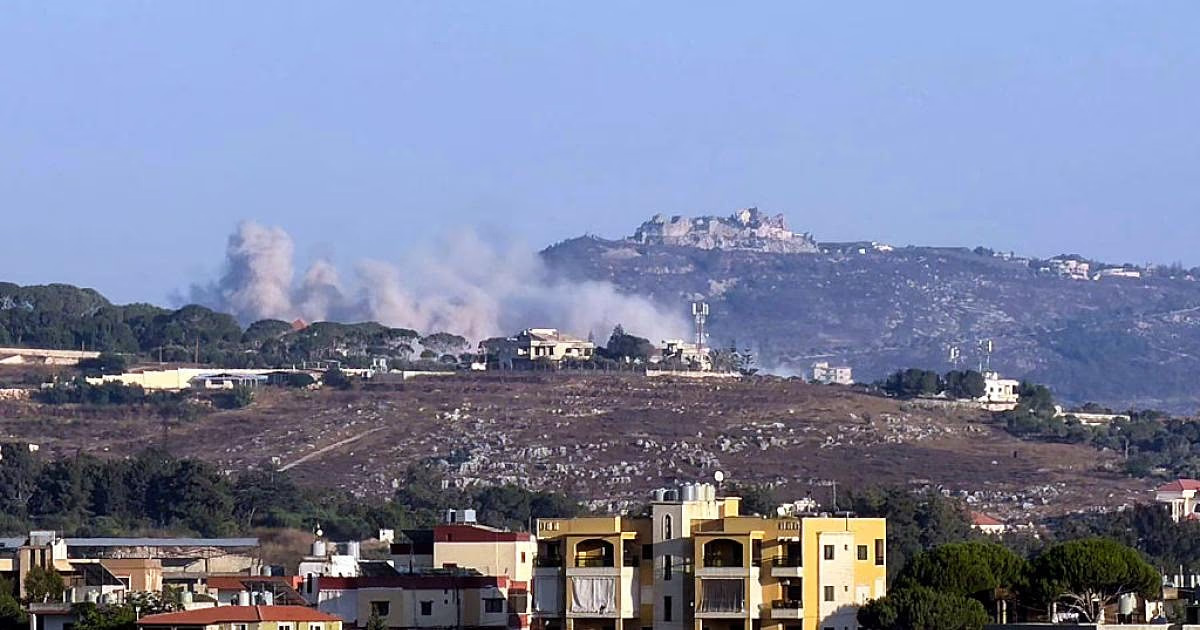
The southern parts of the town of Yahmar Al-Shaqif in the Nabatieh Governorate witnessed a large-scale bombing operation carried out by the Israeli occupation army in the Safita area on Monday evening. Local sources reported that the explosion was so massive that it caused significant cracks and fissures in the surrounding mountainous heights, with its echo reverberating widely across southern villages.
The field escalation was not limited to the Safita area but extended to the town of Kafrtibnit, part of the Nabatieh district, where occupation forces carried out a similar bombing as part of their ongoing military operations. These explosions were accompanied by intensive sweeping operations with machine guns targeting the town of Majdal Zoun, coinciding with artillery shelling that hit the Wadi Hassan area.
Politically, all eyes are on the Italian capital, Rome, where Lebanese President Joseph Aoun expressed his aspirations that the sixth round of negotiations would constitute a real starting point for the withdrawal of occupation forces. Aoun affirmed that Lebanon awaits practical steps that will lead to the deployment of the Lebanese Army in all areas evacuated according to international understandings.
Rome negotiations are scheduled to begin on Tuesday and Wednesday under direct American sponsorship, to complete what was achieved in the previous five rounds hosted by Washington. This round aims to establish precise executive mechanisms for the framework agreement signed on June 26, which outlined the broad lines for ending the Israeli military presence.
The 'framework agreement' signed between Beirut and Tel Aviv stipulates a phased Israeli withdrawal starting from two experimental areas, as a first step towards a full withdrawal from occupied Lebanese territories. However, the agreement still lacks a specific timetable, as the occupation authorities link the implementation of the withdrawal to the Lebanese Army's ability to impose full security control.
President Aoun stressed in his statements the necessity of supporting the Lebanese military institution and providing it with the necessary equipment to enable it to perform its national duties amidst harsh economic conditions. He pointed out that the Lebanese Army proves its readiness despite the challenges, emphasizing that extending national sovereignty is the supreme goal that the Lebanese state seeks at this stage.
In a message addressed to Israeli Prime Minister Benjamin Netanyahu, Aoun affirmed that military force would not achieve security for the people of Israel, and that true stability stems from recognizing rights. He added that continuing the path of aggression completely contradicts any talk of peace, warning that wars only lead to deepening crises and displacement.
The Lebanese President called on the American administration, specifically President Donald Trump, to exert serious pressure on the Israeli side to adhere to what was agreed upon in Washington. He clarified that Lebanon seeks to benefit from the current international desire to achieve comprehensive calm, ensuring the full restoration of Lebanese rights without any compromise on sovereignty.
Basic Lebanese demands in the Rome negotiations, in addition to military withdrawal, include the return of displaced persons to their villages, the return of prisoners, and the recovery of the bodies of detained martyrs. The Lebanese side also stresses the need to begin reconstruction plans for areas destroyed by the ongoing Israeli aggression for months.
On the ground, previous reports revealed continued Israeli violations through low-altitude drone flights over the capital Beirut, and the dropping of incendiary bombs on hills in the town of Kafr Rumman. These breaches pose significant challenges for the international oversight committee to ensure the preservation of the fragile ceasefire understandings reached through international efforts.
Regarding the army's diplomatic moves, Lebanese Army Commander General Rudolph Heikal met with a number of Western ambassadors to discuss ways to enhance the capabilities of the armed forces. These meetings come at a time when Beirut rejects Israeli proposals aimed at testing the army's capabilities in certain areas of influence, considering this an interference in sovereign affairs.
Official statistics issued by the Lebanese Ministry of Health indicate the extent of the humanitarian tragedy, with the death toll since the start of the aggression in March 2026 exceeding 4322 martyrs. The number of injured has also surpassed 12,000 people, while more than a million displaced persons continue to live in difficult conditions away from their destroyed homes.
In contrast, reports speak of Lebanese fears that the occupation will backtrack on its commitments due to escalating regional tensions between Washington and Tehran, which could hinder the Rome negotiations. Beirut insists that implementing the outcomes of the Washington negotiations is the only way to avoid the region sliding into a wider, undesirable confrontation.
President Aoun concluded by affirming that Lebanon will not give up an inch of its south, and that the signing of any final agreement must include an explicit Israeli pledge of no ambitions in Lebanese lands or resources. The Lebanese bet remains on what the coming hours in the corridors of the Italian capital will yield in terms of concrete results.
War will not achieve security, and stability can only be achieved through negotiation and the recognition that continued aggression only leads to more destruction.
שתף את דעתך
Aoun awaits Rome negotiations to schedule Israeli withdrawal amid field escalation in Nabatieh