






Washington's Message
Washington – Said Arikat – 7/11/2026
News Analysis
Southern Lebanon is entering a new phase of tension, amidst continued Israeli strikes and expanding American diplomatic pressures aimed at imposing new security arrangements along the border. Meanwhile, Lebanon finds itself facing a complex equation that combines preserving its sovereignty, fulfilling its international obligations, and avoiding a slide into a widespread military confrontation.
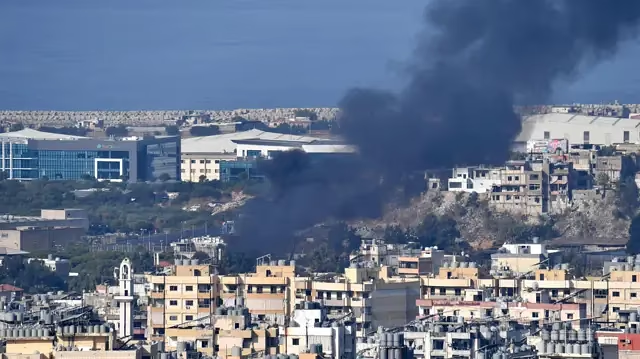
Recent days have witnessed a field escalation, represented by a series of Israeli raids targeting towns in southern Lebanon, under the pretext of targeting sites and elements belonging to Hezbollah. The raids resulted in deaths, injuries, and damage to property and infrastructure, at a time when Israel asserts that it will continue its military operations as long as it considers threats on its northern border to exist.
In contrast, the Lebanese army intensified its deployment in a number of southern areas in coordination with the United Nations Interim Force in Lebanon (UNIFIL), in an attempt to prove the state's ability to extend its authority south of the Litani River, a demand that enjoys wide international support, but faces complex political and security challenges on the ground.
Military developments coincided with internal and external political activity, as Lebanese President Joseph Aoun held a series of meetings with security and military leaders to follow up on developments, while Washington continued its contacts with Lebanese and Israeli officials in an attempt to prevent the deterioration of the situation and push towards more stable security arrangements.
However, these efforts are still clashing with a fundamental obstacle, which is Israel's insistence on retaining the freedom to carry out military operations inside Lebanese territory, in exchange for Lebanon's adherence to Israel's full withdrawal from the territories it still occupies, and an end to its daily violations of Lebanese sovereignty.
American Pressures
Today, the United States appears to be the most influential external player in the Lebanese file. Washington is not content with mediating between Beirut and Tel Aviv, but also seeks to reshape the security reality in the South beyond merely establishing a ceasefire, to include long-term arrangements related to the deployment of the Lebanese army, strengthening UNIFIL's role, and limiting Hezbollah's military activity in border areas.
Observers believe that the American administration considers the success of these arrangements as part of a broader project to redraw security balances in the Middle East after the recent war, and to link the Lebanese arena to a new regional security system that includes a number of Arab countries.
However, this proposal faces widespread internal objections, as Lebanese political forces fear that international pressures will turn into a means of imposing new political and security realities without addressing the roots of the crisis, foremost among them the continued Israeli occupation of parts of Lebanese territory, and repeated aerial and ground violations.
Hezbollah's Dilemma
Hezbollah's future remains the most sensitive issue in any discussion concerning southern Lebanon. Israel believes that any agreement that does not lead to the removal of the party from the border and its disarmament will remain an incomplete agreement, while the party rejects any arrangements that affect its military role as long as the Israeli occupation exists.
As for the Lebanese state, it tries to reconcile its international obligations with the complex internal reality, realizing that any attempt to impose solutions by force may lead to dangerous internal divisions, at a time when Lebanon is already suffering from an unprecedented economic and financial crisis.
Possible Scenarios
The first scenario is the success of American mediation in establishing limited security understandings, allowing for the continued deployment of the Lebanese army and reducing the intensity of Israeli strikes, without reaching a comprehensive political agreement.
The second scenario is the continuation of the current situation, where Israeli raids and limited responses continue, keeping the South in a state of chronic tension that drains all parties.
The third and most dangerous scenario remains the possibility of a complete collapse of diplomatic efforts as a result of a major field incident or a miscalculation, which could lead to the outbreak of a widespread confrontation whose repercussions would be catastrophic for Lebanon and the entire region.
Recent developments reveal that Israel no longer deals with southern Lebanon as merely a front for containing threats, but as an area for reshaping the rules of engagement in a way that gives it a wider margin for military action inside Lebanon. This approach raises fears of consecrating a reality in which Israeli strikes become commonplace, effectively weakening the concept of Lebanese sovereignty and creating a state of permanent instability, even in the absence of an all-out war.
In contrast, Washington realizes that continued escalation could undermine its efforts to rearrange regional files after the war with Iran. Therefore, the American administration seeks to contain the Lebanese crisis quickly, not only to protect Israel's security, but also to prevent the opening of a new front that could hinder its regional priorities and affect its economic and strategic projects in the Eastern Mediterranean and the Gulf.
As for Lebanon, it faces a complex dilemma. On the one hand, it needs the support of the international community to revive its economy and strengthen state institutions, and on the other hand, a wide segment of Lebanese rejects any settlement that is understood to come at the expense of national sovereignty or grant Israel permanent security privileges. Therefore, the success of any future agreement will remain linked to its ability to achieve a real balance between security and sovereignty, rather than being merely a response to military power balances.
In conclusion, it appears that southern Lebanon stands today at a delicate crossroads. Either political efforts succeed in transforming the fragile calm into sustainable stability, or the region remains hostage to the equation of mutual deterrence, where any limited field development is enough to reignite one of the Middle East's most sensitive and complex fronts.
שתף את דעתך
Southern Lebanon Between Israeli Escalation and Settlement Pressures: Lebanon at a Critical Crossroads