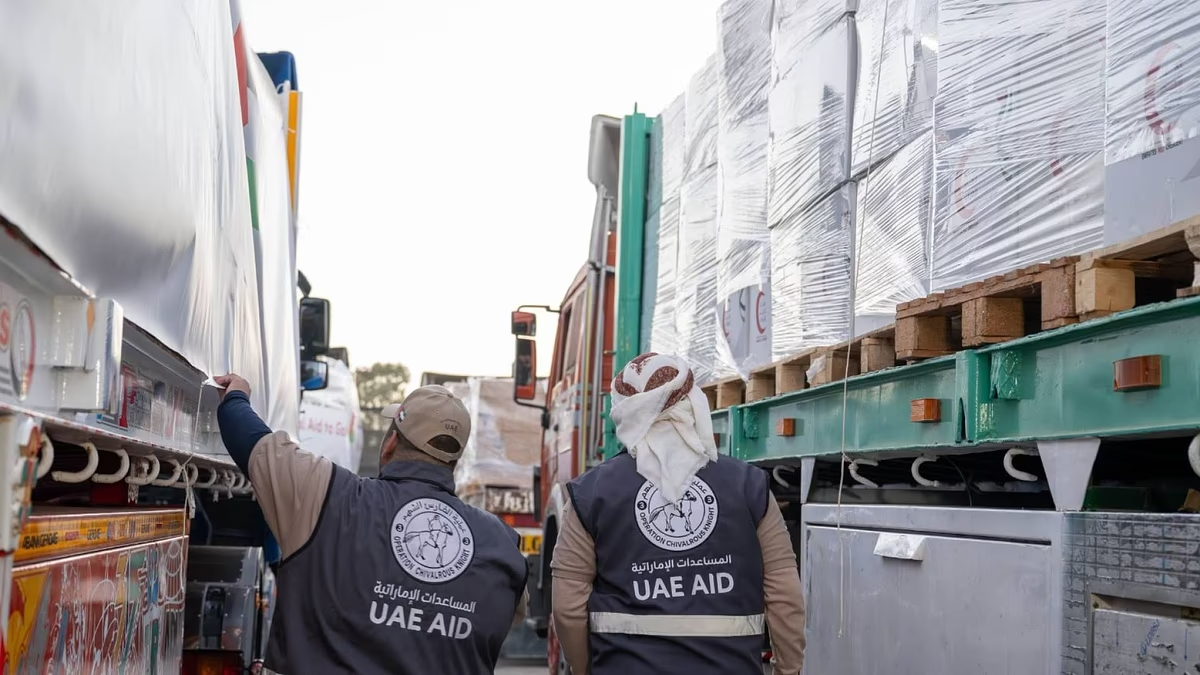







The United Arab Emirates continues to solidify its humanitarian role in the Gaza Strip, with recent data revealing that urgent relief aid accounted for 94.54% of the total support provided to the Strip. This move comes as part of a comprehensive strategy aimed at rapid response to humanitarian crises and providing essential needs for affected populations.
Official sources reported that the value of direct humanitarian aid reached approximately 4.66 billion UAE dirhams, implemented through 166 diverse relief projects. These figures reflect the UAE's commitment to addressing the difficult living challenges faced by the people of the Strip under current circumstances.
As part of the 'Gallant Knight 3' operation, the UAE succeeded in providing approximately 45% of the total international aid that reached the Gaza Strip between 2023 and 2025. The total cost of this support during that period amounted to nearly 4 billion dollars, making it a leading donor country to the Strip.
In the health sector, the UAE allocated 1.86 billion dirhams to support hospitals and medical centers suffering from a severe shortage of supplies. This support included the establishment of a field hospital inside Gaza and another floating hospital in the Egyptian city of Arish to provide urgent surgical and therapeutic care.
The floating hospital in Arish provided more than 12,000 medical services, in addition to performing over 5,000 complex surgical operations for the injured. Medical efforts also focused on fitting prosthetic limbs and providing physical rehabilitation services for hundreds of wounded who lost their limbs during the war.
In the water sector, the UAE implemented strategic projects including the establishment of desalination plants, drilling wells, and maintaining damaged networks at a cost of 24.59 million dirhams. These stations currently produce about two million gallons of potable water daily, contributing to bridging the significant water deficit gap in the Strip.
The developmental aspect was not absent from the support plans, with 260.39 million dirhams allocated for sustainable development projects, representing 5.28% of the total aid. These projects aim to enhance the local community's resilience and rehabilitate some vital facilities to ensure the continuity of essential services.
In the education sector, the value of support provided reached 6.95 million dirhams, focusing on equipping schools and educational centers with necessary supplies. These initiatives seek to ensure the continuity of the educational process and provide a suitable environment for students to continue their studies despite security and field challenges.
Regarding social services, the total cost of interventions amounted to approximately 37.53 million dirhams, including the distribution of food parcels, tents, and shelter supplies. This aid directly targeted the most vulnerable groups such as children, women, the elderly, and displaced persons in camps.
Statistics indicate that direct government aid was the main driver of this support, with a value exceeding 4.37 billion UAE dirhams. These efforts were complemented by contributions from national charitable organizations that played a pivotal role in delivering aid to those in need in various areas of the Strip.
The Emirates Red Crescent contributed 200.70 million dirhams, while the 'Mohammed bin Rashid Al Maktoum Global Initiatives' provided approximately 144.94 million dirhams. The International Charity Organization and Dubai Cares also participated with additional funds that enhanced the capacity of the humanitarian air and sea bridge.
Historically, figures confirm that support for Palestine represents a fundamental pillar of UAE policy, with total aid since the 1970s reaching approximately 15.34 billion dirhams. This historical aid covered 16 essential sectors through the implementation of more than 1392 development and relief projects in the Palestinian territories.
The UAE relies on an integrated system of land, air, and sea bridges to implement these operations, ensuring the uninterrupted flow of supplies. This high coordination has allowed overcoming logistical obstacles and delivering thousands of tons of food and medical supplies to the most affected areas in Gaza.
In conclusion, the report emphasizes that the UAE's vision for humanitarian work in Gaza goes beyond immediate support to include strengthening the foundations for future recovery. The 'Gallant Knight 3' operation continues to provide its intensive response, embodying a steadfast ethical and humanitarian commitment to the Palestinian people in the face of their successive crises.
Following the path of Zayed Al Khair, we will work to enhance our role among the world's leading countries in providing developmental and humanitarian aid and charitable work.
שתף את דעתך
Report: Emergency Aid Accounts for 94.5% of Total UAE Support to Gaza