






Israeli Foreign Minister Gideon Saar announced on Tuesday that the Italian capital, Rome, will host the next round of talks with the Lebanese side next week. Saar explained in a press conference held in occupied Jerusalem that this step comes as a continuation of the historic framework agreement reached less than two weeks ago under the auspices of the United States of America.
For his part, the spokesperson for the Italian Ministry of Foreign Affairs confirmed that the anticipated talks will take place on July 15 and 16, noting that the date stands unless any unexpected developments occur. This round is the sixth in the direct and indirect negotiation process between the two countries, which do not yet have formal diplomatic relations.
Italian Deputy Prime Minister and Foreign Minister, Antonio Tajani, welcomed his country's hosting of these talks, expressing on the 'X' platform his pleasure that Rome is hosting this dialogue sponsored by Washington. These meetings aim to establish the foundations for a permanent ceasefire and end the state of armed conflict that has recently plagued the region.
The framework agreement reached includes sensitive provisions, most notably the initiation of procedures to disarm Hezbollah and ensure a gradual withdrawal of Israeli forces from the territories they infiltrated in southern Lebanon. The agreement also stipulates the deployment of Lebanese army units in two pilot areas as a first step towards extending state sovereignty over the entire national territory.
In contrast, this agreement faces strong opposition from Hezbollah, which rejects its provisions entirely, especially those related to its weapons. The agreement has not yet specified a precise timeline for the Israeli withdrawal, as officials in Tel Aviv condition this step on achieving tangible progress in dismantling the military capabilities of the Iran-backed party.
Regarding international positions, German Foreign Minister Johann Vadivol urged the Lebanese authorities to show determination in confronting Hezbollah's influence and re-establishing state control in the south. Vadivol affirmed during his visit to Jerusalem that Germany strongly supports the historic initiative led by the United States to ensure regional stability.
The German minister stressed the need for Lebanon to ensure that Israel is not exposed to any security risks originating from its territories in the future. He indicated that Berlin and the European Union are fully prepared to provide the necessary support for the success of this negotiation process, which he described as a 'historic step that has been underestimated' in political circles.
Vadivol considered that progress in these negotiations represents a glimmer of hope for civilians on both sides of the border who have paid heavy prices as a result of the military escalation. He added that Germany will be a constant partner in supporting any path that leads to ending security threats and establishing the foundations of peace between the Lebanese and Israeli sides.
These diplomatic moves come after months of fierce fighting that erupted on March 2, following Hezbollah's launch of rocket barrages towards Israel. The party claimed at the time that the attack was in response to the killing of Iranian Supreme Leader Ali Khamenei in strikes attributed to the United States and Israel in February 2026.
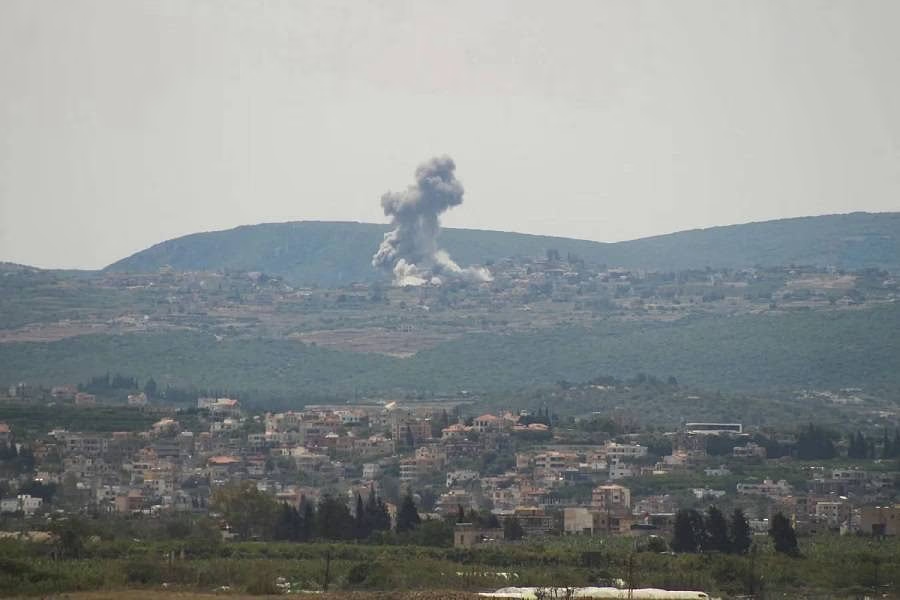
Israel responded to these attacks with a wide-ranging military campaign that included intensive airstrikes and a ground invasion of several areas in southern Lebanon. The Israeli army issued repeated evacuation warnings to residents for over three months, leading to significant demographic and field changes in the border areas.
Military operations, according to official data, resulted in the deaths of approximately 4,300 people in Lebanon, in addition to the displacement of over a million citizens from their homes in the south and the southern suburbs of Beirut. On the Israeli side, 38 soldiers and civilian contractors were killed since the start of ground confrontations and mutual shelling.
All eyes remain on the Italian capital next week, as the international community awaits the outcome of the sixth round of negotiations. Mediators hope that international pressure will succeed in overcoming obstacles to the implementation of the framework agreement, despite the significant field and political challenges posed by the positions of local and regional parties.
The agreement reached by Israel and Lebanon represents a glimmer of hope for the residents on both sides of the border, who together suffer from Hezbollah's terrorism.
שתף את דעתך
Saar announces the launch of a new round of negotiations with Lebanon in Rome next week