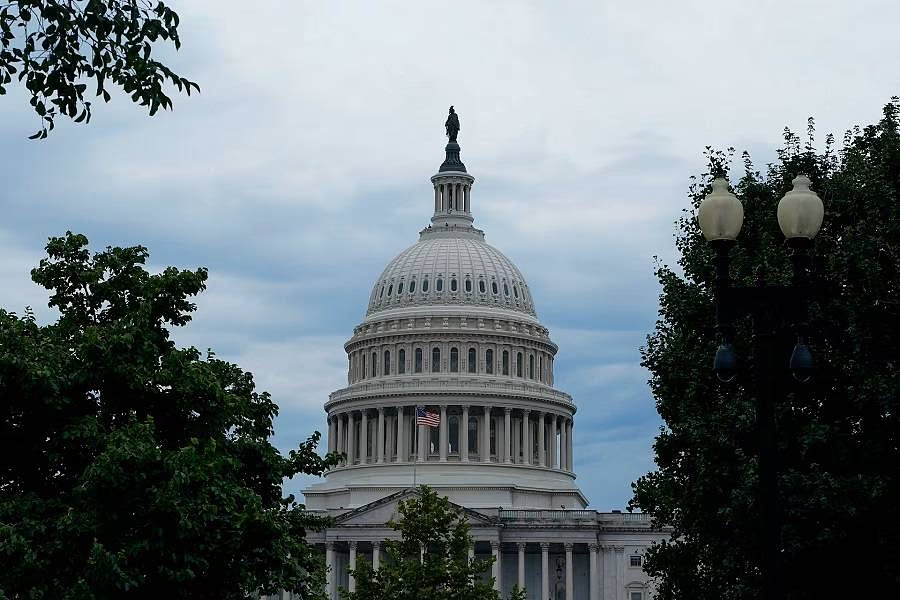







The American political scene witnessed a dramatic shift after Congress, in both its chambers, the House and Senate, passed a joint resolution directing President Donald Trump to withdraw US forces from hostilities against Iran. This move reflects growing concern within the Republican Party, which controls Parliament, regarding the repercussions of the conflict that has been ongoing since late last February.
The Senate's approval of the joint resolution on war powers came weeks after a similar step taken by the House of Representatives, marking a historic precedent in the agreement between the two legislative chambers to limit executive power. This measure aims to immediately suspend all unauthorized military activities against Tehran.
The origin of this legal dispute dates back to the War Powers Act of 1973, which was enacted as a oversight tool after the Vietnam War to ensure that the president does not unilaterally decide on war. This law grants Congress alone the authority to declare wars, while the president's role is limited to leading operations in cases of immediate threat.
Under the current legislation, the US administration must notify lawmakers of any military action within 48 hours, with the necessity of ending unauthorized operations within 60 days. Data indicates that this legal deadline effectively expired on May 1st for ongoing operations against Iran.
For his part, President Trump tried to circumvent these controls by declaring that hostilities had ended thanks to a ceasefire agreement, despite the continued naval blockade and mutual attacks. Legal experts believe that this argument may not stand up to judicial scrutiny for long in light of the continued active military presence.
Informed sources reported that decisions related to war powers have priority in voting, allowing them to be put up for discussion even without the approval of council leaders. This legal path gives lawmakers opposed to the current foreign policy greater ability to maneuver and exert political pressure.
Legal doubts arise about the binding nature of this joint resolution, as its opponents believe that it does not have the force of law as long as the president has not signed it or the veto has not been overridden. However, legal experts confirm that the matter has not yet been judicially settled, given the absence of similar precedents since the 1970s.
Democratic Representative Gregory Meeks, the initiator in the House of Representatives, affirmed that the resolution is legally binding according to the spirit of the US Constitution. Meeks announced his intention to explore all available legal avenues to compel the White House to comply with the will of lawmakers and end unauthorized military intervention.
Observers believe that this legislative movement primarily aims to restore Congress's constitutional authority to declare wars, which has eroded over decades in favor of the presidency. The close voting results are considered a clear message that there is a bipartisan desire to curb the expansion of foreign military intervention.
The White House tried to exert intense pressure on Republican members to obstruct the resolution, as the Senate witnessed heated meetings and direct reprimands from Trump to some lawmakers. Despite his success in changing the minds of some members, the momentum supporting the resolution remained strong enough to pass it.
Catherine Yon Ebright, an expert at the Brennan Center for Justice, explained that the passage of this law represents an explicit condemnation of the continued war, which many see as a violation of the Constitution. She added that lawmakers from both sides have become convinced that the armed conflict with Iran has exceeded the permissible temporal and legal limits.
On the other hand, defenders of Trump's policy describe these moves as mere political maneuvers aimed at weakening the United States' position against its enemies. They claim that such decisions infringe on the president's powers as commander-in-chief of the armed forces responsible for protecting national security.
These developments cast a shadow over the midterm elections scheduled for next November, as American voters closely monitor the developments of the conflict. Opinion polls indicate that the war against Iran lacks widespread popular support, which could threaten Republican control of Congress.
The latest 'Reuters/Ipsos' poll data showed that only 25% of Americans support the necessity of war, while general fears prevail about the fragility of the ceasefire. This popular concern has been reflected in President Trump's popularity, which has fallen to record lows of 34%, further complicating the political scene.
The war powers resolution sends a strong signal to the president that lawmakers believe this war has gone on too long and violates the Constitution.
שתף את דעתך
Congress Challenges Trump: Historic Decision to Limit War Powers Against Iran