






Washington's Message
Washington – Said Arikat – 7/7/2026
News Analysis
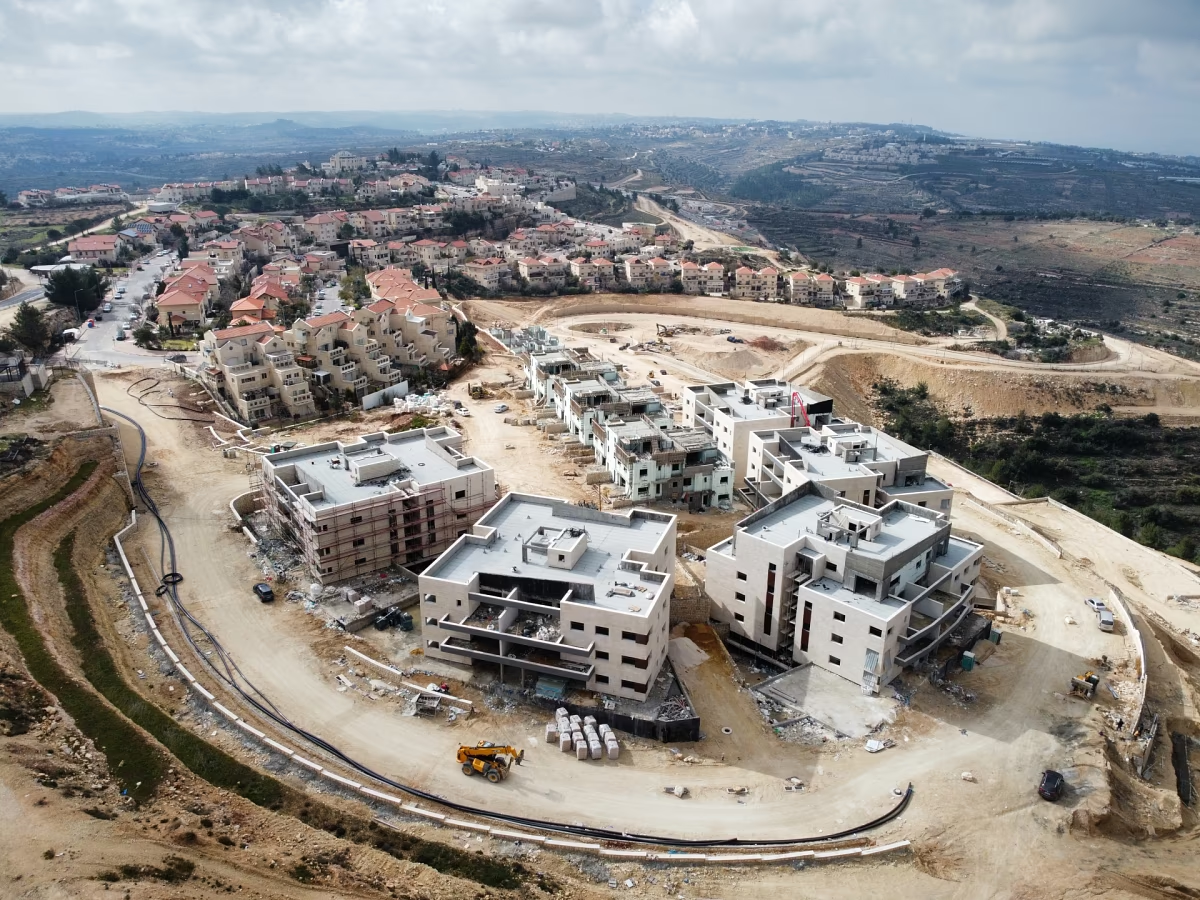
The West Bank is witnessing a development considered one of the most dangerous shifts in the Israeli settlement project since the signing of the Oslo Accords in 1993, following the revelation of a plan led by settler groups to establish one hundred settlement outposts within Areas (A) and (B). This move goes beyond the policy of expanding existing settlements to an attempt to implant a permanent settler presence within the heart of Palestinian cities and towns. Observers believe that this project is not merely urban expansion, but reflects a strategic shift aimed at reshaping the geopolitical landscape of the West Bank, undermining the foundations of the peace process, and ultimately imposing a reality that makes the establishment of a geographically contiguous Palestinian state extremely difficult.
The American website "Mondoweiss," citing information published by the newspaper "Israel Hayom," revealed that the plan, named "Day of Decision," aims to establish settlement outposts in locations described as "strategic" within areas that, under the Oslo Accords, were subject to full or joint Palestinian control. Areas (A) and (B) constitute about 40 percent of the West Bank's area, while the majority of existing Israeli settlements are concentrated in Area (C), which represents about 60 percent of the occupied territories.
The project represents a remarkable shift in Israeli settlement doctrine, as the establishment of settlements within Area (A), which is theoretically under Palestinian civil and security control, was until recently considered a red line that successive Israeli governments adhered to, even amidst continuous settlement expansion in Area (C). Today, the project moves the conflict from the outskirts of Palestinian cities to their interior, opening the door to a new phase of redrawing the field map.
Experts believe that the implementation of this plan will fragment the Palestinian geography into isolated islands, by controlling vital heights, intersections, religious sites, and areas overlooking major cities. This will restrict the movement of Palestinians and weaken the possibility of geographical contiguity between population centers, which is a fundamental condition for any future Palestinian state.
In this context, Palestinian maps and settlement expert Khalil Tafakji explained to "Mondoweiss" that the concept of "strategic locations" in Israeli thought is not limited to mountain heights, but also includes major road junctions, religious sites, and even areas containing central Palestinian institutions. He points out that such locations are spread in cities like Hebron, Nablus, and Jenin, where some areas are already witnessing gradual Israeli measures to control them or turn them into closed security zones.
Two prominent settlement organizations are leading the project: "Habayta," concerned with absorbing and settling Jewish immigrants, and the "Agricultural Union," which is one of the most prominent arms of the settlement movement since the 1980s. Although the project is presented as a grassroots initiative, observers believe it enjoys direct political and institutional support from the Israeli government.
Tafakji and others affirm that the implementation of such a plan cannot be done without the protection of the Israeli army, which makes it, in practice, a government project even if it carries a civilian cover. The establishment of outposts, the provision of military protection, funding, and political endorsement are all decisions linked to Israeli state institutions, and not merely initiatives carried out independently by groups of settlers.
Israeli reports indicate that the project has already reached the cabinet and enjoys the support of influential figures within Prime Minister Benjamin Netanyahu's government, foremost among them Finance Minister Bezalel Smotrich, who is one of the most prominent leaders of the settlement movement and a historical founder of the "Agricultural Union" that is leading this initiative.
This development comes amidst a series of legal and administrative changes witnessed in the West Bank in recent years, where a large part of the occupation administration's powers has been transferred from the military establishment to civilian bodies controlled by officials from the settlement movement. This has led to the acceleration of approval procedures for settlement construction projects and the reduction of bureaucratic restrictions that previously delayed their implementation.
According to Tafakji, settlement projects previously underwent complex security and military reviews before being presented to the government twice a year. Today, they are subject to civilian committees that hold weekly meetings to approve new projects, a change Smotrich previously described as a "change in the DNA of the system," referring to the structural shift in the mechanism of West Bank administration.
In recent months, the Israeli government also approved new measures allowing Israelis to purchase properties within Areas (A) and (B), in addition to expanding the powers of Israeli institutions in managing Palestinian historical and religious sites. Analysts see these steps as part of a gradual annexation policy, aimed at transferring Israeli control from a temporary military level to a permanent civilian sovereignty level.
These measures were accompanied by legislative steps taken by the Knesset, including rejecting the establishment of a Palestinian state, and then issuing positions supporting the annexation of the West Bank, which provided political cover for projects that were until recently considered highly sensitive domestically and internationally.
Smotrich had declared on more than one occasion that his goal is to "eliminate the idea of a Palestinian state" and to end the Oslo Accords "officially and practically." Observers believe that the "Day of Decision" plan represents the clearest practical application of this political vision.
Shift from Occupation Management to Imposing Sovereignty
The importance of the project lies in its reflection of a transition from a policy of settlement expansion to a strategy of penetrating Palestinian cities themselves. The goal is no longer merely to surround Palestinian communities with settlement belts, but to establish strongholds within or in direct proximity to them, making any future Israeli withdrawal more politically and security-wise complex, and transforming the settler presence into a permanent, difficult-to-dismantle element.
From this perspective, the danger of the project is not as much related to the number of proposed settlement outposts as it is to the philosophy upon which it is based. Control over intersections, heights, and religious and administrative sites practically means redrawing the security and demographic map of the West Bank, so that Palestinian cities become surrounded by a network of Israeli control points, which undermines geographical contiguity and prevents the emergence of a cohesive Palestinian entity.
The Settlement Movement: From Pressure Group to Governing Partner
The plan also reveals a profound shift in the structure of decision-making within Israel. The settlement movement is no longer merely a pressure group influencing governments, but has become a direct partner in shaping policies and managing occupation institutions. The transfer of civil administration powers to figures belonging to the settlement movement has accelerated construction and annexation procedures, and reduced the role of security and diplomatic considerations that previously delayed some projects or limited their scope.
This reflects the integration of the settlement project into the core of state institutions, so that settlement is no longer merely a negotiating tool or a political card, but has become the governing framework for the Israeli vision towards the future of the West Bank, transforming annexation from a proposed option into a gradual process that accumulates through facts on the ground.
A New Test for the International Community
In contrast, these developments present the international community with a renewed test regarding its ability to protect the legal and political foundations upon which the peace process was built. For years, the international response has been limited to statements of condemnation and calls to halt settlement, without translating this into practical measures or effective political pressure.
Analysts believe that the international powers' preoccupation with other global and regional crises, coupled with the absence of a genuine Western will to impose a political cost on Israel, has provided the Israeli government with ample space to proceed with its settlement projects at an accelerated pace. If this equation continues, the facts being imposed on the ground today may, over time, turn into new political boundaries, making the two-state solution closer to a theoretical framework than a viable project, and ushering in a new phase where the termination of the Oslo Accords becomes a practical reality rather than a political declaration.
שתף את דעתך
Settlement Plan Targets Heart of West Bank: One Hundred New Outposts Push Towards Practical End of Oslo Accords