





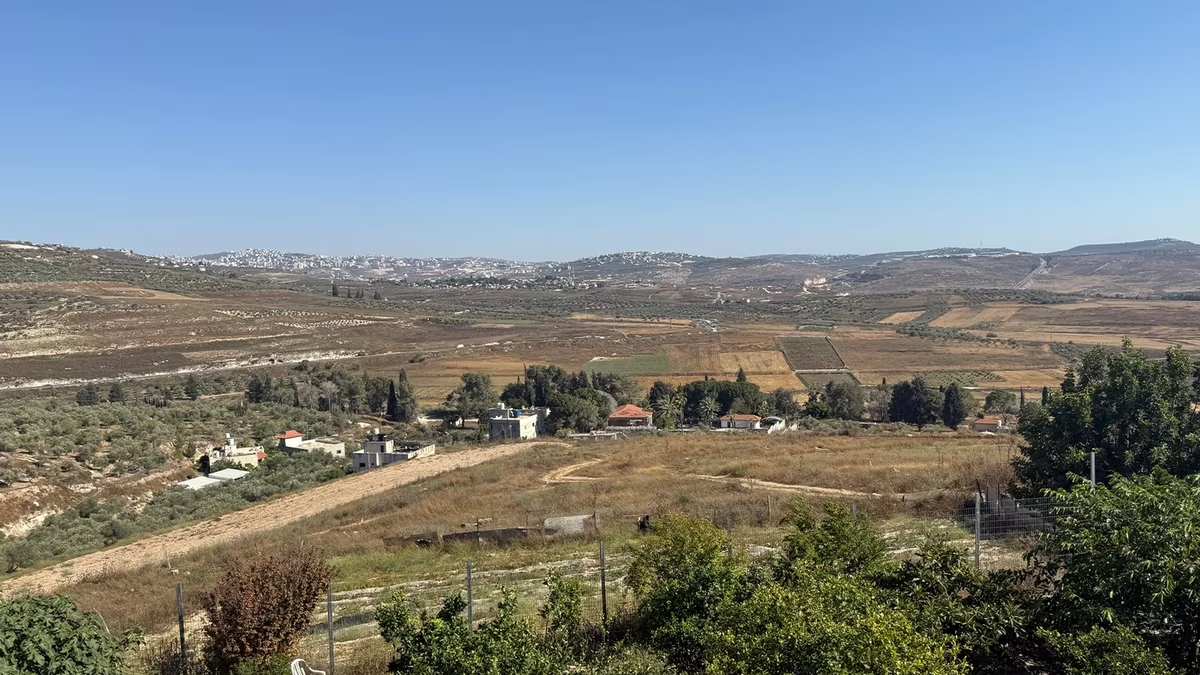
Nablus Governorate, in the northern West Bank, faces an existential threat that impacts the very core of its daily life, as settler attacks escalate against the strategic 'Sabastiya-Al-Masoudiya' well. This well is considered one of the largest water sources in the Palestinian Authority territories, pumping between 350 and 400 cubic meters per hour to supply the city and neighboring villages.\n\nAccessing and operating the well is done amidst real security risks faced by workers daily, as settler groups monitor their movements in the rugged area. Local sources reported that any malfunction affecting this facility would immediately lead to a severe water crisis, forcing thousands of citizens to search for scarce and costly alternatives.\n\nThe area has witnessed a series of violent attacks that began with stone-throwing and escalated to the use of incendiary bottles targeting guard rooms. Nine daily-wage guards are stationed at the site to protect the pumps from deliberate sabotage attempts aimed at cutting off the lifeline to the area.\n\nAl-Masoudiya area holds significant historical and archaeological importance, as it was a main station for the Hijaz railway, making it a long-standing target for settlement projects. Despite the failure of attempts to control it in the 1970s, the current offensive appears more organized and fierce, supported by occupation forces.\n\nThe damage was not limited to the main well but also affected the treated wastewater irrigation project, which cost approximately 13 million euros to serve hundreds of farmers. Settlers destroyed fences, irrigation networks, and seedlings, causing severe losses to the agricultural sector in four surrounding villages.\n\nIn the neighboring town of Burqa, settlers seized the historic 'Ain Al-Dalbeh' spring, which provided about 30% of the residents' water needs. Occupation bulldozers destroyed the main water tank there and began laying alternative water lines for the benefit of 'Homesh' settlement and the outposts encroaching on citizens' lands.\n\nSince October 2023, the Al-Masoudiya area, spanning 12,000 dunams, has witnessed systematic tightening, including the establishment of new pastoral settlement outposts. These outposts expanded to penetrate areas classified as 'B' and 'A', which are administratively under the Palestinian Authority, in an attempt to impose a new geographical reality that prevents farmers from accessing their lands.\n\nResidents of the area, including 12 families in Al-Masoudiya, live under siege after settlers bulldozed the main paved road and turned it into a rugged dirt track. Residents were forced to fortify their homes with iron gates and barbed wire to confront night attacks launched by masked gunmen wearing black uniforms.\n\nCitizen Diab Hajji describes the daily suffering of transporting his children to schools and universities, where he is forced to accompany them for fear of being pursued by settlers using four-wheel-drive vehicles. Population movements have become completely restricted by the spread of settler groups that systematically abuse civilians.\n\nJust a few meters from the pastoral settlement outpost, Musa Da'is and his family live in daily 'hell' due to direct threats of burning and killing. Da'is confirmed that settlers cut the water pipes leading to his house, warning that targeting the main lines of the well would mean the end of Palestinian presence in that area.\n\nThe people of Al-Masoudiya have adopted a 'shift' system for sleeping to ensure constant guarding of homes against sudden incursions. Surveillance cameras document repeated attempts to break down doors and terrorize children, in the absence of any international or security protection for unarmed residents who face weapons with stones.\n\nFor its part, Nablus Municipality confirmed that accessing water wells now requires miniature security plans and precise coordination to ensure the safety of engineering teams. The municipality presidency stressed that the battle for water is an integral part of the battle for existence, and that targeting personnel and facilities aims to destabilize the entire governorate.\n\nRecent UN reports for 2026 indicate that settler attacks have led to the displacement of more than 2,200 Palestinians from their communities in the West Bank. International organizations also recorded the destruction of more than 190 water and sanitation facilities, which increased the suffering of vulnerable communities and their reliance on costly water tankers.\n\nResilience in the Al-Masoudiya area remains dependent on the ability to protect the water well and provide popular support for the besieged families. Activists fear the evolution of settler violence tools from sticks and stones to widespread use of live ammunition, which could lead to massacres against residents clinging to their land.\n\n"Get out of here... this land is ours. We will burn you, your children, and your homes if you do not leave.

ו 03 יול 2026 11:55 am - שעון ירושלים
Nablus' Thirst Under Threat: Settler Attacks Besiege Strategic Al-Masoudiya Well
שתף את דעתך
Nablus' Thirst Under Threat: Settler Attacks Besiege Strategic Al-Masoudiya Well