






By Brian Leishman
Brian Leishman (born July 1982 in Scotland, United Kingdom) is a British politician belonging to the Labour Party, and serves as a Member of the British Parliament representing the Alloa and Grangemouth constituency. He is known for his activism and his supportive stances on human rights, and was among the MPs who signed letters calling on the British government to open an independent investigation into the Gaza war.
The British government recently imposed sanctions on companies involved in the Israeli E1 settlement project in the West Bank, a project which, if completed, would divide the West Bank into separate enclaves and make a two-state solution almost impossible. Last month, I joined 138 Labour MPs in a letter addressed to the Prime Minister, in which we demanded a complete ban on trade with illegal settlements.
While these two steps are welcome, they simultaneously raise an undeniable question about the role Britain played in creating the crisis it now seeks to address. What is Britain's responsibility for what has befallen the Palestinian people? And what does that demand of us today?
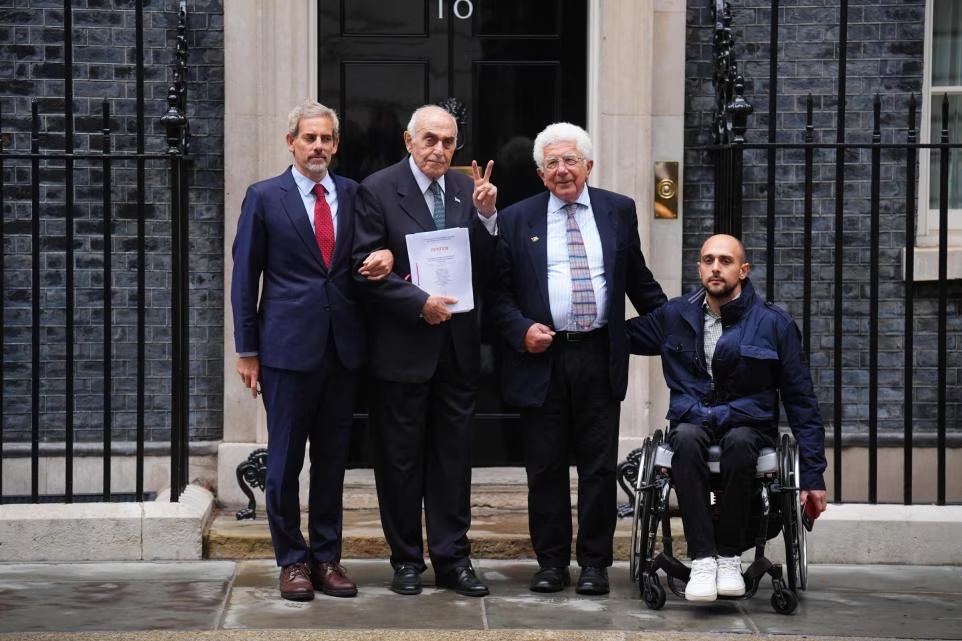
This question lies at the heart of the "Britain Owes Palestine" campaign, which submitted a 400-page legal petition to the British government, documenting Britain's practices during the Mandate period between 1917 and 1948.
In 1917, the Balfour Declaration committed Britain to supporting the establishment of a national home for the Jewish people in a land where more than 90% of the population was Arab, without the consent of its indigenous inhabitants, and in contravention of pledges the British government had previously made to Arab leaders. Over the next three decades, Britain established a system that granted privileges to one party, while denying the other any real political representation. When a project to create a legislative council in which Arabs would have a majority was proposed, the British Parliament rejected it, effectively closing all avenues for peaceful protest.
When the Great Arab Revolt broke out between 1936 and 1939, Britain confronted it with policies of collective punishment against entire villages, and the establishment of military courts where there was no right of appeal. It committed what the British Colonial Secretary himself, in private deliberations with the Cabinet, described as "atrocities" committed by the police, which he deliberately failed to mention in his statements to Parliament. In just three years, at least five thousand Palestinians were killed and about fifteen thousand were injured. Britain did not confine its oppressive colonial methods to Palestine; these policies later became a model inherited by Israel and entrenched within its institutions after 1948.
Upon Britain's withdrawal from Palestine, some 750,000 Palestinians had been displaced during the ensuing war, a displacement process that the petition describes as foreseeable, avoidable, and directly linked to Britain's abandonment of its responsibilities. During that period, the British Parliament passed legislation that retroactively granted immunity to all British officials from any legal prosecution for actions committed during the Mandate period. From this perspective, the E1 settlement project cannot be separated from a historical framework that Britain largely contributed to establishing. It is important to acknowledge this fact as we seek today to mitigate its effects.
In March, I joined a cross-party group of 45 MPs and members of the House of Lords who signed an open letter demanding that the Prime Minister officially respond to the petition. More than eight months later, the government still refrains from providing any response. Munib al-Masri, the main petitioner, was shot by British soldiers when he was a teenager, and he is one of 14 Palestinians whose families were directly affected by the events documented in the petition, and who are still awaiting this response today.
The campaign's demands are not exaggerated; they call for a public government response to the petition, a comprehensive review of any archives not yet released, official acknowledgment of Britain's wrongdoings during the Mandate period, and a formal apology in Parliament. Britain has always presented itself as a state that respects its international law obligations, yet this claim becomes less credible when it refuses to review its own actions.
Imposing sanctions on companies involved in the E1 project is a correct step, and recognizing the state of Palestine last year was also a step in the right direction. However, these measures are accompanied by the British government's continued refusal to confront its historical role in perpetuating the statelessness of Palestine. Britain cannot demand accountability from others while exempting itself from the same standards.
This petition has remained unanswered for many months. What the British government should do today is read it and respond to it, and have the courage to honestly ask a fundamental question about what Britain owes, instead of merely demanding what it can from others.
שתף את דעתך
Britain has the right to take action against illegal settlements, but it cannot ignore its responsibility for dispossessing Palestinians of their land