






Washington Message
Washington – Said Arikat – 2/7/2026
A number of US Congress members, including Representatives Rashida Tlaib, Ilhan Omar, Ayanna Pressley, and Summer Lee, along with a group of Democratic representatives, sent an official letter to Secretary of State Marco Rubio on Tuesday, demanding that the US administration provide urgent clarifications regarding what is known as the “Peace Council,” warning that plans to deploy an “international stabilization force” in the Gaza Strip could have serious constitutional, legal, and humanitarian repercussions.
The representatives affirmed in their letter that deploying US-backed forces at a time when Israel continues to violate the ceasefire agreement, expand its military operations, and obstruct the entry of humanitarian aid, cannot be considered a stabilization mission. Instead, they described it as an American military activity on foreign soil conducted without congressional authorization, in an area that the International Court of Justice has deemed to be under illegal Israeli occupation. This could expose the United States and participating countries to international legal responsibilities related to complicity in grave human rights violations.
The signatories noted that Congress has not yet received clear answers regarding the legal basis for the establishment of the "Peace Council," which was founded without legislation or financial appropriations from Congress. They described its members as individuals accused of war crimes or representing authoritarian regimes, and noted that it operates outside traditional international frameworks.
The letter criticized the broad powers granted to President Donald Trump within the Council, as he holds the position of its lifetime president in his personal capacity, not as President of the United States, and enjoys an absolute veto over all decisions. The representatives considered that granting the Council the status of a “general international organization” and the accompanying privileges and immunities, despite being under the control of a single individual, raises deep constitutional and legal questions about the legitimacy of this step.
Congress members also expressed concern about the imposition of a one-billion-dollar membership fee for countries wishing to join the Council, considering that this grants wealthy or authoritarian governments influence over the future of Palestinians without their consent, and transforms the Council into an institution based on financial influence rather than its commitment to international law or alleviating civilian suffering.
The representatives accused the Council of failing to prove its independence or integrity, pointing to fears that it could become a platform for real estate deals and multi-billion dollar investments for the benefit of the Trump family and its allies, instead of focusing on the reconstruction of Gaza and achieving peace.
The letter addressed plans for deploying an international stabilization force in Gaza, considering that the US administration used a UN Security Council resolution to grant the Council legitimacy that is inconsistent with the original mandate, which was limited to a transitional administration for reconstruction and stabilization, while the Council's charter, adopted later, expanded to much broader powers.
The representatives referred to the Council's High Representative's statements regarding Gaza, in which he affirmed that the war has not ended for Palestinians, and that Israel is still violating the ceasefire, at a time when the Council intends to deploy its forces in areas not controlled by Hamas. They believed that any such operations would practically turn into military operations, not peacekeeping missions.
The letter also warned that President Trump's decision to consider the Council eligible for US weapons and defense services means that a US military commander could oversee foreign forces equipped with US weapons, which the representatives described as direct US military activity abroad conducted without congressional approval, and in contradiction with the US Constitution.
The signatories pointed out that Israel has shown no willingness to withdraw from the areas it controls within the Gaza Strip. Instead, Israeli Prime Minister Benjamin Netanyahu announced his intention to expand military control to cover about 70 percent of the Strip's area, which makes any international force operating in coordination with the Israeli army vulnerable to legal suspicions, especially in light of the International Court of Justice's opinion that the Israeli occupation of Palestinian territories is illegal, and its warnings of potential violations of the Genocide Convention.
The representatives affirmed that the continued transfer of US weapons to Israel, in parallel with any US involvement in these operations, could expose the United States and its partners to legal responsibilities under US and international law.
Congress members demanded that the State Department respond to seventeen detailed questions before July 15th, covering the legal basis of the Peace Council, its funding mechanisms, oversight of its funds, sources of donations, agreements signed with donor countries, plans for deploying the international force, the possibility of using private security companies, the fate of US weapons that may be delivered to these forces, in addition to the administration's position on the continued Israeli restrictions on the entry of humanitarian aid.
They also demanded that the administration disclose whether it has plans to divide the Gaza Strip or impose new geographical arrangements that restrict the freedom of movement of Palestinians, or control land within the Strip, as well as clarify its vision for transferring the administration of Gaza in the future to a legitimate Palestinian government responsible for both Gaza and the West Bank.
The representatives concluded their letter by emphasizing that Congress has not approved the establishment of the “Peace Council,” nor has it allocated any funding for it, and will not accept, in their words, that American resources be used or the international credibility of the United States be exposed to serve this entity without oversight or constitutional accountability.
The letter from Congress members is not limited to objecting to the Trump administration's policy in Gaza, but also reflects a broader constitutional struggle over the limits of executive authority in managing foreign conflicts. The representatives believe that establishing the “Peace Council” and granting it broad powers, with the possibility of deploying and arming US-backed forces, represents a clear overreach of Congress's role in approving spending and authorizing the use of military force. This dispute could open a political and judicial confrontation that may re-raise traditional questions about the balance of powers in the American political system.
The letter reflects a growing awareness within Congress of the legal risks associated with continued US support for Israeli policies in Gaza. Relying on the International Court of Justice's opinion regarding the illegality of the occupation and the possibility of violations of the Genocide Convention provides opponents of the administration with a legal basis to hold any US involvement in security arrangements within the Strip accountable. If Washington proceeds with these plans, it may face increasing pressure from human rights organizations and international courts, as well as a widening circle of criticism from European allies.
The letter also reveals that the real dispute is not about the mechanisms of Gaza's reconstruction, but about who will hold political and security authority there after the war. Opponents of the “Peace Council” fear that it will turn into a framework that entrenches a new political and security reality that serves the occupation more than it paves the way for an independent Palestinian administration. Therefore, the representatives focused on the need to define a clear plan for transferring power to a legitimate Palestinian government, warning that any transitional arrangements lacking Palestinian and international legitimacy will establish a new round of instability and conflict.
שתף את דעתך
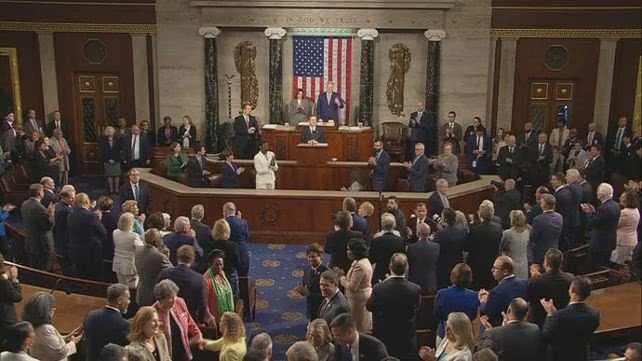
Democrats in Congress demand Trump administration reveal details of "Peace Council" and plans to deploy international force in Gaza