






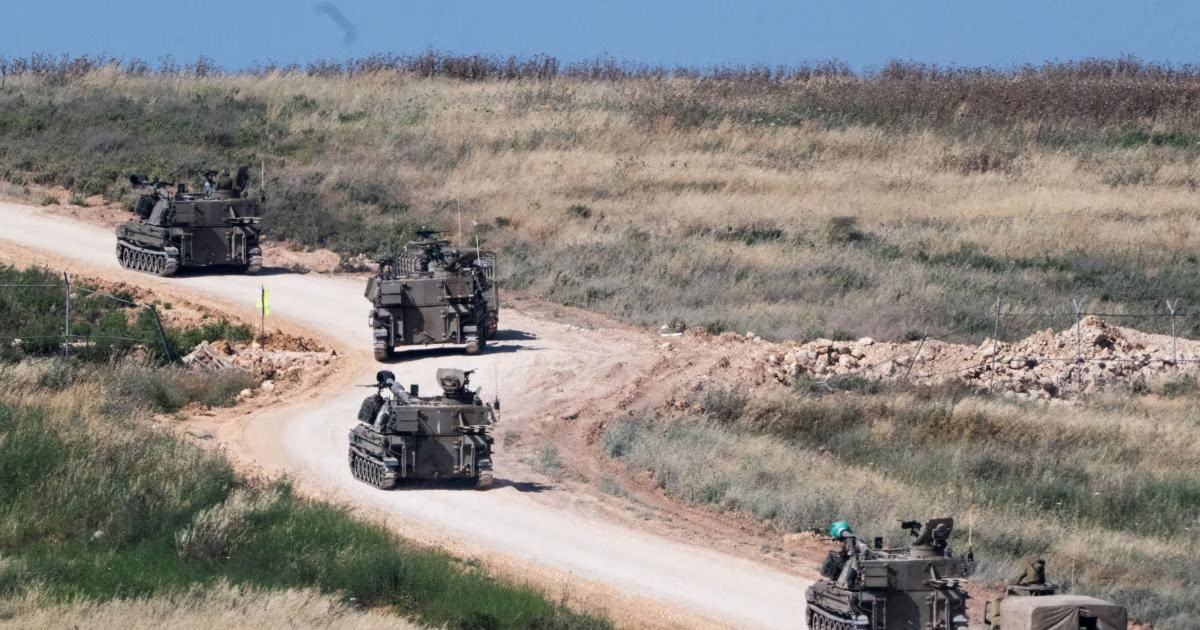
Media sources reported that the Israeli occupation authorities decided to postpone the implementation of the experimental withdrawal plan from two areas in southern Lebanon, following internal consultations within the military establishment. This decision came to impede the timelines that were expected to begin after last weekend's talks between the Lebanese and Israeli sides.
The sources clarified that the delay specifically includes the areas of 'Zawtar' and 'Froun' in the southern sector, where Tel Aviv cited the necessity of waiting until a final formula for a joint monitoring mechanism is reached. This mechanism aims to oversee the implementation of the ceasefire provisions contained in a secret security annex attached to the framework agreement.
Reports indicate that Washington plays a pivotal role in this matter, as the United States is expected to approve the individuals who will manage the monitoring mechanism. This American intervention aims to ensure that no sensitive intelligence or security information reaches Hezbollah through joint channels.
The Israeli side believes that the failure of previous monitoring mechanisms established in the past contributed to strengthening Hezbollah's influence on the ground. Therefore, security agencies in Tel Aviv insist on setting strict standards to ensure the effectiveness of this monitoring before moving any soldier from the positions controlled by the occupation.
In a related context, security sources confirmed that there are currently no specific timelines for the withdrawal, despite acknowledging that it must eventually be implemented. These sources stressed that the withdrawal will only occur if the Lebanese Army proves its ability to take immediate and tangible action against any presence of Hezbollah fighters in the evacuated areas.
Beirut and Tel Aviv had signed, under American auspices last Friday, a framework agreement stipulating a sequential withdrawal of Israeli forces from Lebanese territories. Although the agreement did not specify exact dates, it linked field movements to the Lebanese Army assuming full security responsibility and disarming armed groups.
For its part, official Lebanon cautiously welcomed the agreement, considering it a first step towards restoring national sovereignty over all Lebanese territory. In contrast, the agreement was met with categorical rejection from Hezbollah, which described it as 'humiliating' and 'non-existent,' considering that tampering with its weapons represents crossing red lines.
In a parallel political escalation, Israeli Prime Minister Benjamin Netanyahu reiterated his assertion that his forces would remain in southern Lebanon as long as the Hezbollah threat persists. These statements reflect the magnitude of the gap between diplomatic commitments and the on-the-ground reality imposed by Israel.
Israel occupies vast areas in southern Lebanon, with some strongholds dating back many years, while others were established during recent military confrontations. Occupation forces have penetrated more than 10 kilometers deep into Lebanese territory in the current aggression, complicating the withdrawal issue.
The issue of experimental areas remains a real test of the seriousness of the parties in implementing the framework agreement amidst major security and political complexities. International circles are awaiting the outcome of technical consultations on the monitoring mechanism, which will determine the fate of the fragile calm on the Lebanese-Palestinian border.
Troop withdrawal will not occur until clear standards are established, under which the Lebanese Army commits to taking tangible and immediate action against Hezbollah.
שתף את דעתך
Israeli Postponement of Experimental Withdrawal from Southern Lebanon Awaiting Joint Monitoring Mechanism