






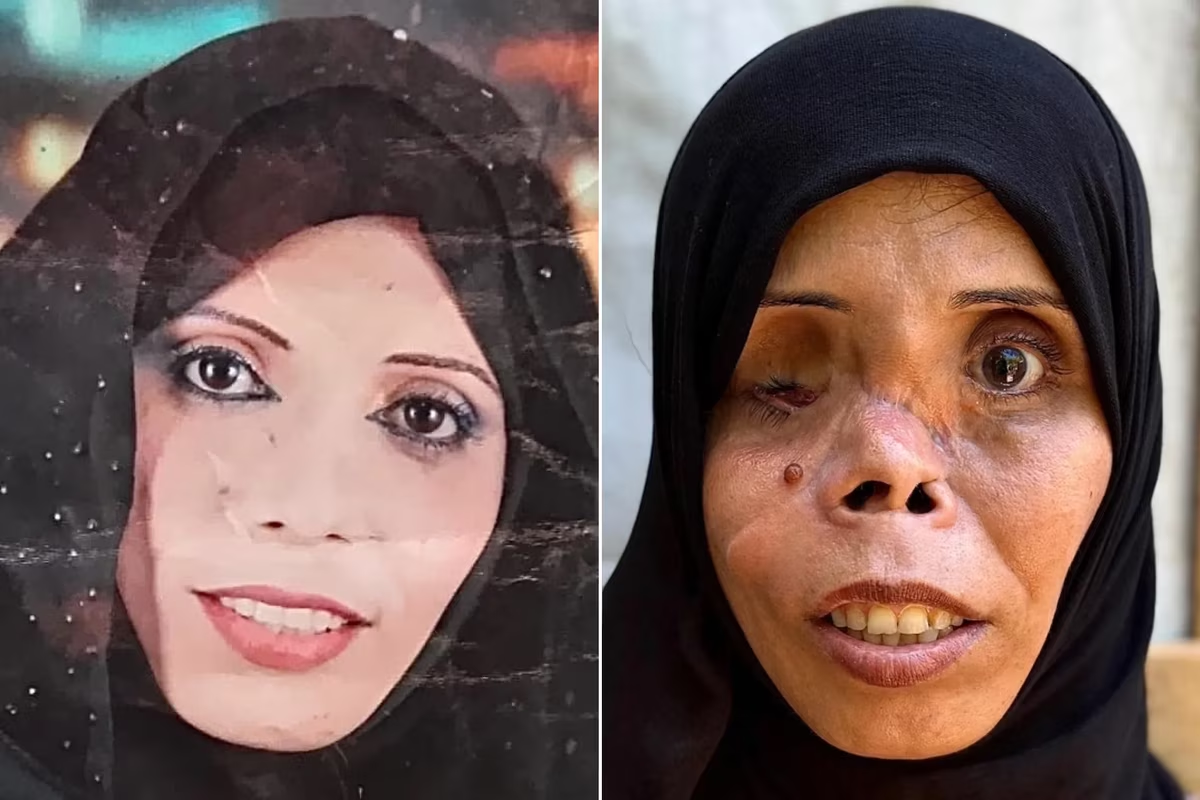
In a scene that encapsulates the brutality of the ongoing war on the Gaza Strip, the story of citizen Najwa Abu Atiwi stands as a living testament to the human tragedies whose wounds never heal. The chapters of suffering began with a treacherous Israeli bombing, which not only robbed her of her facial features but plunged her into a spiral of endless psychological and physical pain.
With bitterness, the Gazan mother recounts how her life turned into a daily nightmare, as her children became afraid to approach her or look at her face, which was completely altered by the injury. This violent transformation in the mother's relationship with her children reflects the magnitude of the trauma imposed by the occupation on Palestinian families, where fear has replaced safety and affection.
Shrapnel and the explosion caused severe damage to the bones of her face, jaw, and nose, in addition to the complete loss of one eye, making eating, speaking, and breathing a difficult daily challenge. Despite undergoing several complex initial surgeries in the Strip's hospitals, the effects of the disfigurement still dominate her appearance and vital functions.
Medical sources following Najwa's case reported that her health condition is likely to deteriorate at any moment due to the limited medical capabilities available in Gaza. Reports confirm her urgent need for immediate travel to complete a treatment journey that includes skull bone reconstruction and artificial eye implantation in specialized centers outside the Strip.
Najwa's tragedy is not limited to her body; she lost one of her daughters in the same attack that disfigured her face, leaving her in a bitter struggle between the pain of loss and the helplessness of injury. Today, she lives in extremely harsh living conditions that exacerbate the daily suffering she faces with the rest of her surviving family members.
Najwa's story sparked a wide wave of sympathy on social media platforms, where activists and human rights advocates launched urgent calls to save her life. Supporters emphasized the necessity of breaking the medical siege imposed on the wounded and enabling critical cases to reach international hospitals before it is too late.
Activists affirmed that this mother's case represents a model for thousands of wounded in Gaza who face complex injuries that exceed the capacity of the exhausted health system. They pointed out that the continued prevention of travel for treatment deprives victims of recovery opportunities and turns their lives into a series of continuous physical and psychological torments.
Human rights organizations described what Najwa is going through as a 'cry of pain' in the face of a silent international community regarding crimes of genocide. They added that the transformation of a mother's embrace into a source of fear for her children is the harshest image of human pain that wars can leave in the collective memory of peoples.
On the official level, the Ministry of Health in the Gaza Strip announced the cancellation of travel for a group of patients and wounded last Saturday via the Rafah crossing. This disruption came as a result of the occupation authorities' refusal to grant them the necessary security approvals, exacerbating the crisis of the already collapsed health sector.
Ministry of Health data indicates a serious humanitarian gap, as only 1204 patients were able to leave out of more than 17,000 registered cases. This inability to secure travel increases daily mortality rates among the wounded who are waiting for their turn behind closed crossings.
The Ministry warned international organizations that every day of delay in opening the crossings means the loss of more lives that could have been saved. It called for real pressure on Israel to ensure the flow of medical aid and the exit of cases requiring precise surgical interventions not available locally.
Since the start of the aggression in October 2023, official statistics have recorded the martyrdom of more than 73,000 Palestinians and the injury of over 173,000 others. These staggering numbers reflect the magnitude of the catastrophe that has affected people and stone, as the occupation destroyed about 90% of the infrastructure in the Strip.
Najwa Abu Atiwi's story remains a cry in a deep valley, demanding the restoration of the right to treatment and human dignity that was taken by the bombing. It represents thousands of hidden stories behind walls, where the wounded struggle with death and oblivion under a tight siege that prevents them even the right to hope for recovery.
Urgent international intervention is no longer a luxury demand, but a necessity to save what remains of humanity in the besieged Gaza Strip. Without opening humanitarian corridors, stories like Najwa's will continue to repeat daily, bearing witness to an era where justice was absent and the language of force and destruction prevailed.
My children have become afraid of my appearance after the injury, in a scene that summarizes the violent transformation that the war has imposed on the details of our lives.
שתף את דעתך
With features obscured by bombing... A Gazan mother recounts the tragedy of losing her daughter and her children's aversion to her disfigured appearance