






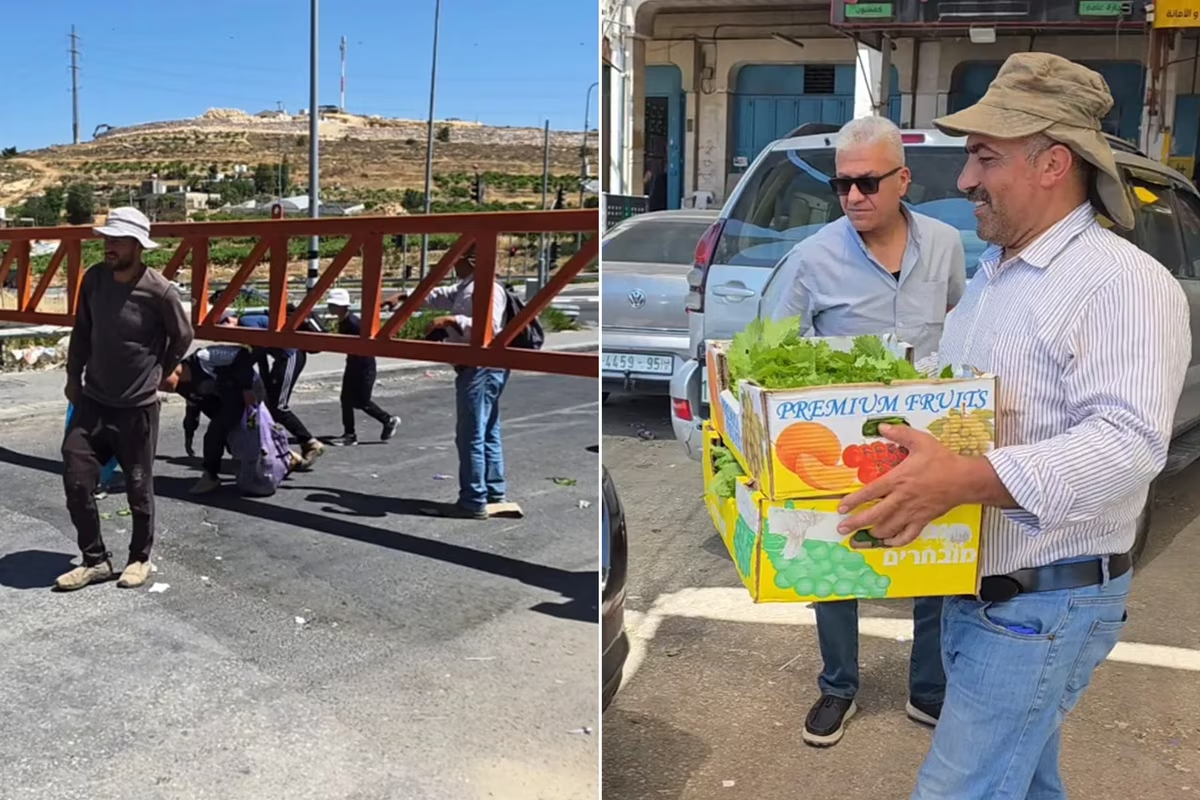
Israeli military gates and checkpoints in the West Bank have exceeded their traditional role of separating areas, transforming into a tool of collective punishment aimed at suffocating Palestinian farmers and preventing them from accessing their livelihoods. This suffering is clearly evident in the town of Halhul, north of Hebron, where residents face severe restrictions preventing them from tending to their grapevines in areas classified as 'C'.
Local sources reported that farmers in Halhul are now forced to enter their lands stealthily and avoid military patrols to carry out necessary plowing and pruning. These lands are under full Israeli control according to the Oslo Accords, which gives the occupation authorities a permanent pretext to pursue landowners and prevent them from agricultural use.
These repressive measures have led to the destruction of vast areas of land and damage to crops that constitute the primary income for hundreds of Palestinian families. While Palestinians are denied access to their land, full facilities are granted to settlers to expand their aggressions and pursue farmers under the protection of occupation forces.
The chapters of suffering in Halhul began to escalate sharply since 2020, with the occupation starting to build the 'Ma'ale Halhul' settlement outpost on top of Jabal al-Jumjuma (Skull Mountain). This mountain is one of the highest peaks in historical Palestine, making it a coveted target for settlement associations that incited the Israeli government to confiscate it and turn it into a settlement center.
The initial settlement outpost expanded into seven other outposts, spreading like an octopus over private citizens' lands, leading to the detention of about 14,000 dunams behind barbed wire. This rapid settlement expansion aims to create a new geographical reality that isolates Palestinian villages from their vital agricultural surroundings.
Faced with this bitter reality, farmers are left with only difficult options to access their fields, either by sneaking in under the cover of darkness at the risk of being subjected to soldier attacks, or through complex security coordination that rarely succeeds. Farmers confirm that the land, which used to be teeming with thousands of workers, is now only reached by dozens with great difficulty.
Farmers are forced to walk long distances, several kilometers, due to the occupation authorities' refusal to allow vehicles or agricultural machinery through military gates. This waste of time and physical effort negatively impacts the quality of agricultural work, with some contenting themselves with taking quick photos of their lands before leaving for fear of arrest.
Israeli restrictions have directly impacted agricultural production, with the quantities of crops supplied to local markets significantly declining compared to previous years. Traders in the central vegetable market confirmed that the delayed arrival of products leads to the spoilage of large parts of them and a decrease in their market value, exacerbating the economic losses for farmers.
In the Qalqilya governorate, north of the West Bank, the occupation authorities issued a new military decision preventing farmers from bringing their vehicles into lands located behind the apartheid wall. This decision threatens to destroy the agricultural sector in one of the most fertile areas of Palestine, known for its production of guava, avocado, and citrus.
Farmers in Qalqilya explained that this decision would take them back to primitive times, as they would be forced to use animals to transport crops over long distances, which is impractical for large quantities intended for export. Qalqilya contributes about 20% of the total Palestinian agricultural production, making its targeting a severe blow to national food security.
Data from the Wall and Settlement Resistance Commission indicates the presence of 916 checkpoints and military gates spread throughout the West Bank, turning it into isolated cantons. Since October 7, 2023, the occupation has intensified the placement of obstacles by erecting 243 new gates, in a move aimed at imposing a comprehensive siege on Palestinian movements.
Farmers and human rights organizations have appealed to the international community and humanitarian organizations to intervene immediately to stop these policies aimed at displacing Palestinians from their land through starvation and intimidation. The Palestinian farmer remains steadfast on his land, trying to harvest the fruits of his labor despite the iron gates and rifles that lie in wait for him at every turn.
In my 30 years of working in the market, I have never seen a worse situation than this, as the occupation continues to build settlement outposts at the expense of our land.
שתף את דעתך
The grip of settlement tightens on West Bank farmers: Infiltration of lands and vehicle bans