





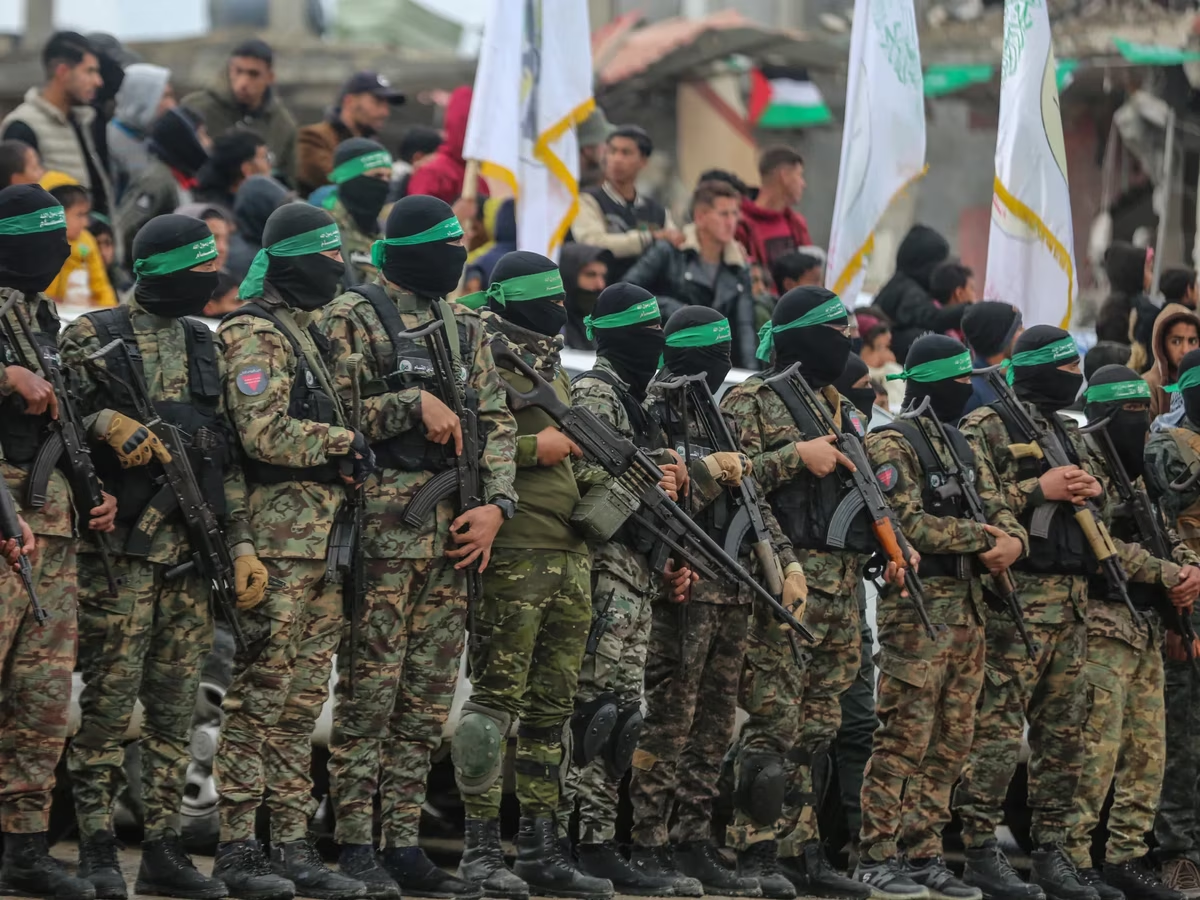
A professional conviction is growing within Israeli security circles that the future of the Gaza Strip is no longer linked to the possibility of ending Hamas's existence, but rather to the necessity of recognizing that it has become a formidable force in the field and political equation. These assessments, circulated by Hebrew media sources, are based on clear indicators that reflect the movement's continued influence and its ability to manage the scene despite the ferocity of the ongoing war.\n\nThe security establishment in Tel Aviv believes that the absence of any real popular movement against Hamas, even amidst the humanitarian catastrophe, is evidence of the stability of its governing system. Sources indicated that recent calls on social media platforms to protest living conditions did not receive a tangible response in the streets of Gaza, which reinforces the hypothesis of tight control.\n\nAccording to Israeli assessments, this field calm is not only due to complex security conditions, but also to Hamas's ability to deploy its armed elements at vital intersections and impose a deterrent environment that prevents any protest. This organizational presence confirms that the movement has succeeded in reproducing its governance tools and restoring its administrative structure amidst the rubble and widespread destruction left by military operations.\n\nSecurity circles go so far as to describe any international or regional plans aimed at managing the Strip independently of Hamas as \"unrealistic\" and lacking practical components on the ground. These circles consider that attempts by some armed groups to challenge the movement's authority have failed in the face of the organizational cohesion demonstrated by Hamas in various areas of the Strip.\n\nIn a message directed to decision-makers in Washington and Tel Aviv, sources confirmed that attempts to create \"Hamas-free zones\" or rely on a technocratic government are doomed to failure. The assessments stressed that any plan put on hold will not find its way to implementation as long as the movement holds the initiative and effective control on the ground.\n\nFor his part, military analyst Ron Ben Yishai presented a different vision from the official political discourse, considering that Hamas is not just an armed faction that can be uprooted, but rather an expression of a deeply rooted social and political structure. Ben Yishai criticized the continuous promotion of the concept of \"complete victory,\" stressing that separating society from the movement in Gaza is an extremely complex process that goes beyond mere military capabilities.\n\nReports indicate that post-war Gaza will not be an empty political space that can be easily reshaped according to Israeli or American visions. The movement remains the central actor, whether through direct governance or through its influence as a field force that cannot be bypassed in any future security or civilian arrangements.\n\n"The absence of an alternative" stands out as one of the most important challenges facing the occupation, as observers believe that the real problem lies in the absence of a party capable of filling the vacuum. The Palestinian Authority suffers from a credibility crisis, while Israel rejects the option of international forces, making Hamas's continued presence a realistic option imposed by the field.\n\nOn the military front, official sources conveyed warnings from senior officers in the Israeli army about Hamas's rapid recovery of its combat capabilities. Reports indicated that the movement has already begun manufacturing hundreds of explosive devices and anti-tank missiles monthly, exploiting the relative calm in some areas to rearm its units.\n\nReconstruction operations include recruiting new elements and training elite units to compensate for the human losses it suffered in recent months. Israeli intelligence also monitored strenuous attempts to smuggle advanced communication equipment and drones, in addition to continuous work on rehabilitating the strategic tunnel network.\n\nMilitary officials confirmed that Hamas is still \"strong on the ground\" and no local or external party poses a real threat to its authority so far. This reality prompted the army leadership to recommend resuming widespread military operations, despite American reservations fearing an exacerbation of the humanitarian crisis and an expansion of the conflict.\n\nIn a related context, analysts believe that Israeli confusion in dealing with the issue of Gaza's administration reflects the gap between declared political goals and the reality on the ground. The war, whose goal was to eliminate Hamas, ended with an implicit admission by the security establishment that the movement remains the main player with administrative experience and popular presence.\n\nThe challenge facing any future vision for Gaza is how to deal with a movement that has deep roots in the Palestinian social and political fabric. This is what always makes theoretical proposals about the \"day after\" the war clash with the reality that Hamas still holds the reins in the besieged Strip.\n\nIn conclusion, it seems that the scene in the Gaza Strip is heading towards more complexity with the movement's insistence on remaining and its ability to adapt to immense military pressures. The latest Israeli assessments remain a frank admission of the failure of the total exclusion strategy, and a call to search for more realistic paths to deal with the existing reality.\n\nToday, conclusive evidence has confirmed that two million Palestinians outside the fence do not oppose Hamas rule, and as long as the movement is in power, there is no chance for change.

ב 29 יונ 2026 7:52 am - שעון ירושלים
Israeli security assessments: Hamas regains control, plans to remove it from Gaza 'unrealistic'
שתף את דעתך
Israeli security assessments: Hamas regains control, plans to remove it from Gaza 'unrealistic'