






By: Said Arikat
June 28, 2026
News analysis
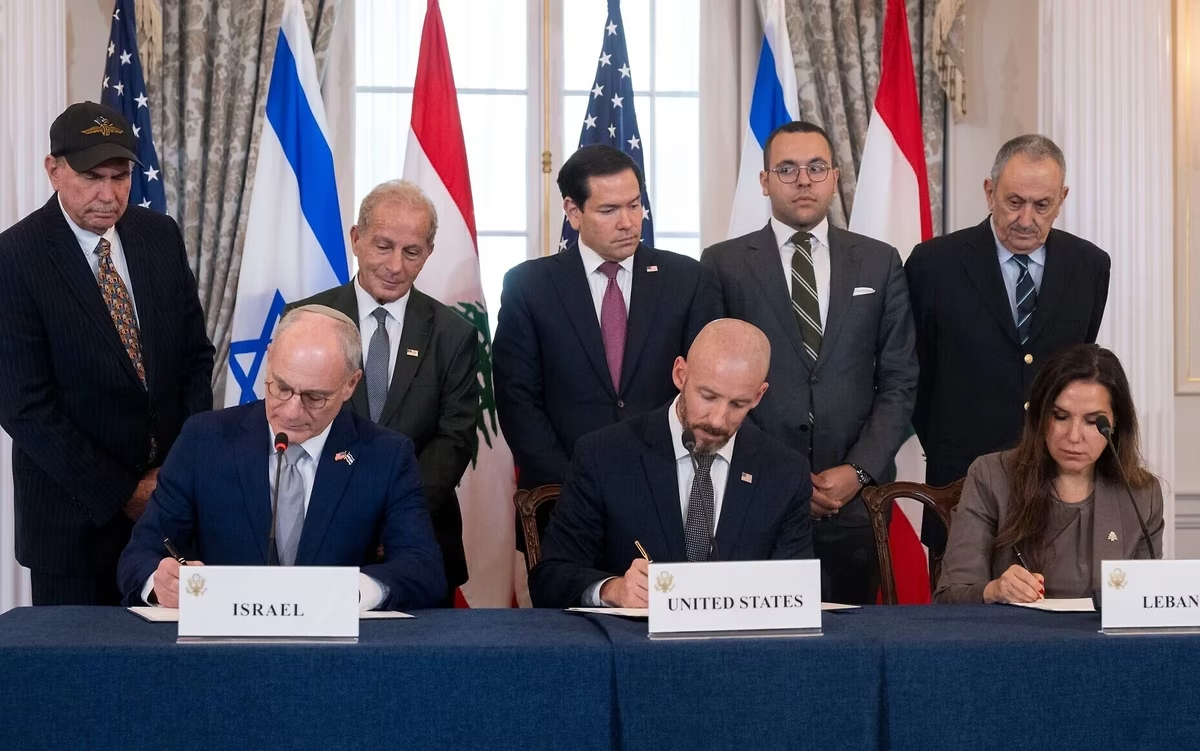
Washington, D.C- The proposed American-Lebanese framework agreement has been presented as a historic opportunity to stabilize Lebanon and end decades of conflict along its southern border. Yet beneath the language of peace, security, and institutional reform lies a document that raises profound constitutional, political, and democratic concerns. Rather than offering a roadmap toward national reconciliation, the agreement appears designed to reshape Lebanon’s political order in ways that privilege external interests over domestic legitimacy.
No peace agreement can endure if it excludes a substantial portion of the society it claims to govern. The most striking weakness of the proposed framework is its apparent disregard for nearly 35 percent of Lebanon’s population, represented politically and socially by constituencies aligned with Hezbollah and its allies. Whether one supports or opposes Hezbollah is beside the point. Sustainable political settlements are not built by pretending that millions of citizens simply do not exist.
History repeatedly demonstrates that durable peace emerges through inclusion rather than exclusion. Agreements imposed upon deeply divided societies without broad political consensus rarely survive. Instead, they deepen polarization, delegitimize state institutions, and often create the very instability they seek to eliminate. Lebanon’s modern history—from the civil war to the Taif Agreement—illustrates that lasting political arrangements require compromise among competing communities, not the victory of one camp over another.
The agreement’s treatment of legal accountability is equally troubling. Rather than placing transitional authorities under the oversight of independent judicial institutions, the draft reportedly grants the proposed Peace Council sweeping authority to manage legal disputes arising from its own decisions. Such an arrangement effectively allows an executive body to become judge in its own cause.
This is not merely a technical legal issue. It strikes at the heart of constitutional governance. Independent oversight exists precisely because governments, particularly transitional ones exercising extraordinary powers, require external scrutiny. When executive institutions acquire the authority both to make decisions and determine the legality of those decisions, accountability becomes little more than a political slogan.
The result is the emergence of an exceptional governing structure operating outside ordinary constitutional checks and balances. Such models have consistently failed elsewhere because they erode public confidence. Political legitimacy cannot be sustained by foreign endorsement or diplomatic recognition alone. It ultimately depends upon transparent institutions capable of holding power accountable regardless of who exercises it.
Even more concerning is the agreement’s apparent security architecture. Although presented as a mechanism to prevent renewed conflict, its practical effect appears to institutionalize Israeli influence over Lebanon’s sovereign security decisions. If Israel is granted authority—directly or indirectly—to determine whether Lebanon is complying with its obligations, then the agreement effectively hands Israel a continuing veto over Lebanese policy.
This fundamentally alters the balance between peace and sovereignty. A neighboring state ceases to be merely a party to an agreement and instead becomes an arbiter of another country’s domestic affairs. Such arrangements rarely produce stability. Rather, they create permanent dependency, leaving one side able to delay, suspend, or reinterpret implementation whenever political circumstances change.
Israel has long argued that its security requires freedom of military action inside Lebanon whenever it identifies potential threats. If that doctrine becomes embedded within an internationally supported framework agreement, Lebanon risks entering an arrangement in which Israeli security concerns consistently supersede Lebanese sovereignty. That would represent not peace between equals but a hierarchy in which one state exercises disproportionate influence over another.
Supporters may argue that these extraordinary mechanisms are necessary because Hezbollah’s military capabilities have prevented previous diplomatic efforts from succeeding. Yet democratic governance cannot be strengthened by circumventing democratic principles. Weakening constitutional safeguards in order to achieve short-term security objectives often produces the opposite outcome over time.
The agreement also appears to assume that Lebanon’s political crisis can be solved primarily through external engineering. This assumption misunderstands the nature of Lebanon’s problems. The country’s institutional paralysis reflects deep internal divisions rooted in sectarian power-sharing, economic collapse, regional rivalries, and decades of state weakness. None of these challenges can be resolved solely through security arrangements negotiated under foreign sponsorship.
Moreover, agreements perceived as externally imposed carry their own political costs. Large segments of the Lebanese public may view the framework not as a national compact but as an American-sponsored restructuring designed to satisfy Israeli strategic priorities. That perception alone risks undermining implementation, regardless of the agreement’s technical provisions.
Peace cannot be built upon political exclusion. Nor can sovereignty be strengthened by transferring essential decision-making authority to external actors. Any agreement that effectively marginalizes more than one-third of the population while granting another state enduring leverage over national security is unlikely to command lasting legitimacy.
Lebanon deserves an agreement that strengthens its institutions rather than bypasses them; reinforces judicial independence rather than concentrates power; and protects national sovereignty instead of creating new mechanisms of external supervision. Above all, it deserves a political settlement reflecting the consent of its people rather than the strategic calculations of foreign governments.
History offers a simple lesson. Peace imposed without inclusion is often temporary. Stability achieved through exceptional powers is frequently fragile. And sovereignty surrendered in the name of security is rarely recovered without enormous political cost. If the proposed framework proceeds without addressing these fundamental flaws, it risks becoming less a peace agreement than a blueprint for a new political order—one that institutionalizes exclusion at home while normalizing Israeli predominance over Lebanon’s future.
שתף את דעתך
A Peace Agreement That Risks Undermining Lebanon’s Sovereignty