






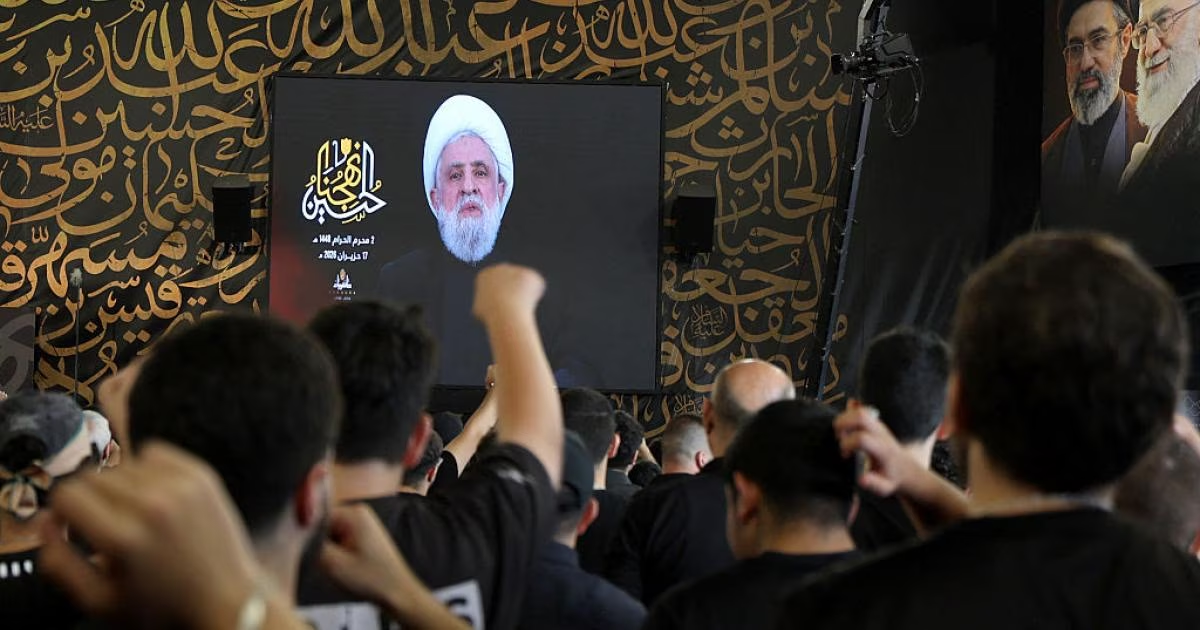
Hezbollah's Secretary-General, Sheikh Naim Qassem, reiterated his firm stance rejecting any agreements or commitments that might infringe upon Lebanese national sovereignty. In a televised speech, he clarified that the Israeli occupation is obligated to withdraw from all Lebanese territories without any conditions, emphasizing that the resistance will not accept any formulas that grant the occupation political or field gains.
These statements come at a sensitive time, coinciding with the US State Department's announcement of extending the fifth round of indirect talks between Beirut and Tel Aviv for an additional day. This extension aims to overcome the deep disagreements that have emerged regarding the Israeli withdrawal from areas where the Israeli army recently advanced in southern Lebanon.
Qassem stressed that reaching any technical understandings does not, in any way, mean normalizing relations with the occupation or ending the existing state of hostility. He indicated that Hezbollah rejects any partial presence of the occupation on Lebanese soil, considering that protecting national interests requires political steadfastness commensurate with the field steadfastness demonstrated by the resistance.
Regarding international pressures, the Secretary-General called on official Lebanese authorities to confront attempts to drag the country into internal strife or forced normalization. He demanded enhanced cooperation with countries supporting Lebanon's sovereignty and reconstruction, warning that international calls for disarmament in exchange for financial aid are agendas that exclusively serve Israeli interests.
On the ground, Hebrew media sources revealed a 'pilot plan' proposed by Washington that includes a gradual withdrawal of the Israeli army from specific locations. The plan stipulates the deployment of the Lebanese army in those areas and the dismantling of any Hezbollah military infrastructure, but disagreement still persists regarding the starting point of this implementation.
Tel Aviv insists in the ongoing negotiations on testing the Lebanese army's capabilities in areas where the occupation is not currently present, to ensure the prevention of resistance activity before withdrawing from forward positions. In contrast, Beirut, supported by Washington's vision, insists on the necessity of starting the withdrawal from areas currently occupied by the Israeli army as a gesture of goodwill and a guarantee of sovereignty.
Naim Qassem described the recent memorandum of understanding between Tehran and Washington as an official declaration of the failure of the American-Israeli project in the region. He considered that the steadfastness of the resistance fronts in Lebanon, Yemen, and Iraq imposed a new reality that forced international powers to acknowledge the changing balance of power, despite continued Israeli violations of ceasefire agreements.
Qassem extended a special greeting to the supporting forces in Yemen and Iraq, appreciating their role in supporting the Palestinian cause and protecting Lebanon from comprehensive aggression. He affirmed that the current confrontation is a 'major war' that aimed to eliminate the existence and identity of the resistance, but the field results proved Lebanon's ability to break ambitious Israeli objectives.
Field data indicates that the occupation army advanced more than 10 kilometers into some sectors in southern Lebanon during the ongoing aggression. Israel still controls strategic points it occupied in previous periods, making the issue of complete withdrawal the most prominent obstacle in any anticipated political settlement under international auspices.
According to official data issued by Lebanese authorities, the aggression that began in March 2026 resulted in devastating human losses, reaching over 4230 martyrs. The continuous shelling and military operations also caused injuries to more than 12,000 people, in addition to a major displacement crisis affecting over one million Lebanese citizens from their villages and cities.
In conclusion, observers believe that Qassem's statements set a high bar for the Lebanese negotiator, reflecting the resistance's distrust of Israeli intentions or American mediation. The field remains the judge amidst continued diplomatic stalemate and each party's insistence on its conditions related to final security and border arrangements.
Israel must withdraw unconditionally, and any commitment against Lebanon's sovereignty will not pass, and no one has the right to sign anything that harms the country's interests.
שתף את דעתך
Naim Qassem insists on unconditional withdrawal of occupation and rejects infringement on Lebanon's sovereignty