






Washington's Message
Washington – Said Arikat – 26/6/2026
News Analysis
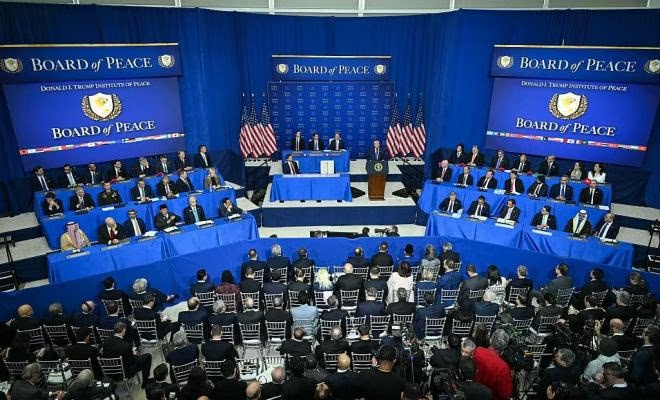
Negotiation documents obtained by "Drop Site" have revealed deep disagreements between Palestinian factions and the "Peace Council" established by the administration of US President Donald Trump to oversee post-war arrangements in Gaza. The documents show that the core of the dispute is no longer limited to establishing a ceasefire or reconstruction, but extends to more sensitive issues related to the future of Palestinian resistance, the nature of governance in Gaza, and the possibility of an independent Palestinian state.
According to the documents, Palestinian factions submitted amendments to a 15-point roadmap proposed by the Council, emphasizing that any security arrangements or discussions about weapons must be part of a clear political path that guarantees the Palestinians' right to self-determination and the establishment of their independent state. In contrast, the Council insisted on formulations that link the disarmament of factions to the creation of "suitable conditions" for a future political path without offering clear commitments regarding a Palestinian state.
Mutual correspondence indicates that the Council, led by former international official Nikolay Mladenov, seeks to expand the scope of disarmament to include not only heavy weapons, but also tunnels, military manufacturing facilities, and weapons depots, ultimately preventing Palestinian factions from possessing or storing any weapons in the future. The factions believe that this formulation goes beyond the terms of the original ceasefire agreement and transforms the negotiations into a comprehensive dismantling process of Palestinian resistance.
The importance of these disagreements is not limited to procedural or security aspects, but touches upon the core of the decades-long Palestinian-Israeli conflict. Palestinian factions believe that the right to resistance is directly linked to the continuation of the occupation and the absence of an independent state, and that any discussion about the future of weapons must come within the framework of a comprehensive political settlement that ends the occupation and guarantees Palestinian national rights. The approach reflected in the "Peace Council" documents, however, treats the issue of weapons as the primary entry point for any political or economic progress, raising fears that the negotiations will be transformed from a process aimed at ending the war and achieving a just settlement into a path focused exclusively on Israeli security requirements. Observers believe that this gap in visions explains the current stalemate in the talks, as each party adheres to a different interpretation of the goals for the next phase. While the factions speak of building a path leading to a Palestinian state, the documents presented by the Council focus on long-term security and administrative arrangements, without setting a clear timeline for ending the occupation or guaranteeing the establishment of a sovereign Palestinian state. This leads many Palestinians to view the entire initiative with suspicion, considering it an attempt to reframe the Palestinian issue from a national liberation cause to a matter of security and demographic management under long-term international supervision.
The documents also reveal significant divergence regarding the role of the proposed international force in Gaza. While the factions want its role to be limited to monitoring the implementation of the agreement and separating forces, the Council's project grants it broader powers, including overseeing the implementation of disarmament arrangements and training Palestinian security agencies.
In the civil administration file, the factions emphasize the necessity of empowering an independent technocratic Palestinian committee to administer Gaza as a prelude to reunifying the Strip and the West Bank within a political framework leading to a Palestinian state. However, the modified version presented by the Council reduces the powers of this committee and places it under the direct supervision of a structure linked to the Council itself, with almost complete disregard for the role of the Palestinian Authority and the future of Palestinian political unity.
Palestinian factions accuse the Council of adopting an approach that focuses on Israeli security demands, at a time when Israeli military operations and restrictions on the entry of humanitarian aid continue, despite the ceasefire agreement signed in October 2025. They also consider that conditioning reconstruction and the completion of Israeli withdrawal on the completion of the disarmament process gives Israel additional leverage and delays any real political settlement.
Information in the documents indicates that the disagreement is not limited to the weapons file, but extends to defining the future of Gaza itself. The factions demand linking any transitional arrangements to the reunification of the Palestinian political system and considering Gaza and the West Bank as a single geographical and political unit, while the formulations pushed by the Council avoid any direct commitment to this principle. The documents also raise questions about the nature of the role that international bodies overseeing the next phase might play, and whether they will act as neutral mediators or as a party imposing specific political and security visions on Palestinians. Critics of the plan fear that the proposed transitional institutions could become a permanent alternative to Palestinian national institutions, which could prolong external guardianship over the Strip instead of paving the way for Palestinians to exercise their full right to self-determination.
In contrast, the Council affirms that its goal is to transform the fragile truce into a sustainable reality that ensures security, stability, and reconstruction, and that security arrangements are a fundamental condition to prevent the renewal of war and create a suitable environment for development and civil governance.
These documents reveal a fundamental shift in the nature of the negotiations surrounding Gaza. After the focus was on ending the war, prisoner exchange, and humanitarian aid delivery, negotiations are now revolving around redefining the Palestinian national project itself. It appears that the weapons file has transformed from a security issue into an entry point for reshaping the balance of political power within the Palestinian arena. The factions fear that linking any political or economic progress to disarmament will create a new reality in which national rights are postponed indefinitely, while Palestinian commitments become immediate preconditions.
The documents also reflect a structural imbalance in the current negotiation mechanism, represented by the lack of balance between mutual commitments. While the proposals include precise details about what is required from the Palestinian side, Israeli commitments appear less clear and more open to interpretation. This pattern is not new in the course of Palestinian-Israeli settlements, as Palestinians have often complained about double standards that link any political progress to increasing security requirements, while fundamental issues such as statehood, borders, and sovereignty remain postponed to later stages that may never come. Therefore, many view these documents as an extension of this historical approach.
Perhaps the greatest importance of these developments lies in the fact that they are taking place away from widespread international attention, amidst media preoccupation with other regional crises. However, what is happening in these negotiations could shape the political and security landscape in Gaza for many years. If the currently proposed formula is adopted, the Strip could transition to an international or semi-international administration model dominated by security considerations more than political and national considerations. However, if the factions and mediators succeed in imposing a greater balance between security and political rights, the negotiations could open a new window for reviving the Palestinian state project within a more comprehensive and sustainable framework.
שתף את דעתך
Leaked Documents: Trump's Peace Council Seeks to Dismantle Resistance and Bury the Palestinian State