






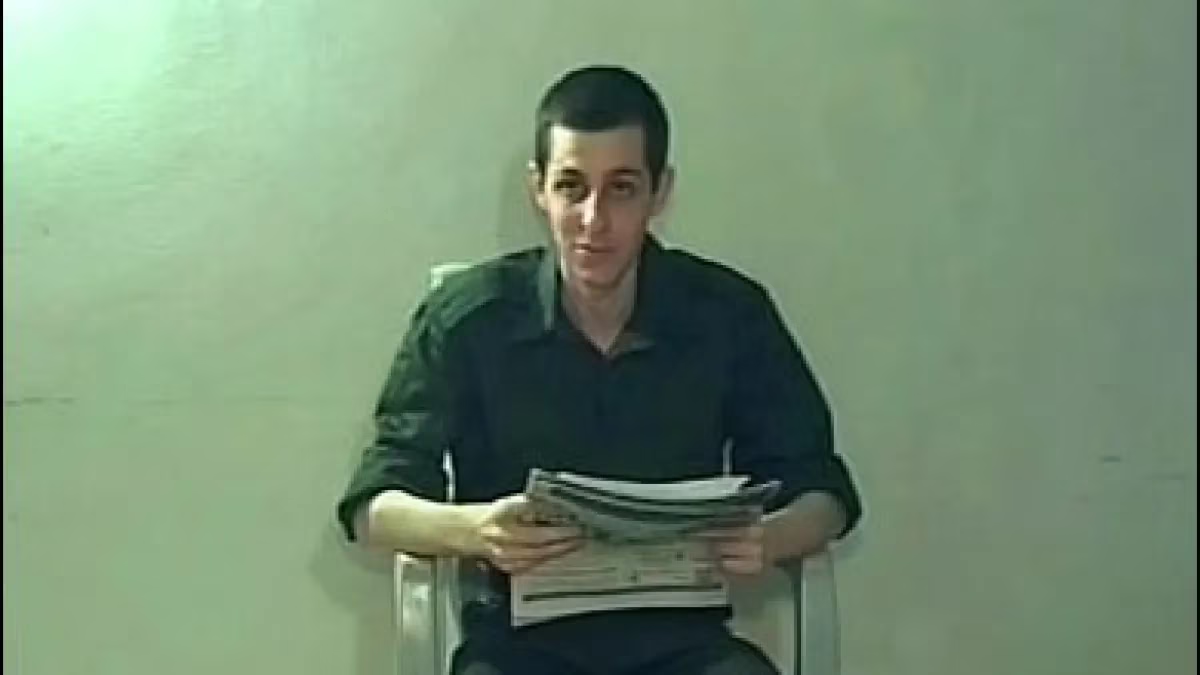
The Israeli army today, Thursday, released secret operational documents and records coinciding with the 20th anniversary of the operation to capture soldier Gilad Shalit by the Palestinian resistance in the Gaza Strip in 2006. These records reveal precise details about the intelligence and field failure that accompanied the attack, and how the military system failed to locate the soldier for many years.
Hebrew media sources quoted excerpts from the records of the Southern Brigade, describing the day the operation was carried out as an embodiment of the state of disarray and helplessness that afflicted the occupation army. The documents clarified that the Palestinian resistance succeeded in carrying out a complex and coordinated attack that surprised the forces stationed near the border, leading to a rapid collapse in the local defense system.
The incident began with the infiltration of a group of Hamas fighters, the Popular Resistance Committees, and the Army of Islam through a strategic offensive tunnel dug under the border, 300 meters long. According to the released archive, the resistance fighters simultaneously targeted a tank, a guard post, and an armored personnel carrier in an area near the Kerem Shalom military crossing.
The surprise attack resulted in the death of a lieutenant officer and another soldier, in addition to four soldiers being wounded with varying injuries, while the attacking group managed to pull soldier Gilad Shalit into the Gaza Strip. The records show that the command center received the first report of mortar fire and small arms fire at exactly 5:13 AM.
A few minutes after the first report, specifically at 05:19, reports described by sources as 'alarming' poured in about soldiers at the separation fence and confirmed casualties. Conflicting information continued to reach the command headquarters about tanks being directly shelled and armed men infiltrating military positions, amidst a state of chaos in managing the situation.
The records indicate that the initial assessment of losses began to emerge after the tanks were evacuated from the engagement area, where the death of one soldier was initially recorded without realizing the full extent of the disaster. More than an hour after the operation began, concern began to escalate within the military command as indicators of losing contact with one of the tank crew members increased.
At exactly 06:34 AM, the word 'missing' appeared for the first time in the official records next to the list of dead and wounded, and it was later confirmed that the missing soldier was Gilad Shalit. Just six minutes after this entry, the phrase 'soldier missing from the tank' was written, which prompted an urgent move by the high command to try to remedy the deteriorating field situation.
The documents revealed that the Israeli army activated the controversial 'Hannibal' protocol at 06:44 AM, a procedure that allows the use of excessive force to prevent the capture of soldiers even if it endangers their lives. However, it turned out that this activation came too late, as the resistance fighters had crossed the border fence back into Gaza with Shalit more than an hour earlier.
Hebrew sources admitted that the activation of the Hannibal protocol had no practical use at that time, given the success of the executing group in withdrawing and securing the captured soldier inside the Strip. By 06:48, the army command realized that the kidnapping operation had become a reality, and widespread search operations began in a desperate attempt to track the kidnappers.
During the first hours of the search, occupation forces found a camouflage vest and helmet belonging to Shalit lying near the separation fence, which reinforced the hypothesis of the successful capture operation. At 8:00 AM, three hours after the attack, the soldier's name was officially recorded in military records as a kidnapped soldier, marking the beginning of one of the longest capture crises in the history of the occupation.
Additional rescue forces arrived in the area at 9:00 AM and were able to identify the footprints of the resistance fighters and the kidnapped soldier heading deep into the Gaza Strip. Later in the afternoon, a reconnaissance officer found Shalit's military uniform with traces of blood and shrapnel, which led intelligence to believe at the time that he was still alive despite his injury.
The records reflect a state of intelligence confusion, as the command developed multiple scenarios, including the possibility of the kidnappers separating from each other or transferring the soldier to Egypt through tunnels. These estimates fluctuated between reality and imagination for years, amidst a dismal failure to obtain any accurate information about Shalit's whereabouts, who remained a captive for five years.
Shalit's case ended in 2011 with a major exchange deal, under which the resistance released him in exchange for the liberation of 1027 male and female prisoners from occupation prisons. These revelations today confirm the extent of the failure suffered by the Israeli security system in confronting the resistance's planning and its ability to hold prisoners despite technology and strict surveillance.
The phrase 'soldier missing from the tank' appeared in the records an hour after the operation, followed by the activation of the Hannibal protocol, which was no longer of any practical use.
שתף את דעתך
Between Confusion and the Delayed 'Hannibal' Protocol.. Israeli Documents Reveal the Inside Story of Shalit's Capture