






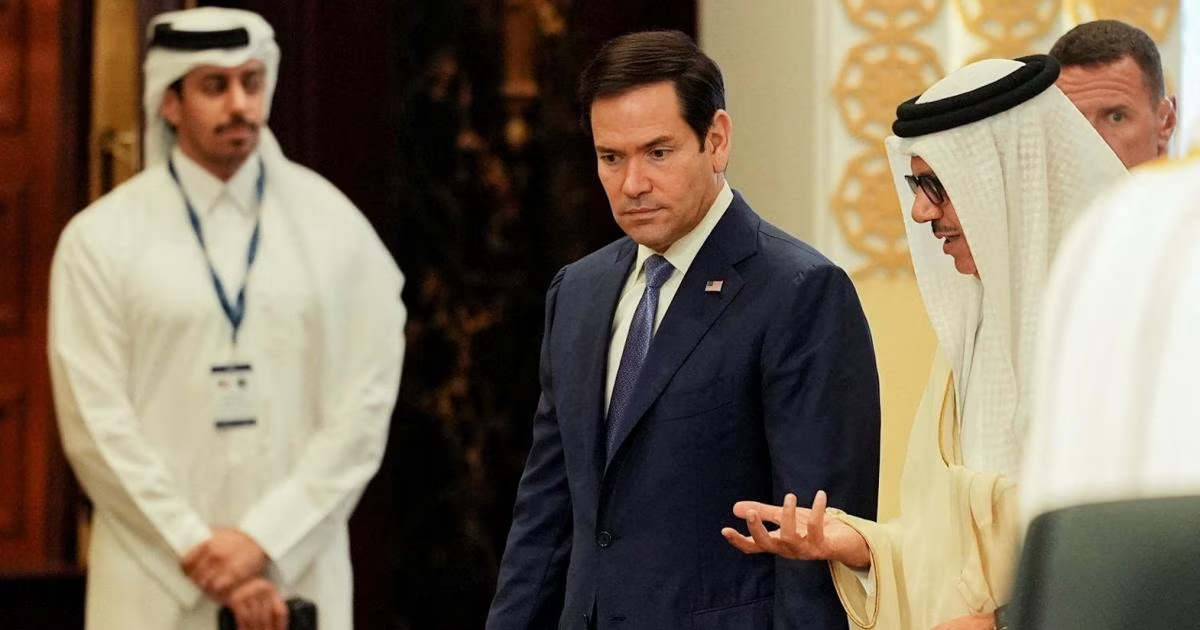
US Secretary of State Marco Rubio announced today, Thursday, his country's categorical rejection of recent Iranian positions regarding the regulation of navigation in the Strait of Hormuz. Rubio affirmed during his participation in the meeting of the foreign ministers of the Gulf Cooperation Council countries in Manama that this waterway represents an international artery and cannot be subjected to the sovereignty of any single state.\n\nThe US Secretary explained that attempts to impose financial fees on the passage of ships in the Strait of Hormuz, under any name, constitute a dangerous precedent that could push other countries to take similar measures in vital passages around the world. He considered that adherence to the freedom of international navigation is a fundamental pillar for the stability of the global system and preventing international trade from sliding into chaos.\n\nRubio stressed in his speech to Gulf officials that the legal debate raised by Tehran regarding the names of the required amounts, whether they are fees or service costs, does not change the essence of the issue. He pointed out that Washington is closely monitoring Iranian moves aimed at imposing a new reality in the region by controlling maritime routes.\n\nThese statements come in response to warnings issued by the Iranian Revolutionary Guard, which stressed the necessity for ships to adhere exclusively to the routes specified by Tehran. The Iranian military leadership considered that any alternative routes announced without prior coordination with them are unacceptable and represent a direct threat to the safety of navigation in the region.\n\nFor its part, Tehran justified its approach to imposing financial amounts by stating that they are in exchange for navigational and environmental services that ships previously provided for free. Iranian sources linked this shift to what they described as the recent US-Israeli aggression, stressing that they will not continue to bear the burdens of maintaining the waterway without financial compensation from the beneficiaries.\n\nIn the context of nuclear talks, Rubio reassured Washington's allies that the US administration is seeking to reach an agreement with Iran that ends tensions, but he added that this will not happen 'at any cost'. He affirmed that any final understanding must include strict guarantees that permanently prevent Iran from possessing a nuclear weapon.\n\n"The head of US diplomacy added that the United States has entered a new phase in its foreign policy aimed at achieving lasting and genuine peace. He stressed that this peace will not be built on making concessions that undermine the security and prosperity of the United States or its strategic partners in the Arabian Gulf region.\n\nDuring the meeting, Rubio pledged that Washington would do everything in its power to ensure the success of the negotiation process while ensuring that regional interests are taken into account at every step. He indicated that the goal is to reach a formula that guarantees stability and prevents any military escalation that could harm the global economy or energy security.\n\n"The visit to Manama is the final stop of a wide Gulf tour that included the United Arab Emirates and the State of Kuwait. The tour primarily aimed to rally support for the preliminary agreement reached by President Donald Trump's administration with the Iranian side, amidst regional questions about the nature of the new balances.\n\nAt the end of the meeting, Bahraini Foreign Minister Abdullatif bin Rashid Al Zayani welcomed the Omani initiative to create a safe passage for ships, as a step to enhance maritime stability. However, Tehran remains insistent on the necessity for any new navigational arrangements to pass through direct consultation channels with it, which portends the continuation of political tug-of-war over this issue.\n\nInternational waterways do not belong to any country; this is a fundamental principle in the international system, and without it, chaos will prevail.
שתף את דעתך
Rubio from Manama: Strait of Hormuz is an international passage and any agreement with Tehran will protect the security of allies