






Washington Message
Washington – Said Arikat – 25/6/2026
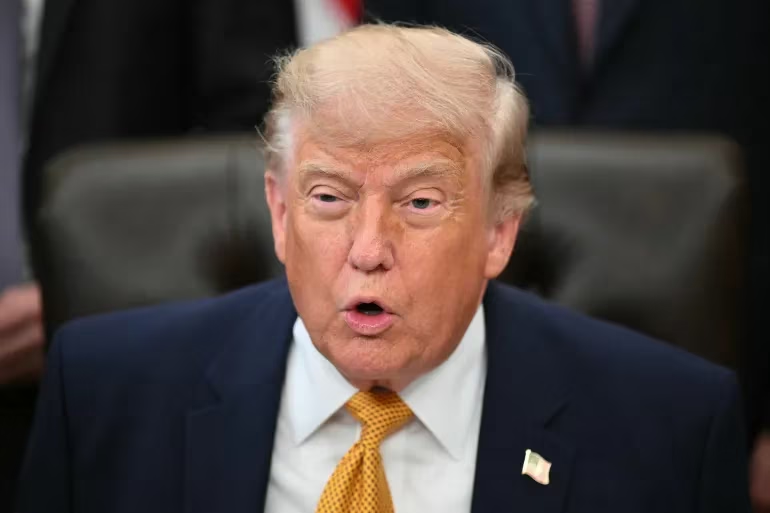
US President Donald Trump announced that any Iranian funds released under a potential peace agreement between Washington and Tehran would remain under direct US oversight and would only be allowed for the purchase of food and medical supplies from the United States. This move reflects the continuation of economic pressure policies even if a political settlement is reached to end the confrontation between the two countries.
Trump stated, in a post on the "Truth Social" platform, that funds or sanctions relief approved for release by the US Treasury Department would be placed in escrow accounts under US control and would be used exclusively for the purchase of food and medicine, including corn, wheat, and soybeans from American farmers.
The US President justified this approach by citing what he described as a "humanitarian crisis" within Iran, emphasizing that providing essential materials has become an urgent necessity that must be addressed before it is too late. However, the wording of the American statements also reflects a clear desire to prevent Tehran from using any released funds to rebuild its military capabilities or support its regional allies.
These statements come at a time when ongoing negotiations between Washington and Tehran are in a delicate phase aimed at stabilizing the cessation of military actions and reaching a long-term political and security framework. Iran has repeatedly stressed that lifting economic sanctions and unfreezing Iranian assets abroad are essential conditions for any final agreement.
In an indication of the extent of the remaining disagreements, Trump announced that Iran had agreed to “the highest levels of nuclear inspection indefinitely,” considering that this would ensure what he called “nuclear honesty.” He added that continued negotiations would have been impossible without Tehran's acceptance of this condition.
However, these statements quickly clashed with a contradictory Iranian stance. One day after US Vice President JD Vance announced that Iran had agreed to allow international inspectors to monitor its nuclear facilities, the Iranian Foreign Ministry denied the existence of any such agreement, raising questions about the reality of the understandings reached during the recent rounds of indirect contacts.
This contradiction recalls the disagreements that surrounded the 2015 nuclear deal, which included a wide-ranging international inspection regime considered at the time to be the strictest in the history of the International Atomic Energy Agency. Despite the US withdrawal from the agreement in 2018 during Trump's first term, Iran continued to allow international inspections for a long time, before the relationship sharply deteriorated following US and Israeli attacks targeting its territory and facilities last year, which led it to expel inspectors and halt extensive forms of supervisory cooperation.
Observers believe that the US administration is trying to build a new agreement that differs from the 2015 agreement in terms of implementation and oversight mechanisms. Instead of merely lifting sanctions in exchange for nuclear restrictions, Washington seeks to retain economic leverage that allows it to monitor the movement of Iranian funds and control their use, which may provoke widespread Iranian objections as an infringement on national sovereignty.
Trump's statements also reflect a desire to reassure opponents within the United States and Israel who fear that any sanctions relief could provide Tehran with additional financial resources that could be used to enhance its regional influence. For this reason, the US administration appears keen to emphasize that the released funds will not be directly available to the Iranian government but will be subject to strict US oversight.
The proposed approach to handling Iranian funds reveals a new American philosophy in conflict management, based on combining political settlement with the retention of economic dominance tools. Washington does not seem willing to relinquish its financial influence even if the conflict ends; instead, it seeks to transform this influence into a permanent part of any future agreement. From an Iranian perspective, these conditions may be seen as a continuation of sanctions through different means, which could complicate the chances of reaching a final and stable agreement, and make negotiations revolve around implementation details rather than major political principles.
Furthermore, the contradiction between American and Iranian statements regarding nuclear inspection reflects a deep trust deficit accumulated over years of confrontation. Tehran still recalls the experience of the unilateral US withdrawal from the 2015 agreement and believes that any new commitment must be met with a genuine guarantee that the same scenario will not be repeated. In contrast, Washington seeks to obtain stricter oversight mechanisms than those previously in place. Between these two positions, negotiations appear vulnerable to repeated setbacks unless a formula is reached that balances American security requirements and Iranian sovereignty demands.
At the regional level, the debate over frozen funds and nuclear inspection is not limited to the bilateral relationship between Washington and Tehran but extends to the calculations of Israel and Middle Eastern countries. The success of any agreement could open the door to a period of regional de-escalation, while its failure could lead to a renewed cycle of military escalation. Israel also continues to press for strict restrictions on Iran's nuclear program and Tehran's missile capabilities, which means that any future agreement will also be governed by regional power balances and the US administration's ability to reconcile the interests of its allies with the requirements of a settlement with Iran.
שתף את דעתך
Trump links release of Iranian funds to strict US oversight, nuclear negotiations face new contradictions