






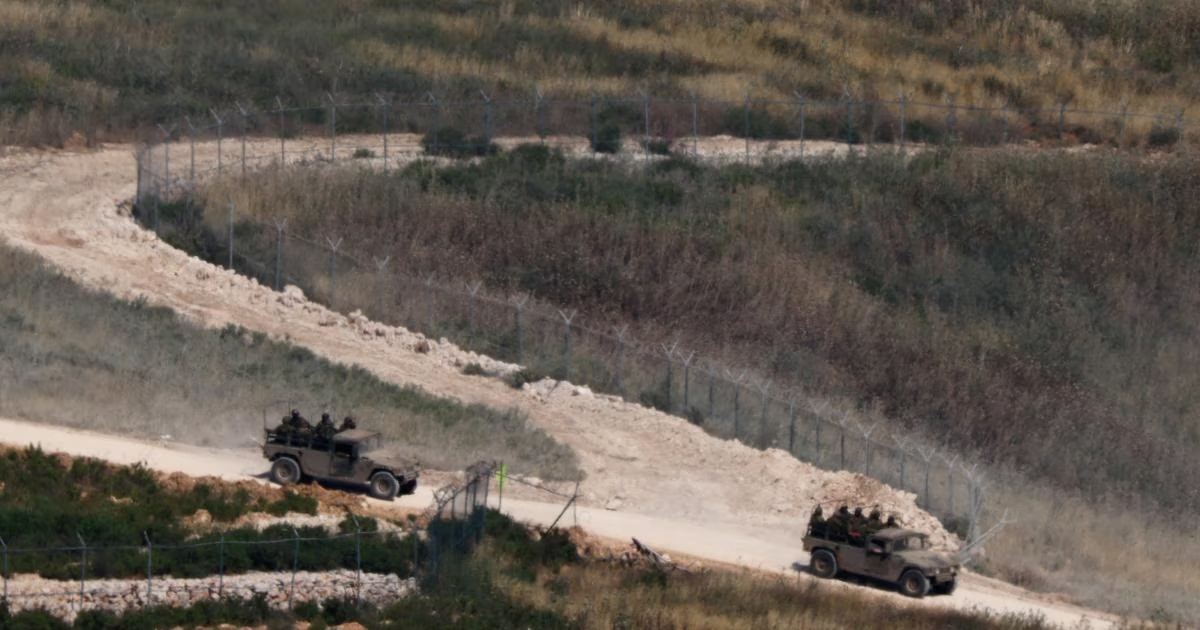
Israeli Prime Minister Benjamin Netanyahu chaired a series of high-level security consultations on Wednesday evening, with the participation of Defense Minister Israel Katz and leaders of intelligence and military agencies. These meetings primarily focused on assessing the field situation on the Lebanese front and movements in Syrian territories, amidst escalating regional tensions.
These security moves come after statements issued by the US administration, led by Donald Trump, regarding the possibilities of Syrian intervention in Lebanon, which was met with a categorical denial from Damascus and Beirut. Syrian President Ahmed Al-Shara affirmed his country's rejection of these claims, while Lebanese officials emphasized protecting their territorial sovereignty from any external interference.
Coinciding with these consultations, General Brad Cooper, commander of the US Central Command, arrived in Israel on an official visit aimed at coordinating positions. Cooper is scheduled to hold meetings with Israel Katz and Chief of Staff Eyal Zamir to discuss strategic cooperation and exchange sensitive intelligence information regarding the inflamed fronts.
Informed sources reported that discussions within the Israeli establishment did not result in clear public outcomes, but indications point to Tel Aviv's insistence on consolidating its military presence in southern Lebanon. Israel is proposing the idea of 'limited withdrawals' from some points south of the Blue Line, but without committing to any timelines for implementation.
In a related context, Defense Minister Israel Katz stated that Israel would not succumb to international pressure, including US pressure, regarding withdrawal from southern Lebanon. Katz considered military presence an urgent security necessity that cannot be compromised at the current stage, regardless of the surrounding political circumstances.
For his part, Benjamin Netanyahu adopts a discourse focusing on the so-called 'safe zone' in southern Lebanon, emphasizing the continuation of military operations to ensure the security of northern settlements. Political readings indicate that Netanyahu seeks to turn the issue of staying in Lebanon into a winning electoral card against his political opponents within Israel.
On the diplomatic front, the fifth round of indirect Lebanese-Israeli negotiations, sponsored by the US, concluded in Washington without reaching a final agreement. Despite talks of a positive atmosphere prevailing in the negotiation halls, significant gaps remain regarding the details of withdrawal and border security arrangements.
Media sources reported that both sides exchanged maps illustrating proposed deployment points, but disagreement clearly emerged over the pace of withdrawal and the areas that should be immediately evacuated. Sources expect Israel to content itself with a partial withdrawal from some secondary locations while retaining strategic positions that Beirut refuses to allow the occupation to remain in.
Official Lebanese position remains committed to the necessity of a complete and unconditional Israeli withdrawal from all occupied territories in accordance with international resolutions. Lebanese political forces affirm that any attempt to impose a new security reality under the name of 'safe zones' will be met with categorical rejection at all official and popular levels.
On the ground, the Israeli aggression that began in March 2026 continues to claim civilian lives and destroy infrastructure in various Lebanese regions. According to the latest statistics issued by Lebanese authorities, the number of martyrs has exceeded 4,200 people, while the number of injured has surpassed 12,000.
The ongoing military operations have caused a widespread displacement wave, with more than a million Lebanese forced to leave their homes and seek refuge in safer areas. Humanitarian organizations face enormous challenges in providing basic needs for the displaced amidst continued shelling and the siege imposed on many border towns.
Israel will not withdraw from southern Lebanon even if Washington asks it to, and we will continue to maintain the safe zone.
שתף את דעתך
Netanyahu links staying in southern Lebanon to electoral calculations amid stalled Washington negotiations