






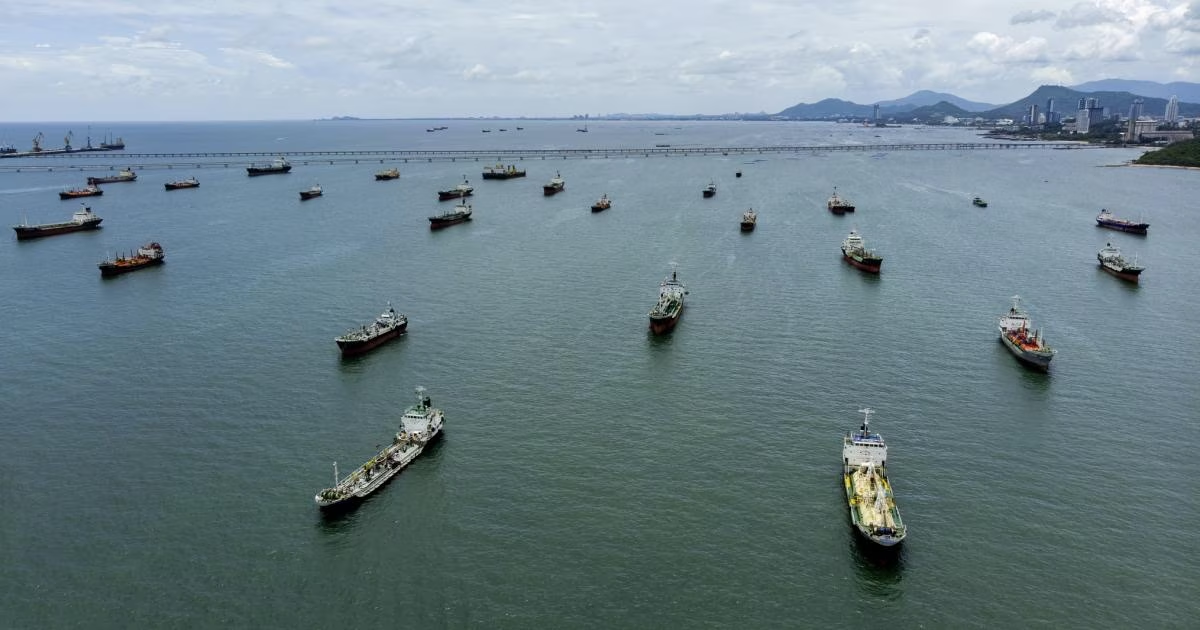
US President Donald Trump announced today, Wednesday, that he had received official assurances from the Iranian side that no transit fees or additional insurance costs would be imposed on commercial vessels passing through the Strait of Hormuz. Trump clarified via his 'Truth Social' platform that these assurances include all types of fees that Tehran had previously threatened to impose, representing a retreat from threats that had raised international concern about the safety of navigation in the strategic waterway.
These statements come amid ongoing intensive negotiations between Washington and Tehran, aimed at drafting a comprehensive agreement to end the state of tension and violence in the Middle East. The US President did not specify whether these Iranian pledges are linked only to the current sixty-day negotiation period, or if they will become a permanent commitment within the anticipated final agreement between the two parties.
Tehran had previously announced, in coordination with the Sultanate of Oman, its intention to study imposing fees for maritime services in the strait, emphasizing its full sovereignty over this passage. These moves were met with strong opposition from the United States and its allies, who considered any additional fees a threat to global trade freedom and the stability of energy markets.
In a related context concerning the nuclear file, the Director-General of the International Atomic Energy Agency (IAEA), Rafael Grossi, revealed arrangements for upcoming inspections at Iranian facilities. Grossi indicated during a press conference in Japan that the interim agreement concluded between Washington and Tehran paves the way for the return of international inspectors to carry out their oversight duties, which had been suspended for varying periods.
However, the Iranian stance appeared more reserved, as Tehran linked allowing access to key nuclear sites to the extent of progress in lifting the economic sanctions imposed on it. Iranian sources confirmed that access to sensitive facilities remains conditional on reaching a final agreement that fully and practically guarantees the interests of the Islamic Republic.
Last week, the two parties signed a memorandum of understanding consisting of 14 clauses, essentially aiming to establish a general framework for ending the ongoing conflict. This memorandum serves as a roadmap for the sixty-day talks, during which the focus will be on complex technical issues, primarily the nuclear program and uranium enrichment levels.
For his part, Iranian Deputy Foreign Minister, Kazem Gharibabadi, stressed that there are no current plans to open facilities that have been subjected to military attacks to international inspectors. He clarified that these files will only be discussed within the framework of reciprocal practical steps that include lifting US restrictions imposed on vital sectors in Iran.
Since the aerial attacks that targeted them in June of last year, the International Atomic Energy Agency has faced significant difficulties in monitoring the most sensitive sites. The recent military escalation in February led to a complete suspension of inspection operations, creating an information gap regarding the actual extent of Iranian nuclear activity in recent months.
The fate of highly enriched uranium stands out as one of the most difficult obstacles in the ongoing negotiations, as Iran possesses stockpiles enriched to up to 60%. This percentage is considered very close to the levels required for producing nuclear weapons, which raises concerns among international powers seeking to prevent Tehran from acquiring nuclear military capabilities.
Grossi affirmed that paragraph eight of the memorandum of understanding clearly stipulates that nuclear activities and facilities are subject to IAEA supervision. He considered that implementing inspections is imperative if Iran wants to prove its seriousness in adhering to the agreement, noting that the exact timing of visits will be determined through executive mechanisms to be established soon.
In contrast, Gharibabadi warned against attempts to use 'media hype' to impose a new reality on the ground before political understandings are completed. The Iranian official indicated that inspection arrangements are not an isolated measure, but rather part of an integrated package that fundamentally depends on Washington's responsiveness to demands for lifting sanctions.
IAEA estimates indicate that Iran possessed approximately 440.9 kilograms of 60% enriched uranium before the Israeli attacks last June. Technical sources believe that a significant portion of these materials is stored in fortified underground complexes in the Isfahan region, sites that the agency insists on inspecting to ensure they are not diverted for military purposes.
Iran has informed us that it will not impose transit fees, insurance costs, or any other fees of any kind on vessels passing through the Strait of Hormuz.
שתף את דעתך
Trump Announces Receiving Iranian Assurances Regarding the Strait of Hormuz and Complications Pursue the Nuclear Inspection File