






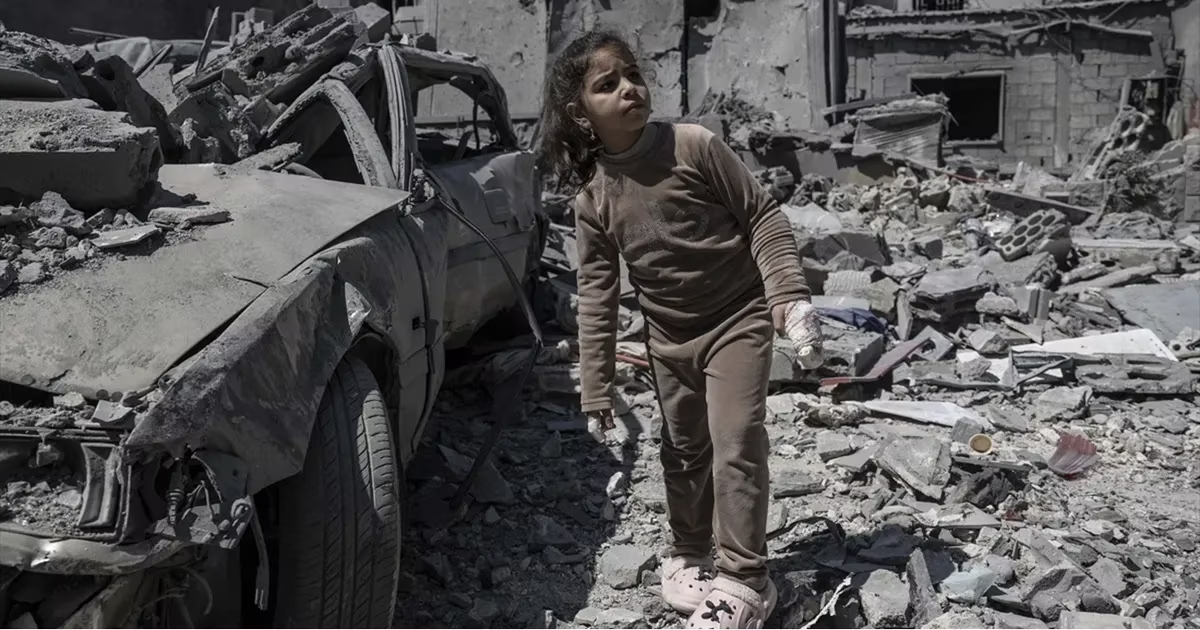
The primary criterion for assessing the justice of the Palestinian cause among Arabs has always been linked to the extent of official policies' ability to directly confront Zionist aggression. With the ongoing crimes of genocide and ethnic cleansing policies, these criteria seem to have lost their effectiveness, as depriving Palestinians of any political gain has become an implicit goal for some regional and international powers.
The occupation authorities have succeeded in imposing the 'fatigue and disengagement' equation on the Arab periphery, using tools of military arrogance and political blackmail. This path has necessarily led to the acceptance of what is called 'peace of power,' which has left the Arab street in a state of forced habituation to news of destruction without a real ability to effect change.
The recent escalatory steps, such as the cancellation by the occupation's Finance Minister Bezalel Smotrich of the 1997 Hebron Agreement, confirm the premeditated intentions for complete control. Control over the Ibrahimi Mosque and the establishment of new settlement plans reflect an Israeli desire to erase any trace of previously signed agreements, amidst suspicious international silence.
The matter did not stop at the Hebron Agreement but extended to movements within the Knesset to completely cancel the 1993 Oslo Accords. This trend proves that the path of Israeli aggression on the ground has surpassed all political understandings, exploiting the global failure to prevent ongoing war crimes in the Gaza Strip and the West Bank.
Annexation and settlement plans are accompanied by fascist statements from occupation leaders, with National Security Minister Ben Gvir openly calling for the burning of Lebanon. This aggressive nature is no longer just a verbal threat but is translated daily through policies of total displacement of populations in Jerusalem and the West Bank, and the demolition of properties in Gaza.
In contrast, some Western capitals merely express 'timid displeasure' at the settlers' behavior, while continuing to supply the occupation with weapons. The United States adopts the narrative of 'self-defense' as a cover for crimes, despite knowing that American shells are claiming the lives of civilians in Gaza and Lebanon.
Israel's policy of escaping forward through expansion and aggression has completely undermined the pillars of stability in the region. If the fate of the Palestinian Authority is self-fettering within the Ramallah compound, then questions increase about the utility of political initiatives that are celebrated while settlement devours the land.
Official Arab positions have not yet crystallized into a formula of real pressure or an effective lever to support Palestinian steadfastness. Instead, the Arab League appears in a marginal role that is inconsistent with the fateful moments the region is experiencing, deepening the gap between peoples and their regimes.
This Arab retreat cannot be linked solely to other regional tensions or conflicts with neighboring powers; rather, it is the result of clear political choices. International understandings on certain issues have not positively impacted the cessation of Israeli aggression or the prevention of expansion in Syria, Lebanon, and the West Bank.
There is a state of imbalance in assessing responsibilities, where excuses are sought for the occupation to justify silence on its continuous crimes. Even in cases where the crime cannot be justified, traditional condemnations and denunciations appear, which have never succeeded in protecting Arab self-interest or deterring the aggressor.
Abandoning the weapon of economic and political boycott has granted the perpetrator continuous impunity and encouraged further encroachment. Instead of besieging the occupation, we find that Arab sovereignty is eroding, while the enemy continues to impose its agenda by force and fire.
It is a painful irony that the Arab role often boils down to that of an 'intelligence mediator' seeking to prevent embarrassment for regimes. This role reduces the issue to narrow security dimensions, ignoring the historical and political rights of the Palestinian people who face an unrelenting killing machine.
Solidarity with Palestine in some Arab circles has become classified as an act detrimental to national security, a dangerous shift in political consciousness. While some elites view the occupation as a potential ally, institutions and unions attempting to raise their voice in protest against Israeli crimes are being suppressed.
Ultimately, Arabs find themselves falling into the same trap set by Washington and Tel Aviv decades ago. Each time they try to escape by making new concessions, they find themselves bound by tighter restrictions, while Israel continues to write a new reality with blood and destruction at the expense of Arab rights.
Israel discusses with Arabs and Palestinians with blood and fire, while Arabs discuss with Palestinians with the sword of austerity and abandonment, and crawl towards normalization with the occupation.
שתף את דעתך
The Israeli Trap: How Has the Arab Stance Eroded in the Face of Annexation and Extermination Policies?