






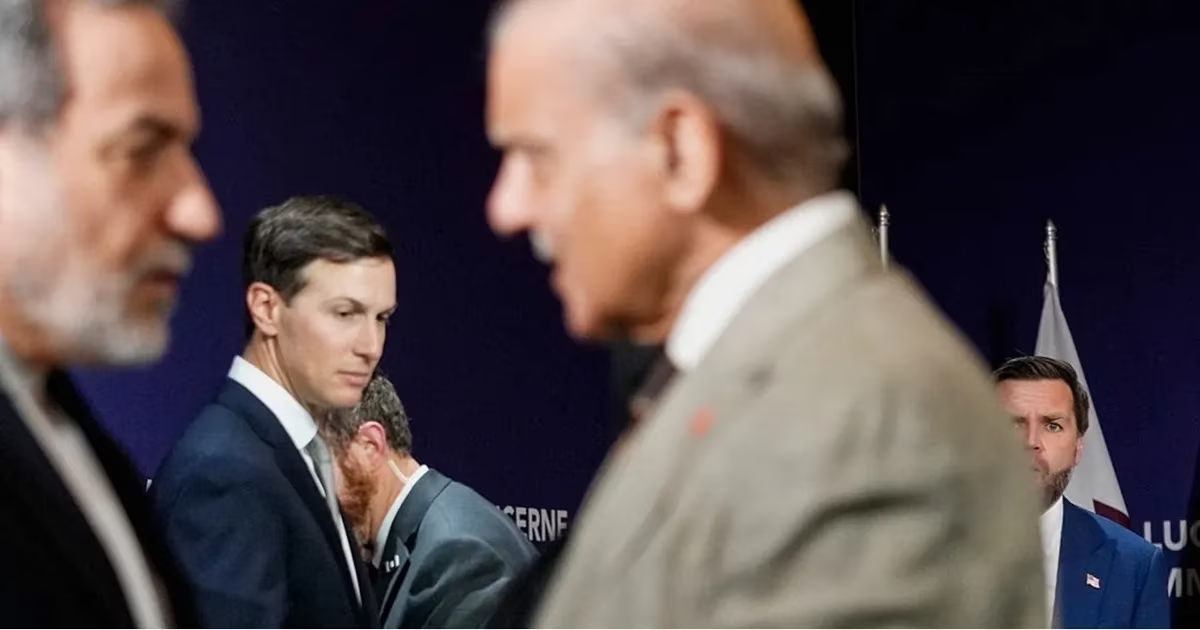
The media committee of the Iranian negotiating delegation, known as 'Minab 168,' revealed details of the first round of talks with the United States at the 'Bürgenstock' resort in Switzerland. Official sources confirmed that the negotiations resulted in an agreement on five strategic points aimed at de-escalating regional tensions and addressing outstanding issues between the two parties.
At the forefront of the understandings, a new security equation for the Lebanese arena was agreed upon, with the Iranian delegation pushing for the consolidation of the fragile ceasefire. Consequently, it was decided to establish an international monitoring mechanism called the 'Conflict Control Unit' with direct participation from Tehran, which is considered official recognition of its role in Lebanese security arrangements, with the complete exclusion of any role for the Israeli occupation in this system.
Regarding international navigation, the agreement approved measures to ensure sovereignty over the Strait of Hormuz and its gradual reopening to trade traffic. This mechanism includes establishing a 'direct communication line' to inform the Iranian side of any executive obstacles, which Tehran considered a confirmation of its legal and security authority over this vital waterway.
Tehran linked the activation of joint working groups for the nuclear file and sanctions to the actual implementation of what is known as 'Article 13.' This article stipulates a comprehensive ceasefire on all fronts, especially in Lebanon, in addition to ending the naval blockade and releasing frozen Iranian financial assets abroad before moving on to the final phase of negotiations.
On the financial front, the Swiss round witnessed the signing of a bilateral memorandum of understanding between Iran and Qatar to establish executive mechanisms for releasing frozen funds. This step aims to facilitate the flow of liquidity to the Iranian Central Bank within an agreed-upon timeframe to ensure compliance with the terms of economic de-escalation.
In a remarkable development, the Office of Foreign Assets Control (OFAC) of the US Treasury Department issued official documents lifting sanctions on the Iranian oil and petrochemical sector for 60 days. This temporary measure allows Tehran to export its oil production and receive financial revenues through official banking channels, representing a gesture of goodwill from the American side towards the progress of negotiations.
Tehran emphasizes that these understandings represent an integrated package that cannot be disaggregated, as it refuses to delve into any technical details before seeing tangible results on the ground related to lifting economic restrictions. International parties are monitoring the sustainability of these agreements amidst ongoing field complexities in the region and mutual political pressures.
The establishment of the Conflict Control Unit with Tehran's participation means Iran's official entry into Lebanese security equations, which thwarts attempts to exclude it.
שתף את דעתך
Iran reveals five-point understandings with Washington, including Lebanon's security and lifting oil sanctions