






Washington Message
Washington - Said Arikat - 20/6/2026
Amidst the accelerating field and diplomatic developments on the Middle East front, informed sources revealed to "Zaytou" website on Saturday a state of intense anger experienced by US President Donald Trump behind the scenes of the White House, due to what he considers deliberate Israeli attempts to drag him back into the quagmire of his war on Iran. According to the report, Trump, who has become desperate to exit a war his advisors describe as "catastrophic and unpopular," appears ready to grant Tehran a stunning diplomatic victory as the price for ending US military involvement.
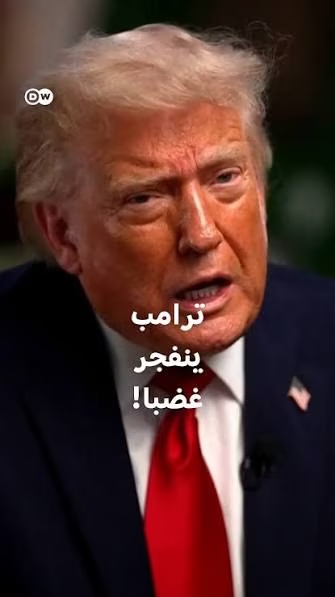
Details conveyed by four individuals with direct knowledge of the President's mood show that Trump is leveling sharp accusations against the Israeli government and its Prime Minister, Benjamin Netanyahu, accusing them of trying to thwart his endeavor to withdraw from "a war they chose together." The source of presidential anger, according to these accounts, is focused on Israel's continued launching of deadly raids on Lebanon, despite the existence of a fragile US-Iranian memorandum of understanding (MOU) calling for a ceasefire there. Trump believes that Tel Aviv is deliberately undermining this understanding to push Washington back into a comprehensive confrontation with Iran, a scenario the US President categorically rejects at this stage.
A close advisor to Trump quoted the President as saying, charged with anger: "He curses a lot about this." An administration official was more explicit when he told "Zaytou": "At least for now, the President is angrier at the Israelis than he is at the Iranians." This presidential mood is no longer just a fleeting annoyance; it has, according to the same sources, transformed into a firm conviction that Israel is seeking to "deceive" him in order to reignite a regional war that Trump considers an existential threat to his political legacy and future ambitions.
"Zaytou" sources indicate that the continuous pressure from Israeli leaders on the Americans to abandon the MOU with Iran, along with the continuation of military operations in Lebanon, has led to a completely opposite result than what Tel Aviv had hoped for. Instead of pushing Trump towards adopting a tougher stance, these practices have made him more determined to move in the opposite direction, drawing closer to the option of a settlement with Tehran and ending the war. The scene reveals one of the deepest undeclared crises in the history of the US-Israeli alliance, where narrow national interests intersect with the personal calculations of a president who places "big deals" above all else.
Trump's state of anger towards Israeli behavior reveals a fundamental shift in the concept of the "strategic alliance" that previous US administrations have always revered. The current President, immersed in the "America First" doctrine, views the Iranian war as an electoral and political burden that threatens his image as a peacemaker. Analytically, this position reflects a transactional understanding of international relations; as long as Israel obstructs the MOU and provokes Tehran, in Trump's view, it transforms from an ally into an adversary that hinders the implementation of his vision based on a rapid withdrawal from the quagmires of the Middle East, even if it costs the undermining of Washington's regional influence.
There is another equally important dimension, related to Israel's own calculations, which seem to be betting on Trump overcoming his objections under pressure from lobbies and the security establishment. But this bet carries a major risk, as the man who did not hesitate to dismiss defense ministers and advisors for personal reasons may take confusing diplomatic retaliatory steps against Tel Aviv. From an analytical perspective, the continuation of raids on Lebanon despite the US-Iranian understanding places Israel in the position of openly challenging presidential will, which opens the door to the possibility of Washington reducing its military involvement in the Eastern Mediterranean, leaving Israel to face alone the repercussions of any potential regional explosion.
As for the MOU, the story highlights the fragility of agreements sponsored by conflicting interests. Iran sees in the moment of American hesitation an opportunity to extract strategic gains without a long-term war, while Trump transforms into a pragmatic player who wants a "deal" that withdraws his troops and returns him to the American public as a victor. The profound comment here is that Trump's shift away from the Israeli position is not a fleeting tactic, but the beginning of redrawing the map of alliances in the region, where Washington is looking for quick exits, and may find in coordination with Tehran, not with Netanyahu, a forced passage, casting thick shadows on the future of stability in Lebanon, Iraq, and Syria.
שתף את דעתך
Trump Rages in Private Meetings at Israel for Trying to Drag Him Back into His War with Iran