






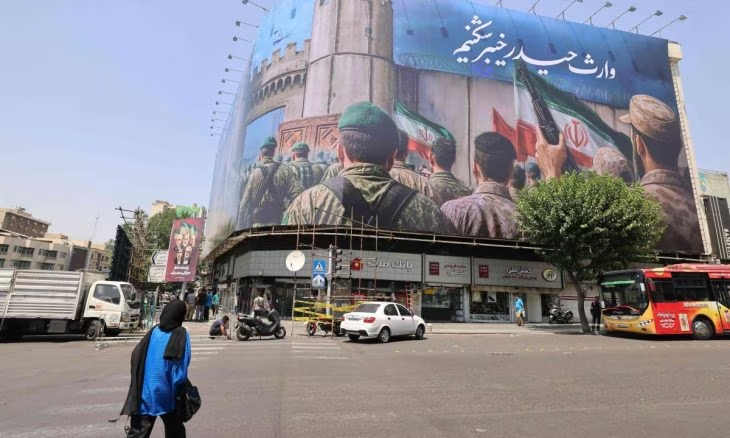
US-Iranian understandings entered a phase of ambiguity following the announcement of the postponement of talks that were scheduled to be held at the Bürgenstock mountain resort in Switzerland. Diplomatic sources confirmed that communications are still ongoing between the two parties to arrange a new date in the coming days, with the aim of completing the implementation of the memorandum of understanding aimed at ending the state of war in the region.
For its part, the Swiss Ministry of Foreign Affairs announced the cancellation of the scheduled meeting, while Tehran preferred to describe it as a postponement, noting that the previous electronic signing of the memorandum made a direct meeting unnecessary at the present moment. The spokesperson for the Iranian Foreign Ministry, Ismail Baqaei, explained that the transition to the final agreement stage depends on actual adherence to the agreed-upon terms.
In Washington, the White House decided to postpone the visit of US Vice President J.D. Vance to Switzerland, where he was supposed to oversee the mechanisms for implementing the agreement. The US administration affirmed that the negotiating delegation remains on standby to depart as soon as political and field conditions improve, allowing for the resumption of direct dialogue.
International media reports, citing informed sources, revealed that the Iranian side set a new condition for resuming negotiations, which is to obtain real guarantees for stopping Israeli attacks on Lebanese territory. It seems that Tehran seeks to link progress in the diplomatic track to the extent of commitment to a comprehensive ceasefire stipulated in the initial understandings.
On the ground, the negotiation atmosphere did not prevent a bloody military escalation in southern Lebanon, where recent Israeli raids resulted in the martyrdom of 28 people and the injury of dozens. In return, the Israeli army admitted the killing of four of its soldiers, including an officer, in confrontations described as the fiercest since the announcement of the memorandum of understanding between the major powers.
This escalation raised serious questions about the resilience of the memorandum of understanding that ended a widespread war that erupted last February and involved multiple parties. The Switzerland meeting was supposed to be the cornerstone for transitioning from a phase of cessation of hostilities to a phase of drafting a final and comprehensive peace agreement that ensures regional stability.
On the internal political front in Iran, Supreme Leader Mojtaba Khamenei expressed conditional approval of the agreement, emphasizing that sitting with the American side does not mean compromising national principles. Iranian officials stressed that any retreat by Washington from its commitments would be met with a decisive response, especially regarding the lifting of oil sanctions.
In a related context, signs of economic relief began to appear with the resumption of navigation in the strategic Strait of Hormuz after a long period of suspension due to military operations. Iranian authorities announced the formation of a new body to oversee the passage of ships, with temporary fee exemptions granted as a gesture of goodwill under the recent understandings.
US Vice President J.D. Vance defended the diplomatic path, noting that the US military allowed the passage of commercial vessels to ensure the stability of global energy markets. This news positively impacted oil prices, which began to decline to approach their normal levels before the outbreak of the military crisis.
However, the agreement still faces fierce opposition within political circles in Israel and the United States, where critics see it as offering huge economic concessions to Tehran. The memorandum includes an ambitious plan to rebuild the Iranian economy worth up to $300 billion, which some see as an undeserved reward for the Iranian regime.
Israeli Prime Minister Benjamin Netanyahu, for his part, affirmed that the conflict is not over yet, despite his keenness not to directly clash with the Trump administration at the moment. In contrast, the Israeli Minister of National Security issued harsh statements calling for an escalation of military operations in Lebanon, putting additional pressure on international mediators.
France and other international powers are seeking to pressure all parties to respect the terms of the agreement and prevent its imminent collapse due to field violations. Observers believe that the next few days will be crucial in determining the fate of the Middle East, either a return to the negotiating table or a slide back towards a comprehensive confrontation.
Iranian President Masoud Pezeshkian described the agreement as a historic moment for his country, considering that the lifting of frozen sanctions would represent a victory for Iranian diplomacy. Tehran hopes that the implementation of the memorandum will lead to the immediate release of its financial assets abroad, which will help alleviate the suffocating economic crisis it is experiencing.
In conclusion, anticipation remains the master of the situation in the concerned capitals, awaiting the outcome of the mediators' efforts to address Iranian demands regarding Lebanon. The gap between the language of diplomacy in Switzerland and the reality on the ground in southern Lebanon continues to widen, putting the credibility of the US-Iranian understanding to the real test.
Negotiations for the final agreement will depend on the commencement of specific provisions of the memorandum and continued adherence to them.
שתף את דעתך
Sudden Setback in US-Iranian Understanding: Switzerland Talks Postponed and Field Escalation in Lebanon