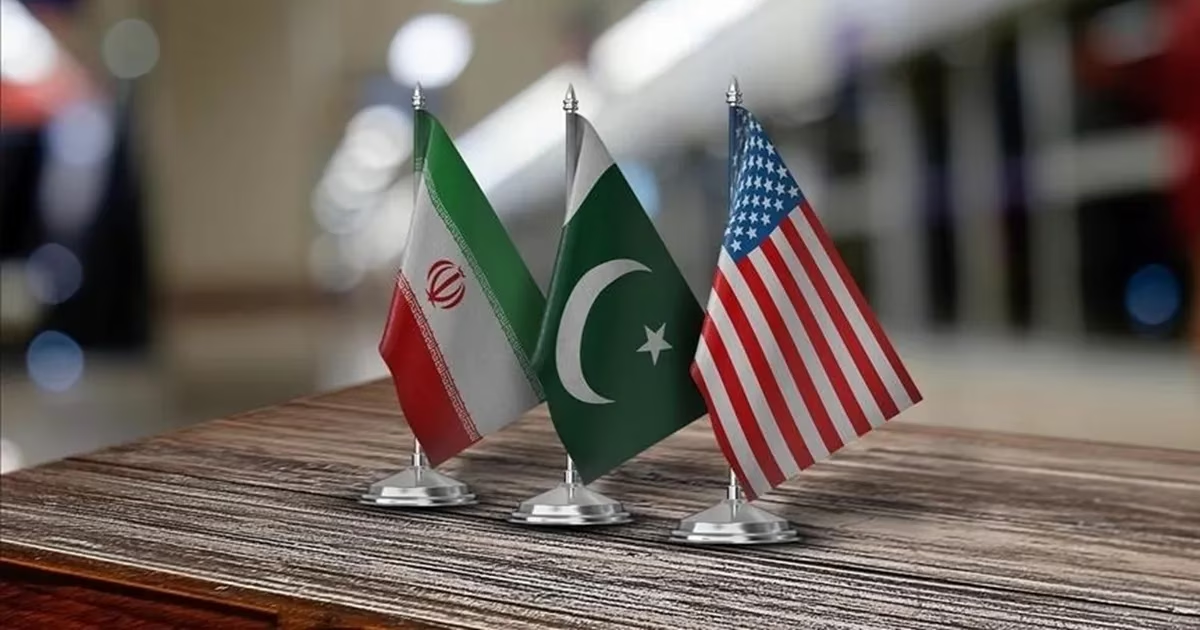







The Middle East is witnessing major geopolitical transformations indicating the decline of the era of unipolar American hegemony, which experts attribute to internal exhaustion and the structural collapse of a political structure founded on coercion rather than popular consent. Observers believe that Washington did not achieve true hegemony, but rather maintained control lacking popular legitimacy, which made it primarily rely on authoritarian regimes to secure its interests.
The regional order that formed after the 1991 Gulf War and the Madrid Conference began to systematically unravel, after the falsity of its foundations was proven. That system was based on absolute military superiority and the claim of a peace process, while the reality was the engineering of a security protectorate that ensured the flow of energy and marginalized legitimate Palestinian rights.
The peace process worked for decades as a diplomatic umbrella that granted the United States legitimacy for its military presence, while enabling Israel to consolidate its occupation of Palestinian territories. Over time, it became clear that overwhelming military force cannot be a substitute for a just political horizon, making the collapse of this system a historical inevitability.
The Abraham Accords in 2020 represented the last attempt to repair this crumbling structure by building a security alliance that explicitly bypassed the Palestinian issue. However, this gamble proved to be a failure because it ignored demographic and historical realities, making the resulting system fragile and vulnerable to violent shocks that were not long in appearing.
Data from the Arab Opinion Index consistently indicates that Arab peoples view American and Israeli policies as the greatest existential threat to their national security. This stark contradiction between the aspirations of the peoples and Washington's strategic necessities pushed the latter to support dictatorships and suppress any democratic transformation that might threaten its vital interests in the region.
The events in Gaza in 2023 are the final catalyst that exposed the moral bankruptcy of the US-led international system, as Washington transformed from a mediator to a direct partner in violence. The unlimited military and diplomatic support for military operations shattered the mental image of Western leadership and ended what remained of its soft power in the region.
In the context of hypothetical military confrontations in 2026, it became clear that the American security umbrella is no longer able to protect its allies from asymmetric attacks. Strikes targeting vital energy facilities in the Gulf undermined the region's image as a safe haven for global capital and revealed the inability of advanced defense systems against cheap technologies.
Regional powers have realized that absolute reliance on Washington is no longer sufficient to ensure survival in an explosive and unstable security environment. This realization has prompted countries like Saudi Arabia and the UAE to seek alternative strategic options, invest in local defense industries, and build diverse partnerships with emerging international powers.
Today, features of a new security system characterized by 'differentiated hegemony' are emerging, where Washington retains military deterrence but loses political monopoly and the ability to reassure. In this vacuum, major regional powers such as Turkey, Egypt, and Pakistan seek to coordinate their positions to manage crises from within the region, away from external dictates.
The escalating Pakistani role as a security guarantor and diplomatic mediator embodies the ongoing restructuring of the balance of power, where geopolitics intertwines to include new actors. Moreover, the Gulf states' shift towards multiple alliances reflects a genuine desire to transform from a consumer of security to a producer of it, serving their national interests first.
On the international level, China and Russia are exploiting American strategic mistakes to strengthen their economic and political influence in the Middle East. Beijing, in particular, offers a model of partnership based on mutual interests without imposing burdensome political or security conditions, making it an attractive alternative for many countries in the region.
The 'BRICS' group and technological cooperation with Asian powers have become vital tools for Middle Eastern countries to hedge against American sanctions and demands. This shift towards the East is not just a change in trade, but a comprehensive strategic repositioning in a world where unipolarity is no longer the dominant force.
The dawn of the post-American era does not necessarily mean immediate stability, but rather an era characterized by turmoil and fierce competition among multiple poles. In this complex landscape, regional actors must constantly negotiate to secure their existence, relying on fluctuating power balances and flexible alliances that transcend old colonial legacies.
In conclusion, it can be said that the era of imperial dictates has ended in favor of an organic regional reality, even if it is forming amidst the pains of conflicts and wars. The new Middle East is redefining itself based on its self-capabilities and the multiplicity of its international options, away from the hegemony that lasted for decades under the crumbling American umbrella.
True hegemony requires ideological consensus and normative agreement, while Washington exercised its control through coercion and structural violence.
שתף את דעתך
The Labor Pains of the New Middle East: Has the Era of American Hegemony Ended?