






By: Said Arikat
June 19, 2026
News analysis
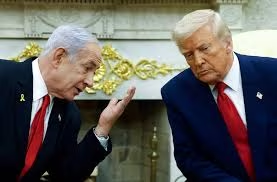
Washington, D.C- Israeli Prime Minister Benjamin Netanyahu finds himself trapped by the consequences of a war he spent years promoting and ultimately helped bring about. The campaign against Iran, which he championed relentlessly and reportedly persuaded President Donald Trump to join, has failed to produce the strategic transformation he promised. Instead of weakening Iran into submission, the war exposed the limits of military force, heightened fears of regional instability, and accelerated the very outcome Netanyahu has spent decades trying to prevent: direct diplomacy between Washington and Tehran.
For Netanyahu, this is more than a policy setback. It is a profound political and strategic defeat.
Few leaders have invested more personal capital in portraying Iran as an existential threat requiring perpetual confrontation. For years, Netanyahu warned that diplomacy was naïve, compromise was dangerous, and military pressure was the only language Tehran understood. Successive Israeli governments under his leadership worked tirelessly to shape American policy around that premise. Whether through public speeches, private lobbying, or direct intervention in American political debates, Netanyahu consistently sought to steer Washington toward a harder line against Iran.
The result was a strategy built on a simple assumption: that sufficient military pressure would either force Tehran to capitulate or create conditions for internal upheaval. Yet the war delivered neither outcome. Iran suffered significant damage but remained intact. Its government survived. Its institutions endured. Rather than producing a decisive victory, the conflict generated uncertainty, economic disruption, and growing concern about the risk of a wider regional war.
As the costs mounted, Washington began confronting a reality that Netanyahu had long sought to avoid. There was no clear military endgame. The prospect of an open-ended conflict stretching across the Middle East offered little strategic benefit to the United States and considerable political risk. Faced with that reality, the Trump administration increasingly gravitated toward diplomacy as the only viable path to de-escalation.
That shift has left Netanyahu politically stranded.
The irony is difficult to miss. The Israeli leader who devoted much of his career to preventing an American-Iranian accommodation may ultimately be remembered as the man whose failed war made such an accommodation unavoidable. Far from discrediting diplomacy, the conflict strengthened the argument for it. The longer the fighting continued, the clearer it became that military force could not deliver the sweeping political objectives promised by its advocates.
More troubling for Netanyahu is the growing perception that he played a decisive role in drawing the United States into a conflict that served Israeli political interests more than American national interests. Critics increasingly argue that Washington was encouraged to enter a dangerous regional quagmire without a clearly defined objective beyond escalation itself. The expectation that military pressure would somehow produce a fundamentally different Middle East proved as unrealistic as it was costly.
This perception matters because the political environment in the United States has changed dramatically.
For decades, support for Israel was among the least controversial positions in American politics. Today, however, public opinion is increasingly against Israel. Younger Americans, independents, and even portions of the traditional pro-Israel constituency have become more critical of Israeli policies. The images emerging from Gaza, the expansion of settlements, the continued occupation of Palestinian territories, and allegations of apartheid-like practices have reshaped public perceptions. Criticism once confined to the margins has entered the political mainstream.
Netanyahu himself has become a central symbol of that shift.
To many Americans, he no longer appears as a statesman safeguarding Israeli security. Instead, he is increasingly viewed as a politician who has repeatedly chosen escalation over diplomacy, conflict over compromise, and political survival over regional stability. The perception that he encouraged the United States to become involved in another costly Middle Eastern war has only deepened that skepticism.
Indeed, a growing number of Americans regard Netanyahu not as a trusted ally but as an ungrateful and manipulative partner—one willing to leverage American power in pursuit of objectives that many believe neither advance American interests nor contribute to regional peace.
Yet even as his standing erodes abroad, Netanyahu faces mounting pressure at home.
The emerging American-Iranian agreement threatens the ideological foundations of the coalition that has sustained him politically. Many of his most ardent supporters reject not merely this agreement but virtually any agreement that limits Israel’s freedom of action. Their vision of regional order rests on permanent military superiority, indefinite occupation, and the belief that force rather than diplomacy should determine political outcomes.
For these factions, any accommodation with Iran is unacceptable. More broadly, they oppose diplomatic arrangements that might constrain Israeli power, whether related to Iran, the Palestinians, or regional security. Their preferred outcome is not coexistence but uncontested dominance.
This places Netanyahu in an increasingly impossible position.
On one side stands Trump, who appears eager to transform a costly and inconclusive conflict into a diplomatic achievement. On the other stands a political base that regards compromise as surrender. Netanyahu cannot afford to alienate either.
Unlike his famous confrontation with former President Barack Obama over the 2015 nuclear agreement, however, Netanyahu’s room for maneuver is severely limited. When Obama pursued diplomacy, Netanyahu openly challenged him, lobbied Congress against him, and effectively inserted himself into American domestic politics. He calculated, correctly, that he could defy a Democratic administration without suffering lasting consequences.
Trump presents a different challenge altogether.
Netanyahu understands that openly undermining a Trump-backed agreement could provoke a backlash from the very political forces upon which Israel has increasingly relied. Whatever influence he once wielded in Washington, he cannot casually challenge Trump in the way he challenged Obama. The political risks are simply too great.
Consequently, Netanyahu finds himself trapped between the failure of the war he promoted and the diplomacy he cannot embrace.
The deeper problem is that the regional landscape is changing in ways that undermine the foundations of his strategy. The assumption that military escalation would produce political transformation has been discredited. Regional actors increasingly favor stability over confrontation. Washington appears more interested in preventing another endless war than in sustaining one. Even among Israel’s closest partners, enthusiasm for permanent conflict is fading.
For Netanyahu, these developments are not merely unwelcome; they are existentially threatening to the political narrative that has defined his career. For decades, he positioned himself as the indispensable guardian against Iranian power and the principal advocate of confrontation. Now diplomacy is advancing precisely because confrontation failed.
That is the essence of his predicament. The war he encouraged did not achieve its objectives. The quagmire he helped create is one Washington increasingly wishes to escape. And the diplomatic process emerging from its ruins threatens to expose the central flaw in Netanyahu’s long-standing strategy: the belief that military force could indefinitely substitute for political solutions.
If the American-Iranian agreement succeeds, it will represent more than a diplomatic breakthrough. It will stand as a verdict on the failure of the politics of perpetual escalation. And no leader will find that verdict more difficult to accept than Benjamin Netanyahu.
שתף את דעתך
The Architect of Failure: Netanyahu’s War, Trump’s Diplomacy, and Israel’s Strategic Isolation