






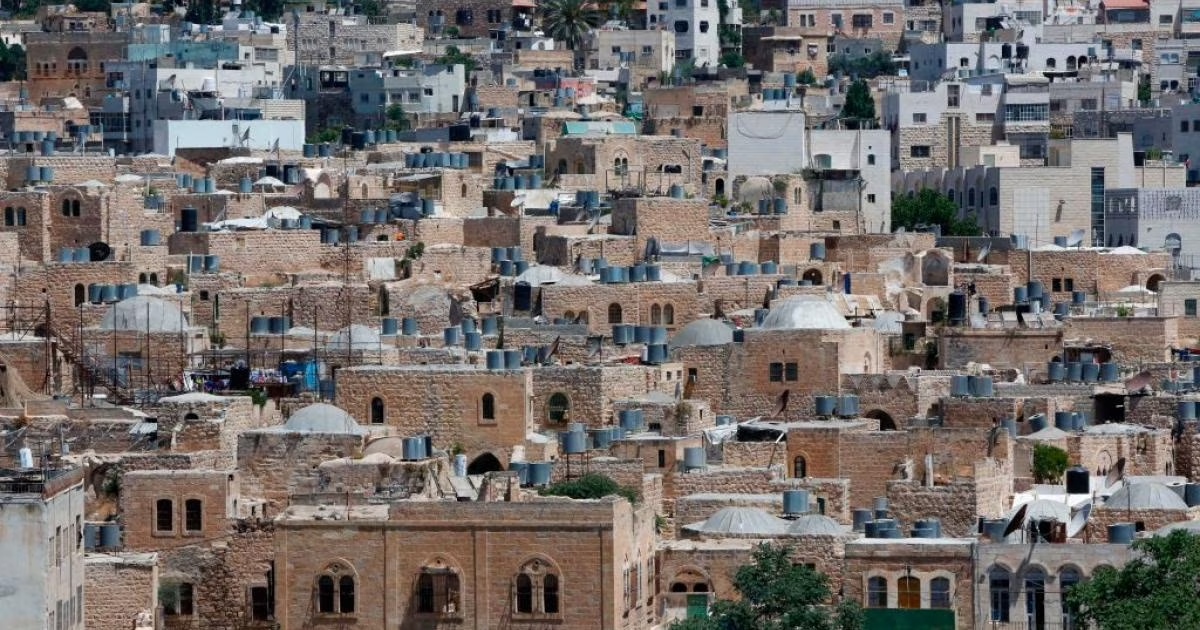
The 'Hebron Protocol', signed in 1997, has once again returned to the forefront of political events, following unilateral Israeli decisions aimed at undermining Palestinian civil powers in the city. This agreement is the legal framework that regulated the reality of Hebron after the Oslo Accords, defining the distribution of security and civil tasks between the Palestinian and Israeli sides.
Israeli Finance Minister Bezalel Smotrich announced the initiation of actual procedures to withdraw planning and construction powers from the Hebron municipality in large parts of the city in the southern West Bank. This step directly targets areas under Israeli security control, including the Old City and the vicinity of the Ibrahimi Mosque.
Under the new decision, full responsibility for urban planning files will be transferred to the Israeli authorities, which effectively cancels the administrative link of the Hebron municipality to these areas. Media sources reported that this measure practically ends the role of Palestinian institutions in overseeing urban expansion or restoring historical buildings in the heart of the city.
The danger of this shift lies in the fact that the Hebron Protocol remained for nearly three decades the sole guarantor of the city's administrative unity despite its security division. The agreement explicitly stipulated that security arrangements do not mean a permanent division of the city, while preserving the municipality's role in providing services to all residents without exception.
The 'Hebron Protocol' dates back to January 17, 1997, and came as a completion of the Oslo Accords and a result of escalating tensions following the Ibrahimi Mosque massacre in 1994. The agreement divided the city into two famous areas, H1 and H2, to define the scope of influence of each party during that transitional phase.
Area H1, which represents about 80% of Hebron's area, is under full Palestinian control in civil and security aspects, and is inhabited by the vast majority of the population. As for Area H2, it remained under Israeli security control, with Palestinians granted broad civil powers to manage their daily affairs.
Area H2 includes the most prominent historical and religious landmarks, most notably the Ibrahimi Mosque and the Old City, in addition to settlement outposts inhabited by hundreds of settlers. Occupation forces in this area impose strict restrictions on the movement of Palestinians, and frequently close the Ibrahimi Mosque during Jewish holidays.
Despite the Israeli military dominance in the area classified as H2, the Protocol guaranteed the Hebron municipality the exercise of its duties in the fields of infrastructure, transportation, and electricity. Municipal inspectors carried out their work in monitoring construction and planning in coordination with the relevant authorities, which the latest decision seeks to completely cancel.
For his part, Hebron Mayor Yousef Al-Jabari affirmed his categorical rejection of these measures, considering them a blatant violation of international agreements. Al-Jabari indicated that this step aims to strengthen settlement in the heart of the city and marginalize the official Palestinian presence in historical areas.
The Hebron municipality appealed to the American administration and the international community to intervene immediately to stop this Israeli encroachment on civil powers. Palestinian officials stressed that Washington, as a primary sponsor of the 1997 Protocol, bears political and moral responsibility for preserving the status quo.
In an attempt to absorb international anger, the Israeli Ministry of Foreign Affairs tried to downplay the decision, claiming that it does not represent a formal cancellation of the agreement. Israeli sources claimed that the measures relate to specific powers, but the reality on the ground indicates a trend towards full administrative annexation of the area.
These developments come a few months after the occupation authorities granted legal legitimacy to a settlement committee to manage the affairs of the Old City in Hebron. This trend reflects the desire of the Israeli far-right to end any appearance of Palestinian sovereignty or administration in areas that include settlement outposts.
Hebron is considered an exceptional case in the West Bank, as it is the only city where settlers are present in the heart of crowded Arab neighborhoods. This overlap made the 'Hebron Protocol' a very sensitive document, as any infringement on it could lead to an explosion of the situation on the ground in the southern West Bank.
Observers warn that the withdrawal of planning powers will pave the way for an unprecedented wave of settlement within the Old City, where building permits will be granted to settlers easily. In contrast, Palestinians will face great difficulties in obtaining permits to renovate their homes or build new facilities, which threatens their forced displacement.
Withdrawing planning and construction powers from the municipality constitutes an infringement on agreements signed under international sponsorship and supervision, and with the participation of the American administration.
שתף את דעתך
Israel undermines 'Hebron Protocol': Withdraws planning and construction powers from Palestinian municipality