






By Said Arikat
June 17, 2026
News analysis
Washington, D.C-If current diplomatic efforts succeed, the United States and Iran could sign a new agreement in Geneva on June 19, marking the most significant development in bilateral relations since the collapse of the 2015 nuclear accord. While many details remain unconfirmed, enough has emerged to reveal something more important than the agreement itself: how Washington, particularly the Trump administration, now defines strategic success in the Middle East.
For months, the United States and Iran appeared to be moving toward a dangerous confrontation. Military exchanges, economic pressure, and regional instability created fears that a miscalculation could trigger a wider conflict. Yet both governments ultimately reached the same conclusion: the costs of escalation had become greater than its potential benefits.
The emerging agreement reflects that reality. For Washington, the goal is not reconciliation with Tehran but the creation of a framework that reduces the risk of war while placing verifiable limits on Iran’s nuclear activities. For Iran, the incentive is equally obvious: relief from economic pressure and greater access to international markets and financial resources.
Reports suggest the agreement will focus on restrictions on Iran’s nuclear program, enhanced monitoring by the International Atomic Energy Agency, and mechanisms for verifying compliance. In return, the United States would gradually ease selected sanctions and permit greater economic engagement. Diplomatic leaks also point to procedures designed to prevent the deal from collapsing at the first disagreement.
This is unlikely to be a simple revival of the 2015 agreement. Iran’s nuclear capabilities have advanced, regional dynamics have changed, and American strategic priorities have shifted. Negotiators appear to be constructing a new framework tailored to current realities rather than attempting to recreate the past.
The domestic debate in Washington is already taking shape. Supporters include former diplomats, arms-control experts, and lawmakers who argue that diplomacy remains the most practical means of managing the Iranian challenge. Figures such as Bernie Sanders, Chris Murphy, John Kerry, and former Iran envoy Robert Malley have long maintained that military pressure alone cannot resolve the nuclear issue.
Their argument is rooted in experience. Years of sanctions, threats, and covert operations failed to stop Iran’s nuclear progress entirely. If the objective is transparency and limitation rather than fantasy solutions, inspections and enforceable restrictions offer more security than the absence of any agreement. Supporters also argue that the alternative to diplomacy is not Iranian surrender but a heightened risk of another costly Middle Eastern war.
Opposition remains strong. Republican hawks, neoconservative policy advocates, and many analysts aligned with Israeli security concerns argue that sanctions relief would strengthen Tehran economically and politically. Senators Tom Cotton, Ted Cruz, and Lindsey Graham, along with former officials Mike Pompeo and John Bolton, have consistently argued that pressure should continue until Iran accepts far more extensive concessions.
For critics, the agreement’s central flaw is that it seeks to manage Iran’s nuclear capabilities rather than eliminate them altogether. They fear Tehran will secure economic benefits while retaining significant strategic leverage. These concerns are certain to fuel an aggressive campaign against the deal in Congress and across the American political landscape.
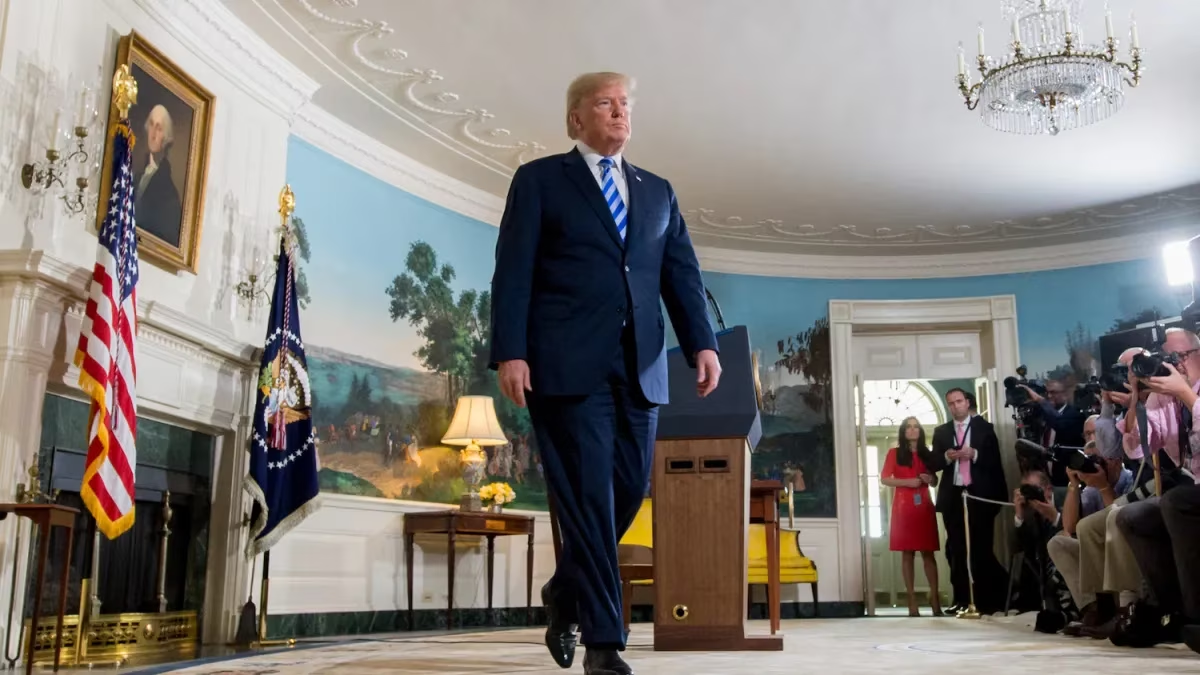
Yet the most revealing aspect of the agreement is what it says about President Donald Trump’s understanding of victory. Traditional foreign-policy thinking often associates victory with military triumph, regime change, or decisive strategic dominance. Trump’s approach has generally been more transactional. Success is measured not by ideology but by outcomes.
Viewed through that lens, the White House can portray the agreement as evidence that economic sanctions, diplomatic isolation, and military deterrence achieved their objective. Iran returned to negotiations, administration officials can argue, because sustained pressure altered its calculations. Whether critics accept that interpretation is another matter, but it is almost certainly how the administration intends to frame the agreement.
Equally important is how the administration defines defeat. For Trump and many of his advisers, failure does not necessarily mean falling short of maximalist goals. Rather, it means becoming trapped in a prolonged military conflict with uncertain objectives and mounting costs. A large-scale confrontation with Iran would threaten energy markets, strain American resources, weaken public support, and distract Washington from broader strategic priorities.
This calculation helps explain why an agreement has become possible. Neither side has fundamentally changed its worldview. Tehran remains deeply suspicious of American intentions, while Washington continues to view Iran as a strategic competitor. What has changed are the costs of maintaining the status quo. Iran faces continuing economic pressure, while the United States increasingly recognizes the limits of military power in resolving the nuclear issue.
Regional and European actors have also contributed to this shift. Many governments fear that another major conflict in the Gulf would disrupt energy supplies, destabilize markets, and deepen global uncertainty. Their diplomatic efforts have reinforced incentives for compromise and helped create conditions more favorable to negotiations.
The agreement also places Washington in a delicate position regarding Israeli Prime Minister Benjamin Netanyahu. If the administration proceeds, it will likely seek to discourage actions that could undermine the deal. The United States possesses significant leverage through military assistance, intelligence cooperation, and diplomatic support. Yet that leverage is not unlimited, given Israel’s substantial political influence within Congress.
The challenge for the White House will be to reassure Israel’s security establishment while discouraging unilateral actions that could derail diplomacy. The personal and political relationship between Trump and Netanyahu may play an important role in determining how effectively these tensions are managed.
The real test, however, begins after the signatures are placed on paper. History shows that negotiating agreements is often easier than implementing them. Decades of mutual distrust, domestic opposition in both countries, and resistance from regional actors will ensure that every provision is scrutinized and contested.
That is why the significance of the accord extends beyond the nuclear file itself. If it survives inevitable crises and political pressure, it could reduce regional tensions, stabilize energy markets, and allow Washington to focus more effectively on long-term competition with China and Russia. If it collapses, it will strengthen hardliners on all sides and reinforce the argument that diplomacy cannot resolve major international disputes.
For Washington, therefore, the agreement is not an act of trust. It is an exercise in strategic calculation. The administration appears to have concluded that avoiding a costly and unpredictable war is not a retreat from American power but one of its most effective expressions. In today’s Middle East, preventing a conflict may be the closest thing to victory that any administration can realistically achieve.
שתף את דעתך
The Emerging U.S.–Iran Agreement: Why Washington Sees Diplomacy as Victory