






Washington Message
Washington – Said Arikat – 6/16/2026
News Analysis
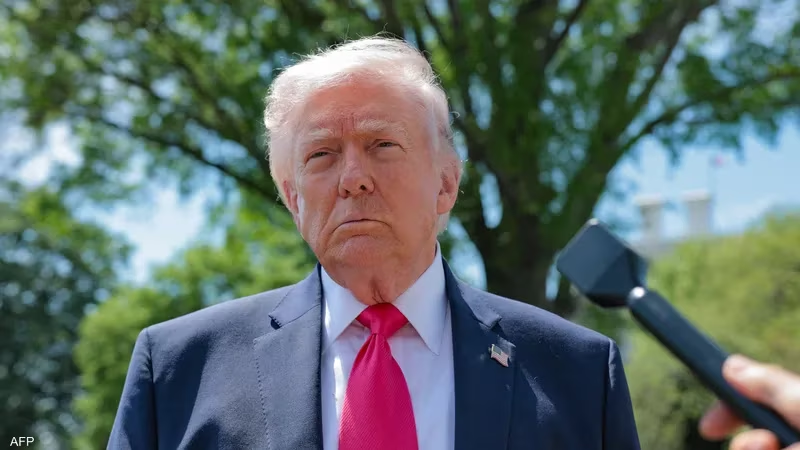
Forty-eight hours after US President Donald Trump announced a framework agreement with Iran to end the four-month confrontation, initial indications appear encouraging for supporters of the deal. So far, neither Washington nor Tehran has issued conflicting statements or taken field actions that would undermine the announced understandings, nor have public disagreements emerged over the basic terms that were agreed upon. In the world of diplomacy, where understandings often collapse in their early hours under the weight of political calculations or internal pressures, the passing of the first day without setbacks is an important indicator, though insufficient to judge the fate of the agreement.
This initial resilience gains double importance with the convening of the G7 summit, where the US-Iranian agreement has become one of the most prominent issues on the table for Western leaders. The understanding announced by Trump does not represent merely a ceasefire or a limited bilateral settlement; rather, it constitutes a test for the future of stability in the Middle East and for the American administration's ability to transform war outcomes into lasting political and diplomatic gains. It also places European allies before a new reality that differs greatly from the scenarios that were on the table weeks ago, when the region seemed closer to a widespread regional confrontation than to a negotiated settlement.
Under the memorandum of understanding announced by both parties, a roadmap has been established to end hostilities, gradually reopen the Strait of Hormuz to international navigation, and begin a sixty-day negotiation phase to address the most sensitive issues, foremost among them Iran's nuclear program, economic sanctions, and regional security arrangements. However, the importance of the agreement lies not only in its announced provisions but in the fact that it represents the first practical acknowledgment by both parties that the cost of continuing the war has become higher than the cost of returning to negotiations.
In this context, recent experience reveals once again that military force, no matter how intense, does not guarantee the achievement of stated political objectives. The war began under slogans related to stopping Iran's nuclear program and forcing Tehran to change its regional behavior, but it ended with both parties returning to the negotiating table. This outcome raises an old question about the limits of power in managing complex conflicts, where military confrontations often end in political settlements very similar to the proposals that were on the table before the outbreak of the conflict.
Despite the positive atmosphere surrounding the announcement, the agreement leaves the most complex issues open. Iran's nuclear program, which constituted the primary justification for the war according to the American narrative, has not yet been resolved; instead, it has been deferred to subsequent rounds of negotiations. Issues of uranium enrichment, ballistic missiles, Iran's relations with its regional allies, monitoring mechanisms, and the lifting of sanctions also remained outside the framework of a final solution.
It is likely that the coming weeks will witness more difficult negotiations than those that preceded the agreement's announcement. The deferred issues are not technical matters that can be easily settled; rather, they are directly linked to the balance of power in the Middle East and to the security and political considerations of both parties. If negotiations fail to make tangible progress, the agreement could turn into a temporary truce that prevents immediate explosion but does not address the real causes of the conflict.
The agreement also highlights the contradiction between political rhetoric and the actual outcomes of the war. The Trump administration presented the confrontation as a means to impose new conditions on Iran, but it ultimately found itself negotiating most of the same issues that were points of contention before the outbreak of fighting. This does not necessarily mean a failure of diplomacy, but rather indicates that political solutions might have been available from the beginning, and that the cost of resorting to force exceeded the gains ultimately achieved.
Diplomatic circles expect Iran to quickly leverage the agreement to improve its economic situation and recover some of its frozen funds, which could provide the Iranian leadership with important breathing room after months of pressure. However, the success of this path will remain contingent on Washington's readiness to fulfill its economic commitments, as any slowdown or retreat could revive the atmosphere of doubt and distrust that has characterized relations between the two countries for decades.
On the regional level, the agreement reflects a growing realization among various parties that continued confrontation threatens everyone's interests. The Strait of Hormuz crisis demonstrated the interconnectedness between regional security and global economic stability, and that any long-term disruption in the Gulf could directly impact energy markets and global supply chains. Therefore, economic calculations appear to have played a role no less important than military considerations in pushing the parties towards de-escalation.
Conversely, Israeli opposition to the agreement is not expected to cease. Rather, it is likely to escalate in the coming period, both within Israel and among influential circles in Washington. Many Israeli officials and commentators believe that the current settlement does not achieve the objectives that were discussed since the beginning of the war, which explains the increasing criticism faced by Prime Minister Benjamin Netanyahu from various political parties who believe that the outcomes of the confrontation fell short of announced expectations.
It is also likely that the American political arena will witness increasing debate about the outcome of the war itself. While Trump will try to present the agreement as a historic achievement that ended the conflict and prevented the outbreak of a widespread regional war, his critics will argue that Washington ended up accepting a settlement similar to what could have been reached months before the fighting and losses.
The most important question remains concerning the future of the regional order after this war. If the agreement succeeds in holding up in the coming weeks, it could open the door to broader security arrangements in the Gulf and the Middle East, including navigation and energy security and regional de-escalation. However, this scenario will remain contingent on Washington's and Tehran's ability to build a minimum level of mutual trust, a task that does not seem easy in light of decades of conflict and mutual suspicions.
In conclusion, the passing of a full day since Trump's announcement of the agreement without clear signs of its collapse represents an encouraging development, but it is not enough to remove the doubts surrounding its future. The war has stopped, but its causes have not disappeared. The agreement has withstood its first test, but tougher tests still await it, whether at the negotiating table during the next sixty days or in the corridors of the G7 summit, where Western leaders seek to find out whether this settlement represents the beginning of a sustainable peace or merely a temporary respite in a long conflict whose final chapters have not yet been written.
שתף את דעתך
Two Days After Trump Announced Agreement with Iran: Cautious Resilience Amid Doubts and a Tough Test at the G7 Summit