






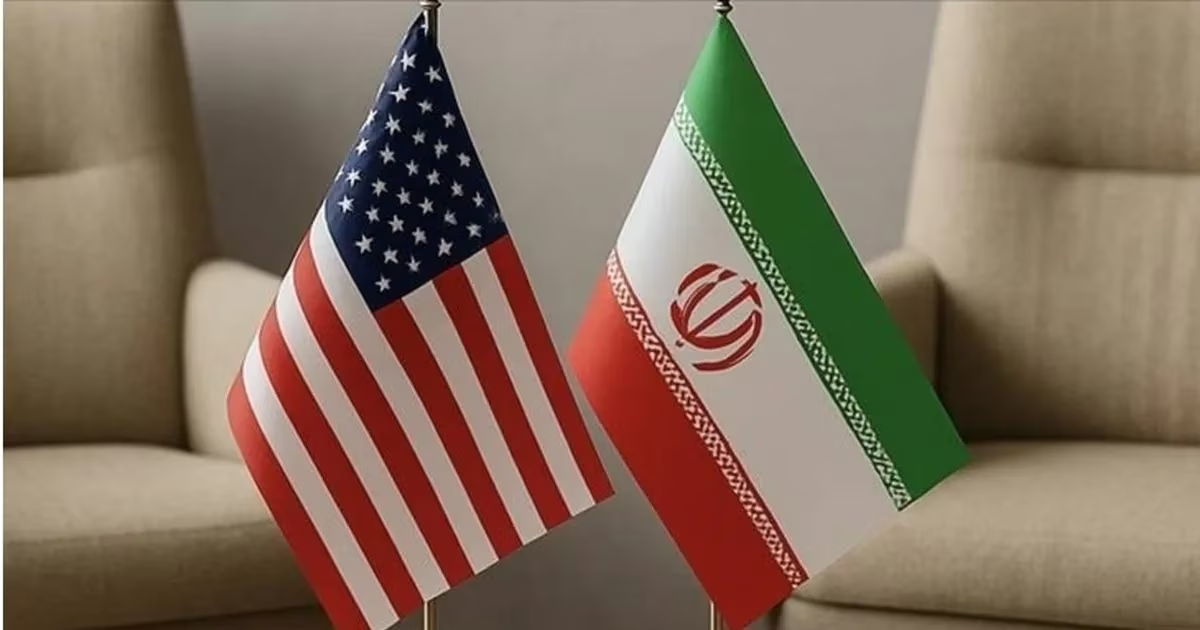
Sergei Lebedev, an expert in international political affairs, highlighted a series of structural flaws in the American approach to the Iranian issue. In an article published by the Russian newspaper 'Izvestia', Lebedev noted that Washington is in a state of confusion between verbal escalation and promises of peaceful solutions. This contradiction is clearly evident in Donald Trump's statements threatening to control the Strait of Hormuz, coinciding with leaks about an imminent agreement in mid-June.
Reports from Tehran speak of a document being prepared that includes 14 clauses for a potential settlement, reflecting the complexity of the diplomatic scene between the two parties. Regardless of the outcome of these negotiations, the current conflict has revealed the limits of American strategic action in managing complex crises. Observers believe that America's ability to impose its political will is facing unprecedented challenges in light of recent technological developments.
The issue of American military bases spread across Iran's neighboring countries is one of the most prominent weaknesses that has recently surfaced. After these bases once symbolized strength and protection, they have practically become direct targets for Iranian missiles and drones. This shift has led regional allies to reconsider the utility of hosting these forces, which now attract threats instead of deterring them.
Sources reported that the discussion within Arab political circles has become more intense regarding the security risks associated with the American military presence. Iran has succeeded in proving that these bases are not immune, but rather 'magnets' for precise strikes targeting vital infrastructure. This reality places Washington in a strategic dilemma regarding how to protect its assets and allies simultaneously.
This strategic concern extends to other international theaters, especially in the event of a potential confrontation between the United States and China over Taiwan. If Iran has succeeded in turning American bases into a security burden, China possesses far greater capabilities to target the 'first island chain'. This places countries like Japan, South Korea, and the Philippines before extremely complex and dangerous security equations.
The Asian theater lacks a comprehensive alliance umbrella similar to NATO, making host countries for American bases more vulnerable. Despite bilateral agreements, the space for neutrality narrows for these countries in the event of a direct conflict between great powers. Japan's options, in particular, appear limited and complex given its organic link to the American defense system.
The conflict also revealed a surprising Iranian ability to cause 'partial blindness' to American intelligence and surveillance capabilities in the region. Iranian drones targeted at least ten sites containing highly advanced and sensitive radar systems. Among these systems are AN/TPY-2 radars, which are a fundamental pillar of the American missile defense system.
On the military field level, the United States has not succeeded in fully neutralizing Iranian firepower despite intensive strikes. Estimates indicate that Tehran retained sufficient capability to carry out effective strikes even after the destruction of part of its launch platforms. This resilience reflects the limits of traditional military superiority in the face of technological 'guerrilla warfare' strategies and flexible platforms.
International powers such as Russia and China adopt an 'anti-access/area denial' (A2/AD) doctrine to undermine the freedom of American military action. This approach aims to create prohibited zones that impose exorbitant costs on any hostile forces attempting to intervene or operate within them. What Iran is doing today is seen as a miniature model of what Washington might face in future major conflicts.
Historically, past decades have proven that the United States often excels on the military field but fails to achieve the desired political victory. The Iraqi model is a stark example of this inability to translate firepower into stability or sustainable political influence. In the Iranian case, it appears that Washington lost the political gamble early on before achieving any real military decisive action.
Washington long bet on the movement of the 'internal opposition' to overthrow the Iranian regime under the weight of economic and military pressures, but the results were counterproductive. External pressure led to the cohesion of Iranian society behind a national anti-American discourse, postponing internal disagreements. This cohesion thwarted the 'change from within' strategy that American diplomacy usually relies on.
Technological development has brought about a qualitative shift in the balance of power, where the weaker party is now able to employ low-cost tools to contain a major power. Drones and cruise missiles have changed the rules of engagement, making it difficult for traditional armies to protect vast areas of targets. This Iranian military innovation has forced Washington to conduct a comprehensive reassessment of the cost of any direct confrontation.
The deeper dilemma lies in the limits of American political capacity to bear the human and material costs of long conflicts domestically. Modern wars are not only decided by advanced technological systems from afar, but also require actual control on the ground and human power willing to engage. It seems that the American public is less willing to engage in 'forever wars' that do not serve direct national interests.
The analysis concluded that the Trump administration, despite its inclination towards compromises, clashes with hard geopolitical realities that require indivisible resolve. War, as political theorists described it, is either fought with full seriousness and clear objectives or not fought at all. The current American hesitation between escalation and de-escalation only serves to strengthen the position of adversaries and expose more weaknesses.
War must be fought with full seriousness, or not at all; and the United States always fails to translate its field superiority into political decisiveness.
שתף את דעתך
Russian Analysis: Conflict with Iran Reveals Erosion of American Deterrence and Military Bases Becoming a Security Burden