






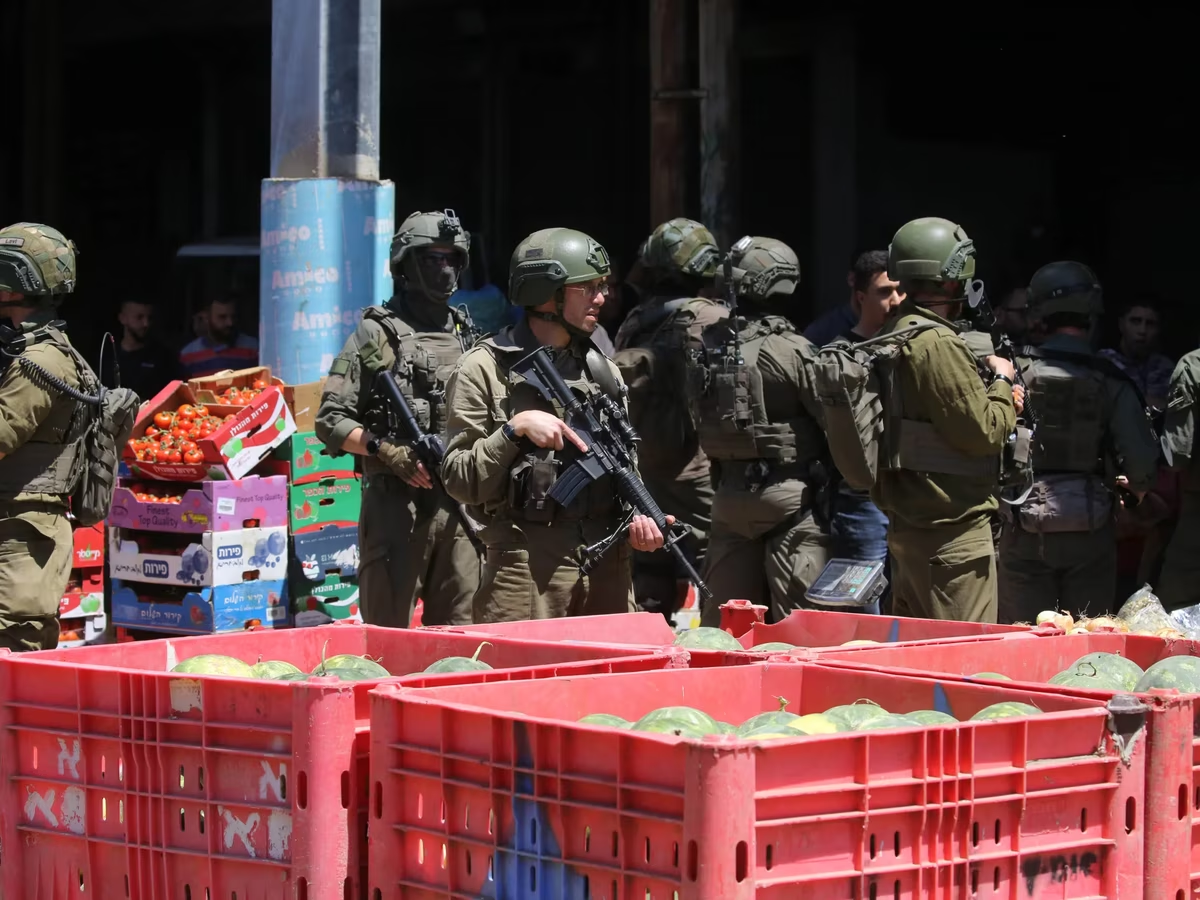
The International Crisis Group issued a detailed report titled "The Choking Grip," in which it monitored the radical transformations that have swept through the Palestinian economy since late 2023. The report confirmed that financial and banking tools have become direct means of pressure exercised by the occupation authorities to influence the daily lives of Palestinians in the West Bank.
The study considered that the current crisis is not merely an accidental product of military tensions, but rather a deliberate strategy aimed at turning the economy into a confrontation arena. Researchers believe that what is currently happening represents a dangerous transition from a state of traditional economic dependence to a stage of direct and systematic strangulation of all vital sectors.
The roots of this crisis date back to the Paris Economic Protocol signed in 1994, which kept the keys to control over borders, crossings, and the monetary system in Israel's hands. Although the agreement was supposed to be transitional, it entrenched the Palestinian Authority's reliance on clearance revenues, the transfer pace of which is controlled by the occupation.
The report stressed that the events of October 2023 constituted a pivotal turning point, as the influence of right-wing currents in the Israeli government, which seeks to annex the West Bank, escalated. This trend was reflected in the statements of Finance Minister Bezalel Smotrich, who openly linked the tightening of financial restrictions to preventing the establishment of any independent Palestinian entity.
The banking relationship between Palestinian and Israeli banks is one of the most dangerous weaknesses exploited by the occupation to destabilize stability. The continuous threat of severing ties with correspondent banks places the Palestinian financial system in a constant state of uncertainty, hindering investment movement and long-term economic planning.
Regarding clearance funds, the report indicated that repeated Israeli deductions have led to the Authority's inability to meet its obligations towards employees and suppliers. This financial imbalance did not stop at the official institutions but extended to all aspects of the local market, which suffers from a sharp decline in purchasing power.
A complex technical problem also emerged, represented by the accumulation of huge quantities of "shekel" currency within Palestinian banks due to restrictions on cash shipment to Israel. This accumulation raises insurance and transportation costs and forces some traders to resort to unofficial financial channels, which weakens general financial oversight.
Regarding movement and mobility, the West Bank has turned into something akin to "isolated islands" due to the intensification of military checkpoints and iron gates between cities. These measures not only hindered the movement of individuals but also dramatically increased transportation and distribution costs, making internal commercial activity a risky and economically unfeasible process.
Thousands of Palestinian families lost their primary source of income after workers were prevented from accessing their workplaces within the Green Line since the start of the war. This double loss led to a drying up of liquidity sources in local markets and contributed to raising poverty and unemployment rates to unprecedented levels in the history of the West Bank.
The report touched upon the situation of Area C, which represents the strategic depth for Palestinian development with its natural resources and agricultural lands. It explained that preventing Palestinians from investing in these areas deprives the economy of enormous growth opportunities and confines economic activity to narrow and crowded enclaves.
The data contained in the report paints a bleak picture of the future of livelihoods, as the economy suffers from a sharp contraction and a continuous decline in individual income levels. The Crisis Group warned that the continuation of these pressures could lead to the collapse of service institutions and municipalities that are currently struggling to survive.
The report proposed a set of urgent solutions, starting with ensuring the regular flow of clearance funds and immediately lifting restrictions on the movement of workers and goods. However, experts stressed that these palliatives will not end the crisis unless international mechanisms are sought to reduce structural dependence on the Israeli financial system.
The international group called for the necessity of internal Palestinian reforms to enhance transparency, in parallel with international pressure to stop using the economy as a tool for collective punishment. The continuation of the current situation portends an imminent social and political explosion whose effects may not be limited to the Palestinian territories alone but will extend to the entire region.
The report concluded that understanding the future of the Israeli-Palestinian conflict necessarily passes through understanding the economic policies pursued by Israel in the West Bank. The economy is not just numbers and statistics, but it is the essential pillar of the Palestinian society's steadfastness and its ability to remain on its land in the face of silent displacement policies.
The Palestinian economy is no longer merely a تابع, but has become an arena of confrontation in which Israel uses financial policies as tools for political subjugation.
שתף את דעתך
International Report: Israel Turns West Bank Economy into a Confrontation Arena to Strangle Palestinians