






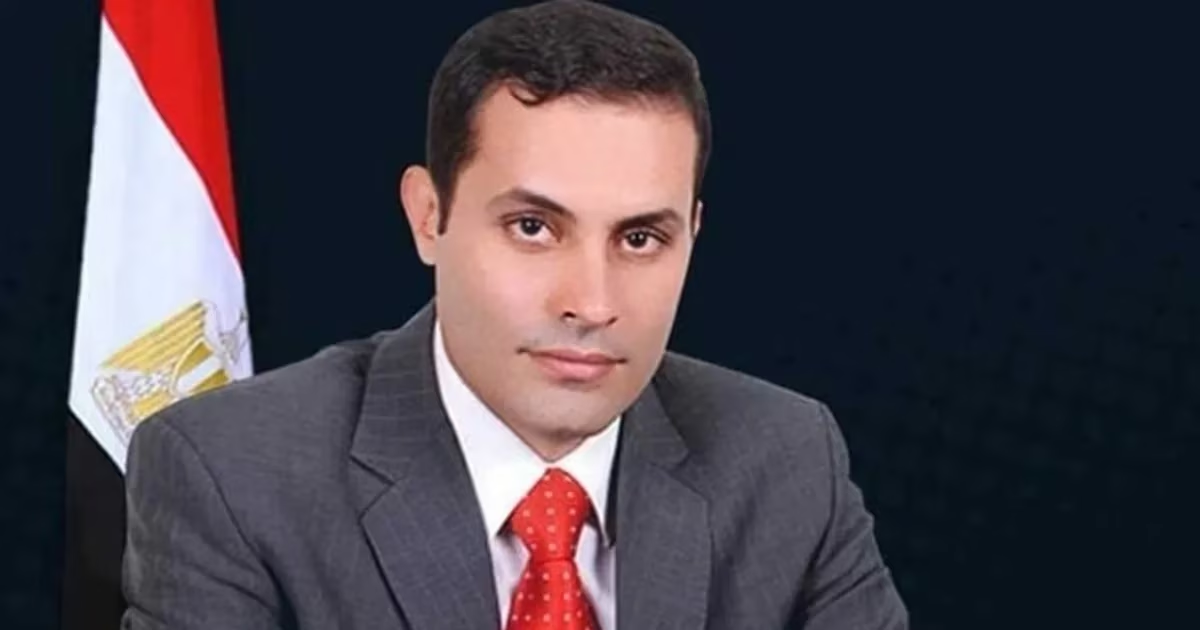
The recent announcement by Egyptian politician Ahmed Tantawi, former presidential candidate and ex-member of parliament, about his search for employment opportunities in academic and media fields, sparked a wave of controversy regarding the reality of economic restrictions imposed on opponents. Tantawi explained via his personal account that he is looking to utilize his 25 years of experience in journalism and scientific research, after a period of political pressure that ended with his imprisonment and deprivation from running in the last presidential race.
Tantawi's case is a revealing example of what human rights organizations describe as the 'drying up the sources' policy adopted by the Egyptian regime against critical voices. After his release from prison following the 'popular endorsements' case, he found himself besieged in the job market, where private sector employers fear hiring any individual with an 'opposition profile' to avoid security accountability or administrative pressures.
Human rights sources reported that these practices are not limited to well-known political figures but extend to include thousands of citizens who were released after periods of detention. These individuals face extreme difficulties in obtaining official documents such as 'criminal record certificates,' which deprives them of their natural right to earn a living and live a dignified life, turning their lives into a large prison outside its walls.
In testimonies documented by field sources, stories emerged of public employees in the education and endowments sectors who were prevented from returning to their jobs after their release. A supervisor in the Ministry of Education was deprived of his retirement pension on the pretext of absence from work, even though his absence was involuntary due to detention, which reflects the exploitation of administrative laws as punitive tools.
Reports indicate that professional restrictions have also affected the academic sector, where university professors have been dismissed or deprived of academic promotions due to their political stances or solidarity with their detained relatives. The case of Dr. Manar El-Tantawy, an engineering professor, stands out as one of the cases where professional advancement was linked to political loyalty or silence on violations.
The media and cultural fields were not far from these pressures, as unofficial lists were created preventing prominent writers and journalists from publishing in local newspapers. Names like Fahmy Howeidy and Alaa Al-Aswany found themselves banned from addressing the Egyptian public through traditional means, forcing many of them into forced emigration or involuntary cessation of writing.
Observers believe that the Egyptian regime has succeeded in creating a 'state of fear' within the business sector, where the private sector has become an indirect partner in political punishment. Factory and company owners request security checks before hiring, and any indication of previous political activity immediately leads to the exclusion of the job candidate, for fear of license revocation or tax prosecutions.
Samar El-Husseini, director of the Egyptian Platform for Human Rights, said that this pattern of punishment represents a blatant violation of economic and social rights. She affirmed that depriving a citizen of work based on their political affiliation is discrimination that violates the Egyptian constitution and international treaties, and aims to turn opposition into a financial and livelihood burden on its proponents.
For his part, human rights researcher Ahmed Hilal pointed out that the political deadlock has led to transforming disagreement with the authorities into 'personal enmities' that follow the details of the opponent's life. He considered that a figure of Tantawi's stature publicly seeking work is a symbolic cry expressing that the political elite has reached a stage of complete livelihood suffocation.
The pressures did not stop at preventing employment but extended to destroying small commercial projects that former detainees try to start. Testimonies documented cases of simple shops being raided and destroyed as soon as security agencies learned the identity of their owner, closing all doors of livelihood for these citizens.
In a related context, dozens of artists and media professionals left Egypt after their programs were shut down or the production companies dealing with them were pressured. Artists like Amr Waked and Khaled Abol Naga found themselves completely outside the Egyptian art scene, as part of a policy aimed at unifying media discourse and marginalizing any voice that does not align with the official narrative.
Sources confirm that security reports have become the primary criterion for appointment in government competitions, including judicial and teaching positions. Applicants are excluded not based on their competence, but based on the 'security check' which may include data about fourth-degree relatives engaged in opposing political activity.
This reality has pushed many national competencies to migrate to work abroad, representing a major loss for the Egyptian state. Activists believe that developed countries compete to attract expertise, while the current authorities work to squander these human resources simply because they differ in opinion with the executive authority's directives.
In conclusion, the 'deprivation of work' file remains one of the most complex issues in the Egyptian human rights scene, as it affects the right to life and survival. While the authorities deny the existence of systematic policies, the stories of hundreds of opponents and those economically pursued remain a testament to the use of livelihood as a weapon in the ongoing political struggle.
The story is not Tantawi's alone, but the story of a country that treats political difference as a reason to squander national competencies and expertise.
שתף את דעתך
The 'Professional Starvation' Weapon: How Opponents in Egypt Face the Policy of Deprivation of Work?