






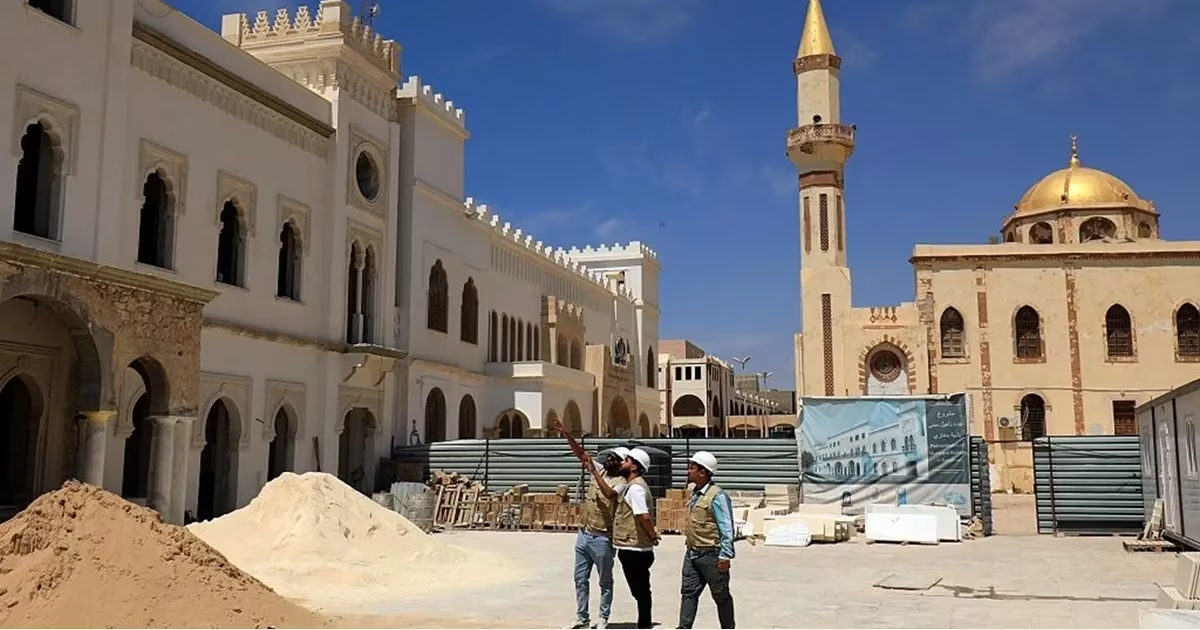
The areas of eastern Libya under the control of the General Command are witnessing an unprecedented urban boom, with cities like Benghazi and Derna transforming into major workshops for building bridges, highways, and residential complexes. Field Marshal Khalifa Haftar, through his sons, has succeeded in attracting dozens of foreign companies to reconstruct areas damaged by Hurricane Derna, leading to a radical change in the region's infrastructure.
Belqasem Haftar, the Field Marshal's son, assumed the presidency of the 'Libya Development and Reconstruction Fund,' an entity that now controls all investment projects in the East. The House of Representatives granted this fund extensive powers under exceptional laws that exempt it from usual financial oversight and allow it to borrow directly from the Central Bank, raising questions about transparency.
International partnerships for the fund have expanded to include British, Polish, and American companies, in addition to cooperation with the European Union in development, security, and border management. European Ambassador Nicola Orlando announced broad agreements to support reconstruction efforts and modernize service institutions in Benghazi, reflecting increasing international recognition of the de facto authorities in the East.
The list of contracted companies includes more than 22 international companies of various nationalities, including Egypt, Turkey, Italy, France, the UAE, and Russia. Egyptian companies such as Al-Arjani Group and Arab Contractors stand out, alongside Turkish and European companies specializing in heavy contracting, tourism development, and artificial intelligence, giving the reconstruction projects a global character.
In contrast, western Libya suffers from a clear setback in the implementation of infrastructure projects despite the Tripoli government launching programs such as 'Return to Life.' Sources attribute this setback to periodic armed conflicts between rival factions, in addition to funding crises and the withdrawal of some foreign companies due to non-payment of dues or security tensions.
Observers believe that the strict military discipline in areas controlled by Haftar has provided a safe environment for foreign companies to operate without fear of armed clashes. However, this stability is described as 'authoritarian stability' that relies on extreme centralization of decision-making and the exclusion of any opposition, ensuring the unification of financial and political resources to serve the reconstruction project.
The British think tank 'Chatham House' warned that the Reconstruction Fund acts as a tool to empower the ruling elite and build private financial patronage networks for the Haftar family, away from Tripoli's oversight. The institute indicated that the goal of presenting Belqasem Haftar as an economic facade is to bring him civilian and technocratic legitimacy before the international community as an alternative to a purely military facade.
On the human rights front, 'Human Rights Watch' documented violations related to the confiscation of properties and apartments of civilians in neighborhoods in Benghazi under the pretext of urban development. The organization considered that preventing displaced families from returning to their homes without fair compensation constitutes a crime of forced displacement that violates international laws and places those responsible under prosecution.
The objectives of these projects go beyond the service aspect to direct political employment, where urban achievements are linked to the person of Field Marshal Haftar and the 'Dignity Operation.' Military names have been given to new cities and bridges, in an attempt to consolidate 'the Field Marshal's rule' and market his political project as a maker of stability and development in the face of political division.
Financial data indicates that the fund received massive allocations amounting to 10 billion dinars as a first installment, with hundreds of millions of dollars of foreign currency being spent. Banking reports confirm that the volume of spending in the East is equivalent to the budgets allocated for investments in the West, but with a fundamental difference in the speed of implementation and the absence of oversight mechanisms.
Libyan academic Faraj Dardour believes that Haftar seeks to gain popular loyalty and ensure the survival of his sons in power by controlling all vital sectors. Dardour warned that this unsupervised spending has caused a huge public debt and a deterioration in the value of the local currency, increasing the suffering of citizens despite the dazzling urban appearance.
Haftar's family strategy in the South also relies on integrating service projects with military maneuvers to enhance influence, as happened in the 'Shield of Dignity 2' maneuvers. Saddam and Belqasem Haftar play a pivotal role in managing these files, indicating a precise distribution of roles between the military and investment aspects to solidify the family's rule.
Today, the Libya Reconstruction Fund represents the 'long arm' that controls the joints of the economy in the east of the country, benefiting from the disaster of Hurricane Daniel, which served as a starting point for expanding its powers. The fund now has the right to open foreign currency accounts abroad, granting it complete financial independence from central institutions in the capital, Tripoli.
Ultimately, the reconstruction file in Libya remains an arena for the struggle for legitimacy and influence between East and West, with each side using field achievements as a propaganda tool. While the East boasts of its urban boom, concerns remain about the economic and human rights costs of these projects, which are being built in the complete absence of accountability and transparency.
Projects in eastern Libya are used to whitewash corruption and looting, and what drives the architectural activity is the availability of unlimited and unplanned financial coverage.
שתף את דעתך
Reconstruction of Eastern Libya.. Haftar's Family Strategy to Consolidate Influence and Gain International Legitimacy