






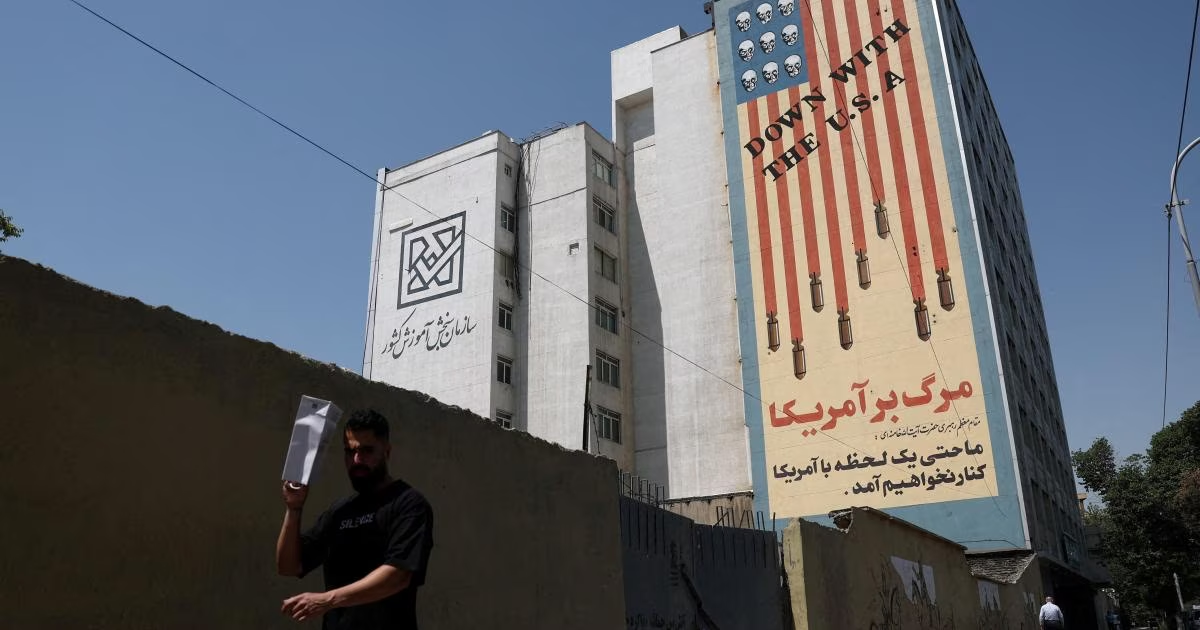
The Islamic Republic of Iran stands at a pivotal historical moment where military calculations intertwine with political paths, as eyes turn towards the signing of a memorandum of understanding with the United States of America. This anticipated agreement may put an end to open confrontations on multiple fronts and establish new security and political arrangements extending from the Strait of Hormuz to the Lebanese arena.
Data indicates that Tehran seeks, through this memorandum, to transition from the logic of field confrontation to a comprehensive political settlement equation. This move comes amidst internal questions about the strategic gains Iran has achieved from the recent escalation, and the extent to which diplomacy can solidify these gains in a written agreement that guarantees its vital interests.
For his part, former Iranian diplomat Dr. Hadi Afkahi explained that the proposed memorandum covers fundamental issues raised by Tehran, foremost among them the complete cessation of military operations, including Lebanon and the countries of the Axis of Resistance. The clauses also include lifting economic sanctions imposed on the country and regulating the rights of managing the Strait of Hormuz in consultation and coordination with the Sultanate of Oman.
Informed sources confirmed that the first phase of the understanding will focus on humanitarian and economic aspects, while more complex files will be postponed to a second phase. This phase includes the Iranian nuclear program file and the fate of enriched uranium stockpiles, issues that require international guarantees and precise inspection mechanisms demanded by Washington.
Regarding the timeline, there is a kind of caution in Tehran towards the final formulations of the agreement to avoid any potential manipulation of legal terms. The final decision is subject to careful review by the Supreme National Security Council, before being submitted for final ratification by Supreme Leader Mojtaba Khamenei to ensure political consensus.
On the other hand, observers believe that the agreement represents a 'negotiated truce' for 60 days, aiming to test the intentions of the parties and shift the conflict from the military field to diplomatic tables. Academic Hussein Riyouran pointed out that the specter of war still looms if the two parties fail to reach tangible results during this sensitive transitional period.
The proposed roadmap relies on 14 basic clauses that guarantee mutual commitments, so that every step taken by Tehran to de-escalate is met by an American step to alleviate pressure. This balance aims to build lost trust between the two sides and provide political cover for both parties before domestic public opinion in Washington and Tehran.
On the economic front, Iran prioritizes the unfreezing of funds to alleviate the living crisis and reassure the Iranian public of the utility of the negotiation path. In this context, a pivotal Qatari role emerged by expressing readiness to provide a financial 'advance' to Tehran, to be settled later once American restrictions on Iranian assets abroad are lifted.
According to leaked information, the US administration also agreed to allow Iran to freely export its oil during the 60-day negotiation period. This step would inject immediate cash liquidity into the Iranian economy, strengthening the position of the Iranian negotiator and giving him room for maneuver in pending political files.
In contrast, Israel continues to adopt an escalatory rhetoric, with its official sources affirming adherence to the option of unilateral action if it feels an imminent nuclear threat. This Israeli position represents one of the biggest challenges facing the US-Iranian understanding, as Tel Aviv fears that the agreement could legitimize Tehran's regional influence.
Between the rhetoric of victory promoted by circles in Tehran and the language of necessity adopted by Washington, the Middle East remains at a historical crossroads. Either this memorandum succeeds in formulating a new relationship between Iran and the world, or it is merely a warrior's respite preceding a new round of confrontations that could redraw the balance of power in the region.
The current agreement is a 14-point roadmap, where each Iranian step is met by a parallel American step within the framework of mutual arrangements.
שתף את דעתך
Anticipated Memorandum of Understanding Between Tehran and Washington: Will it Draw a Roadmap to End the War in the Region?