






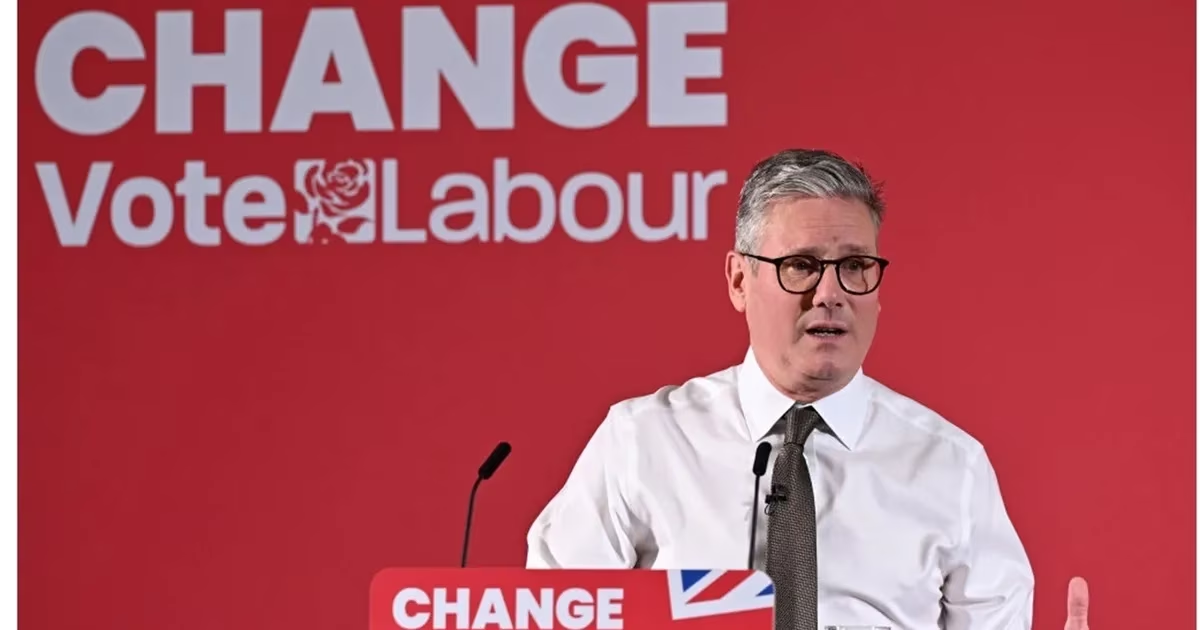
Expectations are rising in British political circles about a fundamental shift in the approach of Keir Starmer's Labour government towards the crisis in the Middle East. This anticipation is driven by the successes achieved by the Green Party in local elections based on a pro-Gaza agenda, as well as increasing pressure from the party's grassroots.
Sources reported that activists supportive of the Palestinian cause are observing a change in the general mood within government corridors, especially with recent opinion polls reflecting an overwhelming desire among Labour Party members to take punitive measures against the occupation. These demands include a comprehensive ban on arms shipments to Israel, which puts the current leadership to a real test against its declared principles.
Observers believe that this relative optimism among activists reflects a shift in the balance of political power, despite the legal challenges faced by some protest movements. Analysts suggest that the possibility of Starmer's future departure from the premiership could open the door for more radical leaders in their handling of the Palestinian issue.
Wes Streeting and Andy Burnham emerge as preferred candidates to succeed Starmer, as both have a record of statements calling on the Labour Party to make greater efforts to support Palestinian rights. Despite their current reservations about describing what is happening as genocide, Streeting has previously accused Israel of committing overt war crimes.
Streeting, the former Shadow Health Secretary, had sparked controversy within the shadow cabinet after circulating a file prepared by British doctors working in the occupied territories documenting humanitarian atrocities. This move led to tensions with Starmer, who accused him of attempting to leak documents to influence public opinion, revealing the depth of internal division over Gaza.
In a related context, figures show that 87% of Labour Party members support a ban on trade with illegal Israeli settlements in the West Bank. A survey conducted by Medical Aid for Palestinians also revealed that 78% of members demand an immediate and complete halt to arms exports, putting the government in direct confrontation with its electoral base.
Emily Thornberry, Chair of the Foreign Affairs Committee, criticized the government's slowness in taking effective steps after recognizing the state of Palestine last autumn. Thornberry said the government had lost its diplomatic momentum, questioning the next steps to end the stalemate and stop Israeli threats to divide the West Bank.
Thornberry pointed out that the humanitarian situation in the Gaza Strip has become unbearable, yet international action remains insufficient. She called on Britain to use its diplomatic authority to convene international meetings aimed at imposing a complete Israeli withdrawal and ending the siege imposed on the civilian population.
For his part, Brian Privett, Executive Director of the 'British Palestine Project,' considered that change within the government is imminent and inevitable. He explained that the disparity between the leadership's handling of the Ukrainian crisis compared to the Palestinian issue has created a credibility gap, both legal and moral, that is difficult to bridge without decisive decisions.
At a specialized conference, experts and former officials discussed ways to convince Israeli society that occupation does not provide security but undermines it. There was a consensus on the need to move from hollow diplomatic statements to practical measures, such as imposing a complete trade ban on settlement products and publishing the government's response to the International Court of Justice's rulings.
Vincent Fean, former British Consul General in Jerusalem, warned of Europe losing its diplomatic control over the issue to the American administration. Fean stressed the need for Britain to regain its leadership role in the region by adopting independent policies consistent with international law and human rights.
Chris Doyle, Director of the Council for Arab-British Understanding, criticized the 'deep concern' policy pursued by the British Foreign Office without tangible actions on the ground. He said that Gaza has become a pivotal issue for an entire generation of Britons who will not accept continued complicity or silence towards what they describe as ethnic cleansing crimes.
Former Israeli negotiator Daniel Levy suggested that Britain should focus on undermining the system of impunity enjoyed by the Israeli leadership. Levy affirmed that individual sanctions on some settlers are insufficient; rather, the political and economic system that directly fuels the occupation must be targeted.
Levy concluded by referring to the South African experience, where the apartheid system was undermined by offering a political alternative that ensured security for all while ending injustice. He called on Britain to contribute to drafting a new freedom charter for Palestinians that ends decades of military occupation and expansionist settlement.
There is an imminent radical change within the British government, and it would be surprising if it did not happen because most dynamics are moving in one direction towards supporting Palestinian rights.
שתף את דעתך
Internal Pressures Push British Labour Government Towards Radical Shift on Palestine Issue