






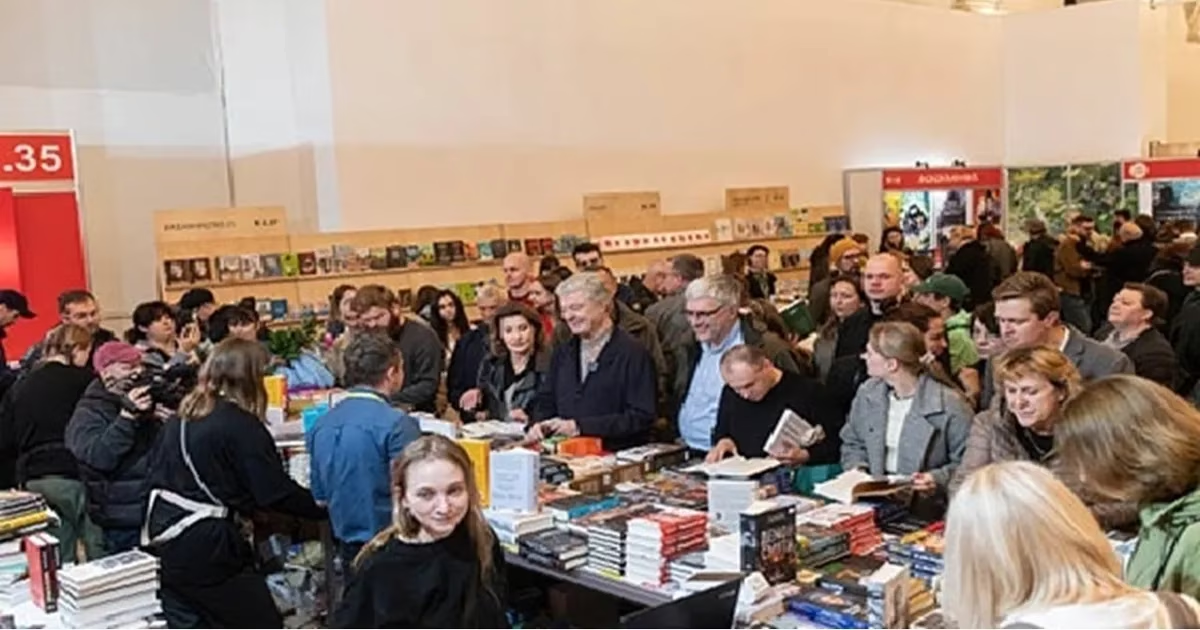
Recent cultural lists on reading trends in the West for the current summer season have revealed a literary landscape that noticeably shies away from hot political issues and direct wars. Despite the bloody conflicts the world is witnessing in Gaza, Ukraine, and Sudan, the recommendations favored retreating into themes of personal memory and historical exile, far from engaging with the bitter human reality of these conflicts.
The selections, in which an elite group of writers and thinkers participated, showed a clear dominance of themes of identity and diaspora, with the memoirs of Austrian writer 'Stefan Zweig' standing out as a historical testimony to the collapse of old Europe and the rise of fascism. Analysts considered that the return to these texts reflects a desire to understand the present through the mirror of the past, without getting involved in analyzing contemporary geopolitical conflicts that shape global consciousness today.
In a related context, cultural sources drew attention to the shocking absence of translated Arabic literature from these lists, despite the momentum witnessed in the literatures of other regions such as Africa and Latin America. This absence raises fundamental questions for Arab cultural institutions about their ability to penetrate global circles of influence and criticism, and to convey the voice of the Arab creator to the Western reader who seems preoccupied with other literary horizons.
History was strongly present in the historians' recommendations, with works such as 'This Small World' by researcher Nandini Das focusing on deconstructing narrow national narratives in favor of a more comprehensive vision of the world in past centuries. These choices come in an attempt to reconstruct traditional perceptions of the past and understand the roots of contemporary civilization by evoking the experiences of Babylon and Alexander the Great.
Regarding social issues, feminism linked to environmental crises emerged as one of the main themes on the list, with novelist Tehimah Anam recommending the book 'Feminism for a Burning World'. This work calls for collective action linking women's rights and confronting climate change, reflecting a shift in feminist literature towards issues of cosmic existence and existential crises threatening the planet.
Autobiographical memoirs also recorded a notable presence, with prominent writers recommending works exploring experiences of disability and hybrid identity, such as Raymond Antrobus's memoirs which dealt with deafness and Jamaican-British roots. These hybrid texts, which blend social investigation with personal biography, are attracting readers more than traditional novels, due to their ability to touch reality in a documentary style.
It is noteworthy that the religious dimension was almost completely absent as an independent intellectual topic in these recommendations, despite the growing role of religion in contemporary international conflicts and identity discussions in Europe. It seems that the Western cultural elite prefers to address issues of general values from a secular or individual perspective, ignoring the deep civilizational influences of the religious component in shaping political and social attitudes.
In contrast, issues of migration and race were present through the recommendations of novelist Zadie Smith, who highlighted African diaspora literature and documented half a century of creativity in this field. Novelist Gary Shteyngart also addressed the experience of immigrants in the United States through a satirical novel, indicating that Western interest is focused on immigrants 'within' their societies rather than on the tragedies of peoples in their homelands.
Analyzes indicate that summer reading in the West is no longer just a means of fleeting entertainment, but has become a window for understanding major transformations from identity crises to questions of social justice. However, this understanding remains incomplete as long as the voices of victims in burning conflict zones continue to be ignored, and as long as Arabic literature remains far from global platforms of recognition and nomination.
When comparing this reality with the Arab cultural environment, the absence of 'summer reading' traditions as an institutional act directed at the public is clearly evident, as media outlets are preoccupied with festivals and celebratory events. This disparity leads to the transformation of culture in the Arab region into a fleeting event instead of being a knowledge project that accumulates awareness and stimulates critical interaction with contemporary issues.
The absence of Arabic literature from these lists is not just a coincidence, but a reflection of the weakness of systematic translation movements and the absence of cultural strategies capable of marketing Arab creative products. While Asian literatures succeed in asserting themselves, the Arab writer remains confined to narrow local circles, or to limited translations that do not reach the 'most read' or 'most influential' lists.
The book 'The Dead Said' by writer Doireann Ní Ghríofa presented a model of literature that reconstructs the voices of the marginalized through the archive of mental asylums, which reinforces the trend of literature towards 'the document'. This type of writing proves that the contemporary reader seeks truth mixed with fiction, which is abundant in Arab reality but lacks an effective cultural mediator to convey it globally.
In conclusion, this year's selections reflect a cultural scene where the boundaries between thought, history, and literature are receding, but it remains an incomplete scene in its geographical and human comprehensiveness. Ignoring major wars and ancient literatures like Arabic literature makes these lists an expression of a Western 'cultural bubble', recycling its self-interests away from the real pains of the world.
The question remains open about the responsibility of Arab cultural institutions in changing this reality, by supporting creators and revitalizing the reverse translation movement. Without a strong presence in these international forums, the Arab voice will remain absent from shaping global consciousness, and Arabic literature will remain a distant echo that does not reach the ears of readers in the capitals of cultural decision-making.
Despite the clear presence of African literature, translated Arabic literature appears completely absent from the scene, raising questions about the position of Arab culture in the global translation market.
שתף את דעתך
Outside Western Summer Calculations.. A Striking Absence of Arabic Literature and Current War Issues