






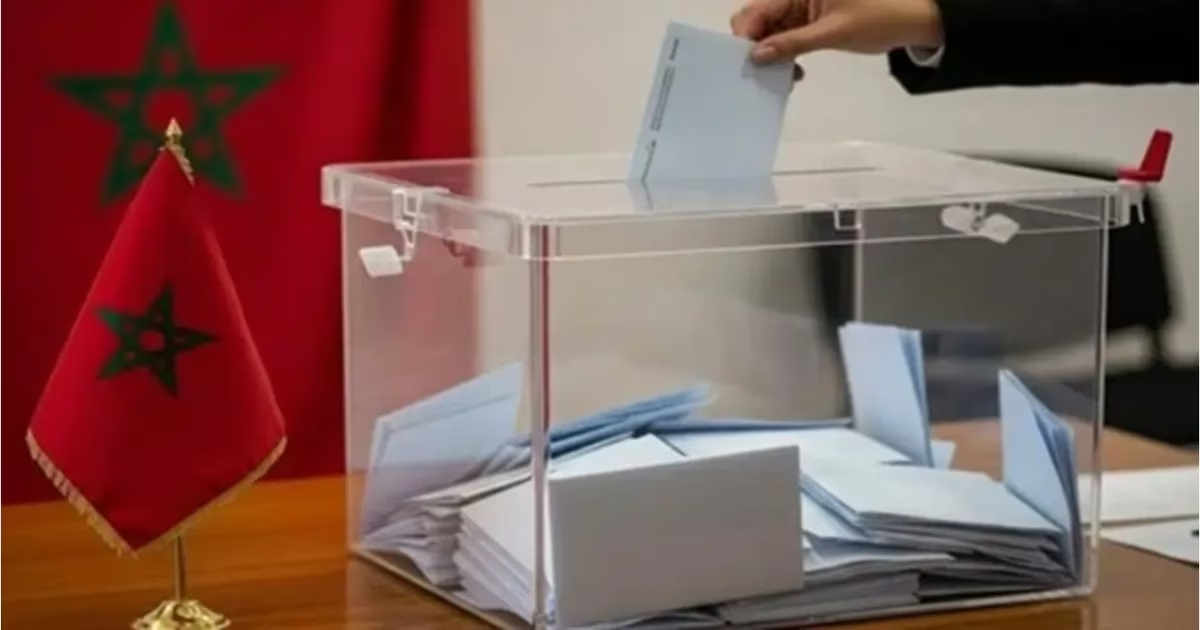
The issue of boycotting electoral processes in non-democratic environments sparks a wide intellectual and political debate about the utility of working within official institutions. Observers believe that this behavior goes beyond mere passive abstention from voting, transforming into a strategic political stance that rejects existing institutional rules.
Deconstructing the structure of these regimes leads many political actors, including parties and independent figures, to adopt boycotting as a choice based on a precise reading of the general scene. They believe that the absence of guarantees for genuine competition turns ballot boxes into a mere tool for reproducing ruling elites and solidifying the status quo.
The importance of boycotting stems from its ability to expose superficial political paths and withdraw popular and international legitimacy from them. Instead of being a retreat, it becomes an effective means to put the rules of the game 'on hold' and redefine the concept of true opposition.
'Electoral abstention' contributes to shifting political action from the corridors of formal institutions to the broad societal sphere. This transition aims to build an alternative legitimacy based on popular awareness and direct engagement with street issues, away from official dictates.
Advocates of this approach emphasize that engaging in a political process that lacks sovereign decision-making weakens the opposition and makes it a partner in failure. Participation in elections with predetermined controls grants the regime free endorsement before internal and external public opinion.
Based on this intellectual framework, boycotting and engaging with reality from outside official walls becomes the stance most consistent with democratic principles. This choice protects the moral capital and popular credibility, which represent the true wealth of serious opposition forces.
This abstention falls within the forms of peaceful resistance and conscious protest, and is not a withdrawal as its opponents promote. It is a responsible call to rebuild the political field on foundations of freedom and integrity, away from the superficial beautification of institutions that lack powers.
Groups that adopt this option shift from the logic of parliamentary work to arenas of guiding public opinion and sparking major debates. Their activity focuses on the nature of the constitution, the separation of powers, and the utility of institutions described as lacking actual decision-making authority.
Through their political alternative, these forces seek to create a societal awareness that rejects identification with the rules of the game set by the regime that monopolizes power. They present their assessments as a moral alternative that refuses to compromise on principles in exchange for small political gains or fleeting positions.
This parallel action constitutes continuous pressure on the authority, pushing it to try to improve its image or offer concessions to absorb tensions. This proves that influence from outside can often be more profound than 'tamed' opposition within legislative councils.
In the Moroccan context, the Al Adl Wa Al Ihssane group stands out as one of the most prominent currents that has insisted on this approach for decades. The group bases its stance on deeply rooted theoretical and practical foundations in its political literature that reject any concessions to the regime.
The group views the existing institutional game as a trap that leads its participants towards moral and material 'political demise'. It bases this on the experiences of other bodies and parties that entered the parliamentary experiment and ended up losing their popular credibility and ideological distinctiveness.
This historical awareness leads the group to take a decisive, uncompromising stance, preferring to remain within the sphere of societal and educational action. Analysis indicates that the group may choose to transform into a purely advocacy current rather than participate in elections that do not guarantee real change.
In conclusion, the electoral boycott remains a strategy aimed at protecting the political project from erosion and disappearance. It reflects a desire to avoid the confusion that afflicted other actors who accepted integration into the regime's structure without possessing the ability to influence its authoritarian essence.
Participation in elections with known outcomes in advance is merely a means to grant the existing regime a certificate of absolution and endorsement before the international community.
שתף את דעתך
Electoral Boycott as an Act of Resistance: A Reading on Exposing Regimes and Withdrawing Legitimacy