






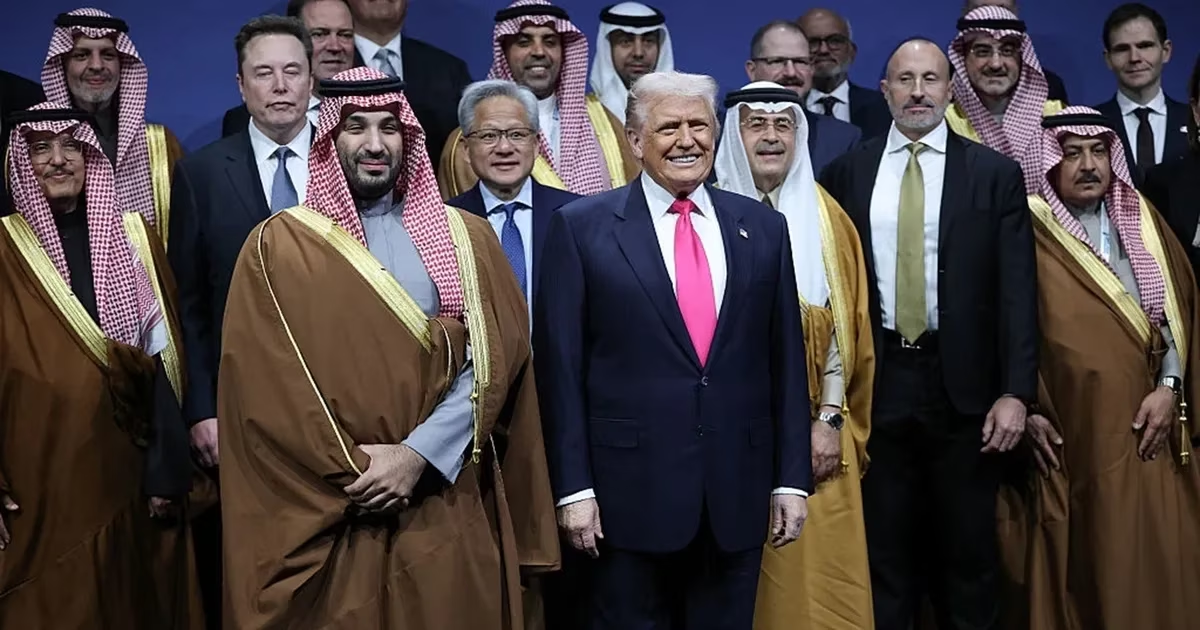
An international press report revealed a growing state of anxiety in Gulf capitals following the sharp statements made by U.S. President Donald Trump against the Sultanate of Oman. Media sources indicated that these threats, which included hinting at military action, raised deep questions about the predictability of the American approach in the region, especially amidst ongoing tensions with Iran and maritime security in the Strait of Hormuz.
The sources explained that Trump's threat to bomb the long-standing partner and trusted regional mediator, the Sultanate of Oman, increased the confusion among Washington's traditional allies. This sudden shift in American rhetoric reflects a significant gap between economic and political interests, as Trump's family company had previously announced massive investments in the Sultanate estimated at $500 million.
Muscat finds itself today at the heart of a diplomatic storm after Trump's public warning to it to change its policies or face dire consequences. This unprecedented attack targeted a country known for decades for its diplomatic neutrality and its ability to facilitate secret and public communication channels between Washington and Tehran, making it a pillar of regional stability.
Observers believe that Trump's anger stems from his suspicions that the Sultanate might support Iranian efforts to impose fees on ships passing through the Strait of Hormuz. Despite Oman's categorical denial of these accusations and its affirmation of commitment to international law and freedom of navigation, the U.S. administration continues to exert maximum pressure to force Muscat to fully engage in its strategy.
In analyzing these developments, experts at international research centers pointed out that Trump seeks to extract any strategic gain in his confrontation with Iran by pressuring allies. It appears that the U.S. administration believes that countries that do not fully align with its vision, or those that hinder its efforts, must bear the consequences of this stance directly and strictly.
Reports indicate that the U.S. President's frustration over his failure to force Tehran to reopen the vital waterway on his terms led him to vent his anger on regional mediators. From the White House's perspective, the failure to achieve a diplomatic victory with Iran places the responsibility on Gulf countries to make concessions to compensate for this failure.
American pressure is not limited to the maritime issue but extends to demanding Arab governments accelerate the pace of normalizing relations with the occupying state. This American desire clashes with regional opposition that links any progress in this matter to the necessity of achieving tangible progress in the issue of establishing an independent Palestinian state.
This shift in the American approach has prompted many Gulf governments to monitor the situation with extreme caution and reconsider their strategic bets. This incident has reinforced fears that complete reliance on the American security umbrella may entail uncalculated risks under an administration whose decisions are characterized by volatility and surprise.
As a result of these policies, countries in the region have begun to seriously seek to diversify their international partnerships with other global powers to ensure a balance of their interests. Despite continued close military and defense cooperation with Washington, the trend towards building strong economic and diplomatic relations with alternative international poles has become an unavoidable strategic option.
Ultimately, the Sultanate of Oman remains committed to its traditional role as a voice of reason and wisdom in a region plagued by crises, despite immense pressures. Gulf capitals are closely watching how Muscat will deal with these bouts of American anger, and whether Washington will realize the importance of preserving its allies instead of threatening their stability.
Act like other countries, or you will face dire consequences.
שתף את דעתך
Trump's Threats to Oman Alarm Gulf Allies and Raise Questions About U.S. Policy Stability