






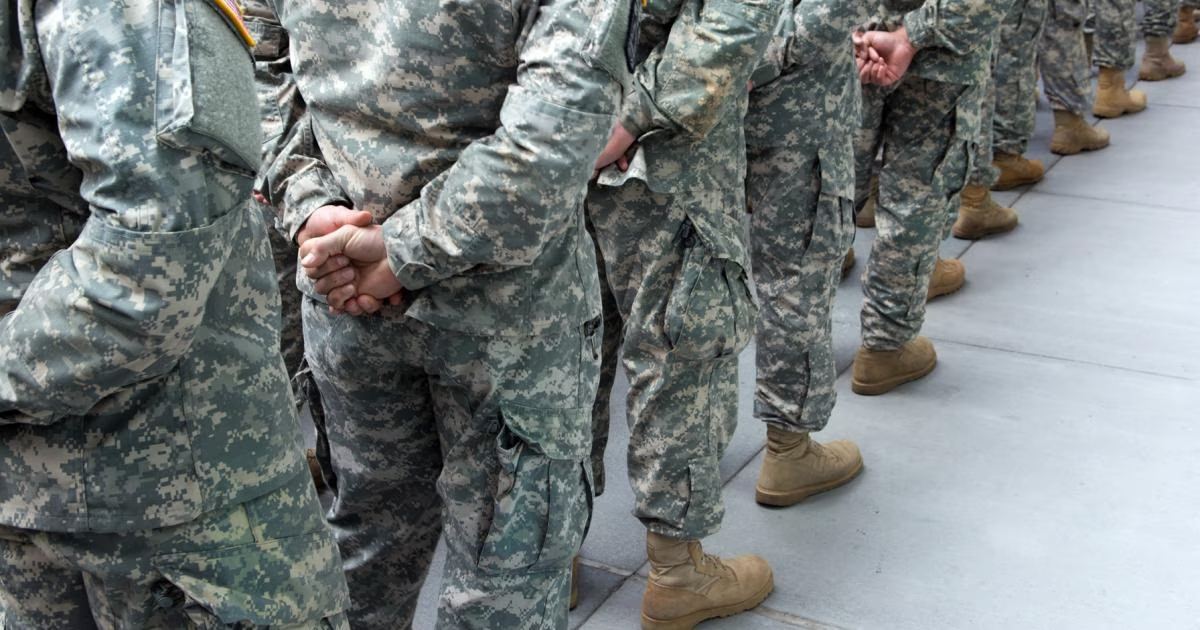
The United States is moving towards breaking a legal and military tradition that has lasted for more than six decades, as the military establishment has not carried out any execution since 1961. These moves come amid the Trump administration's efforts to reactivate maximum penalties and strictly enforce the law within the armed forces.
Media reports revealed an operational plan launched last February under the name 'Operation Resolute Justice,' aimed at ending the long suspension of death sentences issued against military personnel. The plan includes complex logistical procedures, including coordination between military authorities and the Federal Bureau of Prisons to ensure the execution of sentences according to specified timelines.
New directives stipulate the transfer of convicted military personnel from the military disciplinary barracks in Kansas to the federal execution facility in Terre Haute, Indiana. This transfer must take place within 150 days of the final presidential approval of their sentences.
Despite the initiation of technical and logistical procedures, the final word remains with President Donald Trump, who has the constitutional authority to approve the execution. This issue is considered one of the most sensitive due to its impact on the core of US military justice and the Uniform Code of Military Justice (UCMJ).
The list of condemned individuals who may face the gallows or lethal injection includes four former military personnel convicted of crimes that shook American public opinion. Prominent among these is former Major Nidal Hasan, responsible for the infamous Fort Hood shooting in 2009, which resulted in the deaths of 13 people.
The list also includes former Private Ronald Gray, who was convicted in 1988 of committing a series of horrific murders and rapes. Former President George W. Bush approved his execution in 2008, but federal judicial intervention halted the execution at that time.
The third name is former Staff Sergeant Timothy Hennis, who faced a complex judicial path that ended with his conviction through DNA evidence. Hennis was convicted of raping and murdering a woman and her two daughters, which brought the case back to military courts that ruled for his execution.
Also prominent is the name of Hasan Akbar, a former sergeant in the Corps of Engineers, who was convicted of attacking his colleagues at Camp Pennsylvania in Kuwait in 2003. His attack, using hand grenades and gunfire, resulted in the deaths and injuries of American soldiers before the invasion of Iraq began.
These steps reflect Trump's desire to expand the scope of the death penalty at the federal level, which he confirmed through previous executive orders. This policy contrasts with the approach of the previous Biden administration, which had temporarily suspended federal executions.
This trend sparks sharp division in American society and among legal circles, with supporters believing that justice has been long delayed for these victims. In contrast, opponents argue that the return to military executions opens a door to ethical and legal debate about the president's broad powers.
Statistics indicate that 27 US states still retain the death penalty in their laws, despite varying rates of actual execution between states. Meanwhile, 23 other states have chosen to abolish the penalty entirely and replace it with life imprisonment, reflecting the significant legislative disparity within the country.
Current US laws prohibit the execution of minors at the time of the crime or those with proven intellectual disabilities. However, the four cases currently under consideration have completed all stages of legal appeal, making presidential approval the only obstacle to execution.
Amid the White House's silence on official comment so far, observers are awaiting the final decision that could change the face of military justice. If these executions take place, they will be recorded as a historic event ending a long era of freezing maximum penalties within the US military.
Executing the sentences requires final approval from the President of the United States, placing the fateful decision solely in Donald Trump's hands.
שתף את דעתך
By Trump's decision.. US Army prepares to carry out first military executions in 6 decades