






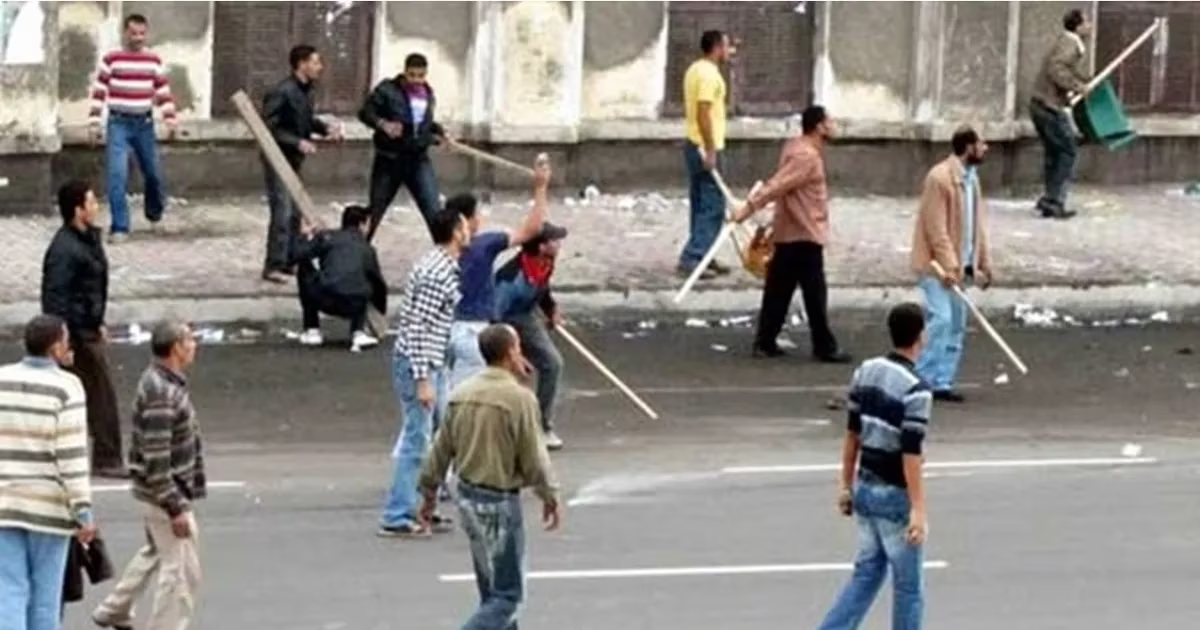
Observers in many developing countries are struck by the phenomenon of the growth of individuals and groups operating in ambiguous spaces, where roles intertwine between the state and society, and between the authority of law and the power of actual influence. These groups, appearing under various names such as auxiliary organizations or parallel guards, reflect a flaw in the structure of the modern state, which is supposed to exclusively hold the right to use legitimate force.
In the contemporary Egyptian scene, names like Sabry Nakhnoukh and Ibrahim El-Argani have emerged as symbols of this widespread debate. The discussion around them is not limited to them as individuals but extends to what they represent: a shift in the nature of the relationship between official authority and unofficial actors. This shift indicates a gradual transition from a state of established institutions to what can be called a 'state of intermediaries'.
Analysts believe that political regimes' reliance on these networks grants them a kind of political flexibility that official institutions, constrained by legal texts, lack. In cases where the authority wishes to implement measures that do not conform to strict legal frameworks, these unofficial networks provide an effective tool for greater freedom of action, away from oversight.
These tools also contribute to lowering the direct political cost for the ruling regime, allowing it to disclaim responsibility for certain practices by attributing them to local intermediaries. This approach provides the regime with room for maneuver and denial before the international community or local public opinion when human rights or legal violations occur.
The necessity of these intermediaries emerges in managing security and social vacuums in marginalized or troubled areas that official agencies may not be able to fully control. Here, the 'thug' or local influential leader becomes a partner in maintaining social order in exchange for privileges or implicit recognition of their influence.
Furthermore, some regimes seek through these forces to create new loyalties that break the traditional elites' monopoly on influence and wealth. The use of unconventional power elements deters old influential figures and reshapes the map of local powers, ensuring absolute loyalty to the central authority, away from bureaucratic complexities.
However, this strategy carries serious strategic risks that threaten the stability of states in the long run, as it necessarily leads to weakening the prestige of official institutions and eroding citizens' trust in the rule of law. Prioritizing personal influence over institutional competence creates a fertile environment for corruption and cronyism.
Over time, these parallel forces transform from mere temporary tools into independent power centers with their own agendas and interests, which may later conflict with the state's own directions. Recent history in countries like Russia, Iraq, and Syria provides clear examples of how auxiliary militias can become a structural burden that is difficult to dismantle.
Reliance on individuals instead of laws makes the political system hostage to these individuals. As soon as the person is absent or their interests change, the entire entity shakes. Meanwhile, states that invest in building institutions remain capable of continuity and power transfer without their fundamental functions or national security being affected.
Institutions, by their nature, bequeath stability and sustainability because they are based on abstract rules that do not change with individuals. The personalization of power, however, bequeaths structural fragility. No matter how strong and decisive these groups may seem at the present moment, they remain parasitic entities living at the expense of the state's true power.
The summoning of 'thugs' or illegal forces is an implicit admission of the state's inability to perform its basic functions through legitimate channels. This inability opens the door to the erosion of the social contract that binds citizens to the state, where the search for protection and influence outside the framework of law becomes the norm rather than the exception.
International experiences have proven that security and political solutions based on 'organized thuggery' are short-term solutions, often ending in internal conflicts over influence and resources. Forces created in the dark do not accept living long under the light of law and always seek to expand their areas of influence at the expense of national sovereignty.
Therefore, the real challenge for any regime seeking stability lies in returning to the principles of the modern state and strengthening the role of oversight and judicial institutions. Strengthening the army, police, and judiciary as professional national institutions is the only guarantee to prevent societies from sliding into chaos or gang rule.
In conclusion, the fundamental question facing these countries remains: Do they want to build a state of institutions that protects everyone, or a state of intermediaries that protects narrow interests? The answer to this question will determine the fate of political and social stability in the coming decades, away from the false glitter of power provided by intermediaries.
States that link their influence to individuals become hostage to them, while states that build strong institutions can change individuals without shaking.
שתף את דעתך
Erosion of Institutions and the Summoning of Parallel Powers: A Reading on the Phenomenon of the 'State of Intermediaries'