






Washington Message
Washington - Said Arikat - 6/6/2026
News Analysis
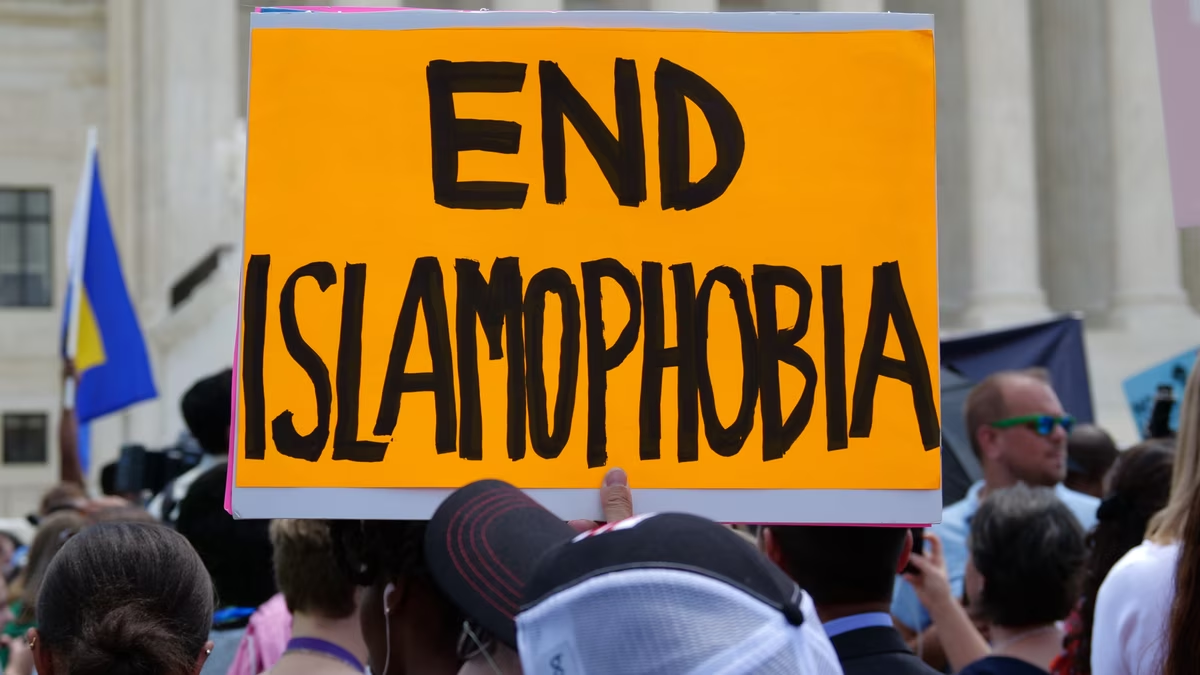
Democratic Congresswoman Summer Lee of Pennsylvania warned of the growing anti-Muslim rhetoric within American political life, considering that the recent attacks targeting Palestinian-American Congresswoman Rashida Tlaib and Egyptian-American Democratic candidate for New Jersey, Adam Hamoui, reflect a disturbing trend that goes beyond traditional political disagreement to questioning the legitimacy of Muslim and Arab participation in the public sphere.
Lee's statements came at a time when Washington is witnessing heated debates about the Israeli war on Lebanon and its political repercussions within Congress, where discussions related to foreign policy have turned into an arena for debate about identity, belonging, and political loyalty.
The House of Representatives had rejected a resolution proposed by Rashida Tlaib calling for preventing the participation of American forces in the Israeli war on Lebanon, after more than one hundred Democratic representatives, including Democratic Minority Leader Hakeem Jeffries, joined Republicans in voting against it.
However, the real controversy erupted during the discussions preceding the vote, when Republican Congressman Max Miller accused Tlaib of "defending terrorists daily," while Republican Congressman Brian Mast described supporters of the resolution as "agents of Hezbollah." Tlaib responded by demanding that these statements be expunged from the official record of the House of Representatives, considering them a direct attack on her character and political positions.
Commenting on what happened, Summer Lee believed that the issue is not merely a disagreement over foreign policy, but rather an extension of a recurring pattern of political targeting of Muslims and Arabs. She said that two Republican representatives treated Tlaib as if she were a terrorist "just because she is Palestinian, Muslim, and a woman," considering that such accusations reveal preconceived notions that are still present in American political discourse.
She added that what is alarming is not only the issuance of these accusations from political opponents, but their gradual transformation into part of the prevailing discourse when dealing with Muslim or Arab figures who adopt positions contrary to the traditional political consensus in Washington, especially on issues related to the Middle East.
These debates come at a time when Israel has continued its military operations in Lebanon since last March, operations that have resulted in thousands of casualties and the displacement of large numbers of civilians, making the war a major subject of disagreements within Congress and among the wings of the Democratic Party itself.
Lee's observations were not limited to Tlaib's case. She linked what the Palestinian congresswoman was subjected to with the controversy that followed the victory of Adam Hamoui, a retired military surgeon and the winning Democratic candidate in the primary elections for the twelfth district in New Jersey.
After his electoral victory, Hamoui faced criticism focused on a previous acquaintance he had with Egyptian cleric Omar Abdel Rahman during social activities related to the Egyptian-American community in New Jersey many years ago. Hamoui clarified that this relationship did not go beyond social acquaintance within community circles, and that attempts to link him to it politically ignore his long professional and military career.
Despite this, the issue sparked widespread political and media reactions. Some Democrats, including Congressman Jared Moskowitz, considered that Hamoui does not align with the party's values, while some media coverage focused on that old relationship more than on his military record or political program.
Lee believes that what unites the two cases is the tendency to subject Muslim politicians to loyalty tests not usually imposed on others, warning that the continuation of this approach could harm the image of the Democratic Party, which champions slogans of justice, equality, and pluralism.
She stressed that the problem is not limited to Republicans alone, noting that she has heard Democrats use some of the harshest stereotypes against their Muslim colleagues. She added that the party that presents itself as a protector of civil rights is required to show the same degree of sensitivity when it comes to Muslims and Arabs, otherwise it risks undermining its credibility among important segments of its voters.
Lee's statements were welcomed by activists and progressives who saw them as one of the clearest positions within the Democratic Party regarding what they consider an escalation of Islamophobia in American political and media circles.
The Democratic congresswoman concluded her stance by emphasizing that no targeted group should be left alone in the face of defamation and hate campaigns, calling for dealing with anti-Muslim hostility with the same seriousness with which other forms of discrimination are addressed. She stressed that the defense of rights and freedoms cannot be selective, and that protecting any minority from political targeting ultimately represents a defense of democratic values themselves.
Attacks on Rashida Tlaib and Adam Hamoui reflect a new reality in American politics. Muslims and Arabs are no longer just electoral pressure groups seeking to influence politicians' decisions, but have become producers of leaders, candidates, and decision-makers. With each new electoral success, the sensitivity of some political circles to this growing presence increases. Therefore, the recent accusations appear to be part of a broader struggle over the redistribution of influence within American institutions, more than just disagreements over foreign policy issues or positions related to the Middle East. The importance of this phenomenon increases with the entry of growing numbers of Arab and Muslim candidates into electoral races during the 2026 cycle.
This issue reveals a growing challenge for the Democratic Party. The party, which presents itself as the primary defender of pluralism and minority rights, finds itself facing increasing criticism from within its Arab and Muslim bases. Many feel that the defense of diversity recedes when it comes to the Palestinian issue or Muslim candidates. If the party cannot seriously address these concerns, it may face difficulty in maintaining the cohesion of the diverse electoral coalition that has been one of its most important strengths over the past two decades. Ignoring these objections may also open the door to further tension between party leaders and young voters involved in human rights issues.
In recent years, discussions about Islamophobia have mostly focused on hate crimes and social discrimination. Today, however, the issue has moved to the heart of the political struggle in Washington. As the number of elected officials of Arab and Muslim descent increases, the debate revolves around who has the right to participate in decision-making and determine the priorities of American policy. This is why the recent confrontations are particularly important, as they do not merely reflect ideological differences, but indicate a gradual redrawing of the balance of power within American political life. The 2026 elections may represent a pivotal moment in this transformation, which has become clearer than ever before.
שתף את דעתך
Escalating Controversy Over Islamophobia in Washington After Targeting of Tlaib and Hamoui