






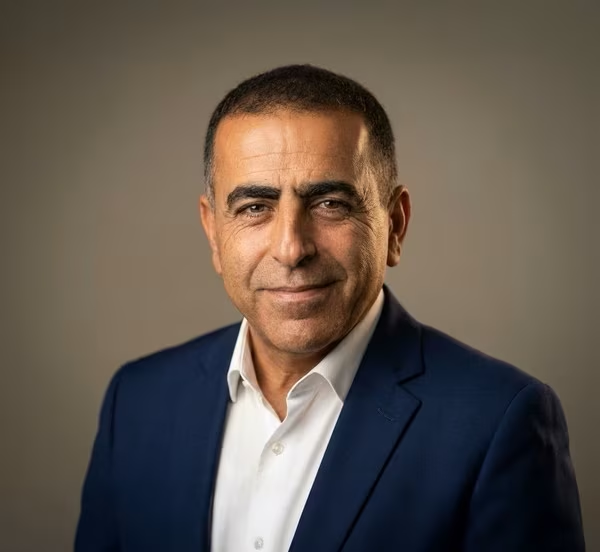
Dr. Ibrahim Nairat
Throughout decades of long conflict, Palestinians have been preoccupied with the question of leadership more than they have been with the question of power. Leaderships have succeeded one another, organizations have risen and others have declined, and programs and slogans have changed, but the reality has continued to pose the same question: Where does true Palestinian power lie?
Often, the Palestinian crisis is reduced to a crisis of leadership or a crisis of political organizations, as if changing individuals or replacing positions is sufficient to bring about a fundamental transformation in reality. However, a calm review of the Palestinian experience leads to a different conclusion; true power has never been exclusive to a leader, a faction, or an institution, but rather has been inherent in Palestinian society itself, in its exceptional ability to steadfastness, survival, and preservation of its national identity despite all transformations and pressures.
Long occupations do not only confront armies, but they confront peoples. A military force may be able to win a battle or impose its control over land, but it faces a more complex dilemma when it finds itself before a people who refuse to surrender, assimilate, or abandon their national narrative. Therefore, the secret to the continuation of the Palestinian cause throughout these decades has not been military or economic superiority, but rather the ability of Palestinian society to reproduce itself generation after generation, and to maintain its national presence despite all attempts at weakening and attrition.
From this perspective, true Palestinian power appears to be inherent in the Palestinian individual himself; in the student who insists on his right to education, in the farmer who protects his land, in the worker who continues to search for a dignified life, and in the family that transmits national memory to its children, as well as in millions of Palestinians inside and outside the homeland who have maintained their belonging and identity despite changing places and circumstances.
However, possessing power is one thing, and the ability to employ it and transform it into effective political action is another. Here begins the deeper Palestinian dilemma. The people possess enormous energy, but this energy does not necessarily transform into organized power capable of asserting its presence in the political equation. Between latent power and effective action stands a set of structural obstacles that have accumulated over time.
Perhaps the most prominent of these obstacles appears in the complex relationship between Palestinian society and the Palestinian Authority. Since the establishment of the Authority, a political and administrative structure emerged, primarily designed within a vision based on building and managing state institutions. Over time, a complete system of laws, agencies, functions, interests, and political culture was formed, deriving its logic from the idea of the state more than from the logic of national liberation movements.
Here emerges a paradox worth contemplating. On the one hand, official discourse repeatedly calls for popular resistance as a strategic option in confronting the occupation. On the other hand, the existing political structure appears incapable of producing or leading a broad and sustainable popular movement. The reason is not necessarily the absence of will, but rather because the logic of authority and the logic of popular resistance stem from different priorities.
Authority, by its nature, seeks stability, administration, and the preservation of institutions, services, and public order, while popular resistance relies on community initiative, mass mobilization, and direct political friction with the reality of occupation. The former fears chaos and the political, economic, and security costs that may result from it, while the latter believes that stagnation itself carries an increasing national cost.
For this reason, the problem may not be the absence of calls for popular resistance, but rather the existence of a structural gap between the party issuing the call and the environment required for its success. Popular resistance is not an administrative decision that can be issued from above, but rather a social and political process that grows when people feel that they are partners in the decision, not just recipients of it.
Over time, the distance between society and its political institutions widened. Traditional popular frameworks declined, public participation weakened, and feelings of frustration accumulated among broad segments of Palestinians who no longer saw a direct impact of their political participation on the course of events. In light of this reality, it became difficult to mobilize society around long-term collective projects, no matter how just or necessary they were.
Hence, the question that is increasingly present in Palestinian discourse emerges: Has the existence of the Authority become a structural obstacle to popular initiatives?
Perhaps the answer is not that simple. The problem is not in the existence of the Authority itself, but rather in the nature of the relationship that has developed between it and society. When institutions become a closed space and mechanisms of participation, renewal, and accountability weaken within them, they gradually lose their ability to absorb popular energy. And when citizens feel that their role is limited to waiting for decisions rather than participating in making them, individual and collective initiative both decline.
Conversely, reducing the crisis to the Authority alone ignores other equally important factors; such as political division, social and economic transformations, declining trust in public work, and the exhaustion of society under the weight of daily burdens. Nevertheless, the relationship between the Authority and the people remains one of the most important knots that hinder the transformation of latent societal power into organized political power.
Palestinian history has repeatedly proven that society possesses an exceptional ability to act when it feels that it is the owner of the national project, not just its audience. In moments when popular will met with a comprehensive national vision, Palestinians were able to produce forms of collective action that left a deep impact on the course of the cause, while when the gap between leadership and people widened, initiatives declined and frustration replaced action.
This analysis gains further clarity when looking at the current field reality, where settlement expansion is accelerating unprecedentedly, amidst a clear inability to produce Palestinian initiatives capable of curbing it or even creating a serious political or field cost for it. This scene is not only read as a unilateral development by the occupying power, but also as a reflection of the state of paralysis and dispersion in Palestinian collective action, and the absence of the ability to transform popular anger into organized and effective action.
From this perspective, it appears that the other side is not content with investing in the material balance of power, but also benefits from the state of division, narrow horizons, and lack of initiative, allowing it to expand its facts on the ground with the least cost or deterrence. Here, the gap between the latent power in society and the inability of political frameworks to activate it becomes clearer, and it becomes one of the most important elements in explaining the current scene, where the strength of settlement action intersects with the weakness of counter-action, at a moment when political confusion is mixed with a strategic dead end.
Therefore, the central Palestinian question today is not only about who leads, or which organization has the greatest influence, but about how to rediscover the true source of power inherent in society itself. The issue is not a crisis of faces or names as much as it is a crisis of the relationship between original power and its political institutions.
The Palestinian people still represent the largest elements of power in the conflict equation. They are the source of steadfastness, continuity, legitimacy, and the ability to raise the cost of occupation and deplete its project in the long run. But this power will remain latent unless it finds a political and institutional framework capable of absorbing it, organizing it, and transforming it into a comprehensive national project.
However, understanding this source is not enough unless it is coupled with rebuilding the mechanisms capable of transforming it into organized and sustainable action. The Palestinian dilemma today does not seem to be in the absence of popular will as much as it lies in the widening gap between society and the political frameworks that are supposed to represent it and organize its energies. Therefore, the question is no longer how to mobilize people, but how to rebuild the relationship between society and politics on new foundations.
This begins with freeing community initiatives from the captivity of factional polarization, and restoring credibility to intermediary institutions such as unions, student federations, cooperative societies, and local committees capable of representing public interests away from political divisions. It also requires redefining popular resistance itself, not as seasonal events or fleeting moments of protest, but as a daily community culture embodied in education, volunteer work, land protection, promoting local production, and building networks of solidarity and steadfastness.
At the same time, no popular project can rise without restoring trust between citizens and their institutions, a trust that is not built on slogans, but on transparency, accountability, expanding participation, renewing elites, and opening the way for new generations to contribute to decision-making. This task may require transcending the centrality of national action by empowering local initiatives in cities, villages, and refugee camps, and building community coordination networks capable of acting from the grassroots up instead of waiting for decisions from the political center alone.
The most sensitive challenge is to redefine the role of the Authority itself. It is not required to monopolize national action or to lead all forms of popular movement, but rather to transform from a position of controller to a position of enabler, and from an authority that manages society to a framework that allows society to organize itself and express its interests and initiatives.
Here emerges the deeper question that will determine the shape of the next phase: Do Palestinians seek to build a popular movement independent of the Authority or integrated with it? Perhaps the solution does not lie in either of the two options in their absolute form, but in a third formula based on a strong society that possesses its independent institutions and free public spheres, and an authority that recognizes the role of society as a partner, not a subordinate.
Only then can the latent power in the Palestinian people transform from a historical energy of steadfastness into an organized political and social force, capable of renewing the national project and restoring balance to the conflict equation.
שתף את דעתך
The Absent Source of Power: The Palestinian People Between the Authority's Dilemma and the Potential of Popular Resistance