






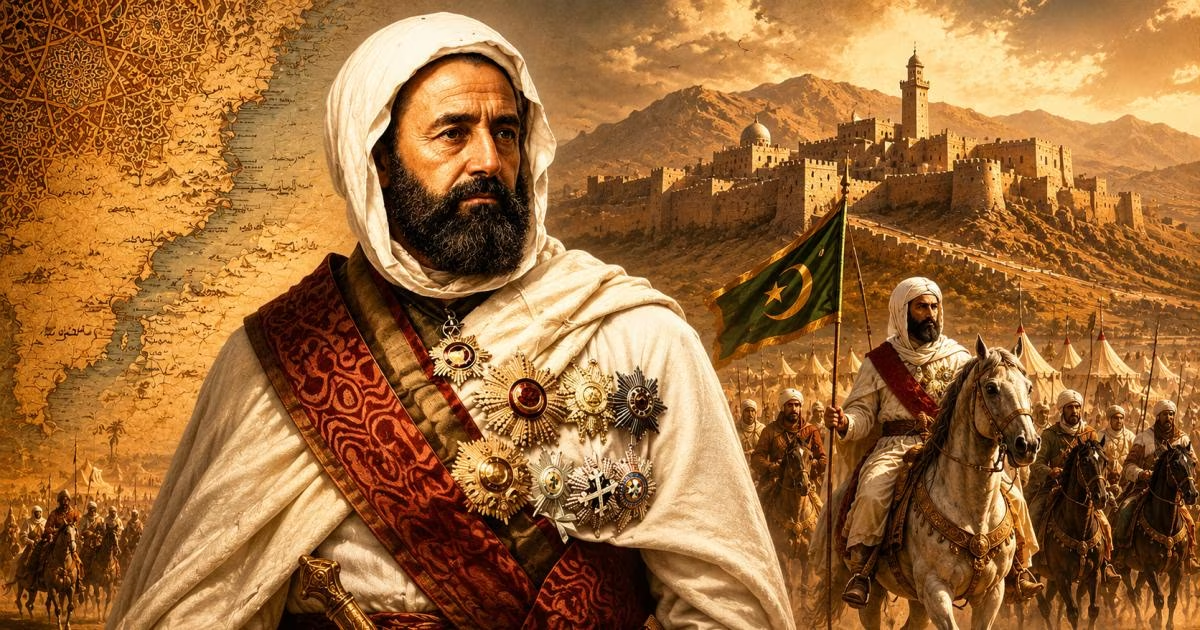
The memoirs of Emir Abdelkader al-Jazairi encapsulate the journey of an exceptional leader who managed to combine the ideology of armed resistance with the genius of state-building simultaneously. This historical journey began after the fall of Algiers in 1830 and the signing of the surrender treaty, when an urgent need arose for a national leadership to unite the scattered tribes under one banner to confront French colonial expansion.
On November 27, 1832, a historic pledge of allegiance took place in the Mascara region under the 'Dardara Tree,' where Abdelkader bin Muhieddine was appointed Emir of the Believers. This choice came after his father, who declined leadership due to old age, endorsed him, betting on his son's courage and shrewdness, which had been evident in the early battles of Oran.
Emir Abdelkader's movement was not merely a military rebellion; it was a renaissance project that sought to establish a modern state with clear institutional features. He divided the country into eight administrative provinces and established a government comprising five ministers with specific tasks, reflecting an advanced vision for managing public and political affairs at that time.
On the military front, the Emir succeeded in organizing a regular army and building fortified castles across the high plateaus to serve as strategic refuges. He also focused on establishing factories for weapons and ammunition, realizing that true independence required self-sufficiency in military equipment to confront a regular army that outnumbered and out-equipped his forces.
Victories of the resistance forced French commanders to the negotiating table, resulting in the signing of the 'De Michel' treaty in 1834. This treaty served as an implicit diplomatic recognition of the Emir's authority and opened avenues for him to communicate with other international powers that were competing with France in the region.
The Emir's political gains evolved with the signing of the 'Tafna' treaty in 1837, in which Paris recognized his sovereignty over two-thirds of Algerian territory. Abdelkader used this truce to strengthen the pillars of his state and expand his administrative influence, while the French viewed the agreement as a warrior's respite to regroup their forces.
Emir Abdelkader invented the concept of 'Zmala,' a mobile capital that included thousands of people, treasuries, and administrative facilities, making it difficult for the occupation to strike at the heart of the state. This mobile city was an embodiment of the resistance's flexibility and its ability to adapt to the conditions of the asymmetrical warfare imposed by the colonizer.
France responded to the Emir's military genius by adopting a 'scorched earth' policy under the command of General Bugeaud, aiming to isolate the resistance from its popular base. This policy included destroying crops and displacing tribes allied with the Emir, creating immense humanitarian and economic pressure on the resistance army.
The fall of 'Zmala' into the hands of French forces dealt a devastating blow to the war effort, as the Emir lost most of his wealth and treasury, and the families of his senior commanders were captured. This loss led to a decline in morale and the dispersal of supporting forces, especially after increasing military pressures from multiple directions.
Amidst deteriorating conditions and the difficulty of securing supplies for the army, the Emir convened a consultative council to make a fateful decision regarding the continuation of fighting. The council favored saving lives and preserving what remained of the forces, so surrender negotiations began with the French commander 'Lamoricière' based on specific conditions.
Emir Abdelkader stipulated, in exchange for laying down arms, a guarantee of safe passage and the right to move with his followers to Alexandria or Acre in the Arab East. French commanders officially agreed to these terms, and the surrender took place in December 1847, with the Emir boarding a ship, believing his destination was Jerusalem or Damascus.
The French deception soon became apparent when the Emir realized that the ship was heading towards French ports instead of the East, in a clear breach of written agreements. The Emir transformed from a state leader into a prisoner in French castles, sparking a wave of international criticism and concern in European political circles regarding French conduct.
Despite imprisonment and exile, Emir Abdelkader remained in the Western imagination a symbol of the 'Noble Arab,' with historians likening him to Saladin al-Ayyubi in his wartime ethics. His personal integrity and his desperate defense of his country above any personal interest made his cause transform from a local matter into a global conscience issue.
Emir Abdelkader's memoirs remain a historical document witnessing a pivotal stage in modern Algerian history, laying the first foundations of the resistant national identity. The Emir's story is an epic that combines the ambition of institution-building with the bitterness of colonial betrayal, his memory remaining alive as the father of modern Algerian state institutions.
I accepted this position so that I would have the right to be the first to go to the battlefield.
שתף את דעתך
Memoirs of Emir Abdelkader: A Biography of State-Building and the Epics of Resistance Against Colonialism