






Washington's Message
Washington – Said Arikat – 24/5/2026
News Analysis
Once again, Lebanon finds itself hostage to regional and international understandings crafted far from the will of its people, after President Trump announced that an agreement with Iran was on the horizon, potentially opening the door to de-escalation across several fronts in the Middle East, including Lebanon. However, Lebanon's long experience with foreign interventions makes many view these promises with suspicion, especially since the United States and Israel have historically not treated Lebanon as an independent, sovereign state, but rather as a pressure point and a field for settling scores that serves their strategic interests in the region.
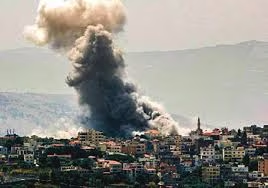
The recent war clearly revealed the extent of this external exploitation of Lebanon. After Hezbollah fired towards Israel in solidarity with Tehran, the country turned into an open confrontation zone, with southern villages and Lebanese civilians paying the price, while international powers continued to manage the conflict according to their own calculations. The widespread Israeli shelling did not only target the party's military infrastructure but also civilian infrastructure and the livelihoods of residents, in a clear attempt to plunge Lebanon further into chaos and collapse, thereby preventing the establishment of a strong state capable of asserting its independent national decision.
Despite talks of a ceasefire brokered by Washington last April, Israel continued its attacks inside Lebanese territory on an almost daily basis, relying on full American political and military cover. This reality confirmed that Washington does not treat Lebanon as an independent partner, but rather as a security file exclusively linked to Israel's security. Therefore, the American administration did not exert any real pressure to compel Israel to respect the truce, but rather left the door open for continued strikes and military attrition.
According to what the New York Times reported from Iranian officials, the potential agreement between Washington and Tehran may include a cessation of fighting on various fronts, including Lebanon. But these leaks do not dispel fears, because previous experiences have proven that any American-Iranian understanding is often used to manage crises, not to resolve them, while Lebanon remains the weakest link left to its fate amidst international tug-of-war.
Israeli policy towards Lebanon has never been based on seeking genuine peace, but rather on keeping the country weak, divided, and incapable of building a strong, independent state. From repeated invasions to the ongoing occupation of parts of the South, Israel has treated Lebanon as an arena that should be politically and sectarianly dismantled so that it does not become a source of Arab strength on its northern border. The United States, instead of playing the role of an impartial mediator, provided full cover for this strategy through open military, political, and diplomatic support. Therefore, American talk of stability seems contradictory to the actual policies that have continuously and intentionally contributed over the years to deepening Lebanese division and weakening central state institutions.
In this context, recent statements by the Israeli government appear highly significant, as it stressed that it would not relinquish its "freedom of action" inside Lebanon even if a broader regional agreement were reached. This practically means that Israel wants to impose a permanent equation that allows it to intervene militarily whenever it wishes, without any actual respect for Lebanese sovereignty or international law.
Despite the losses suffered by Hezbollah, the party still represents a fundamental force in the Lebanese and regional equation, whether Lebanese agree or disagree with it politically. But the real danger lies in the continued internal division over how to confront the Israeli project, as Tel Aviv always benefits from Lebanese divisions to justify its interventions and expand its security and military influence.
The current Lebanese reality compels all political forces, including Hezbollah and its opponents, to realize that continued internal division serves Israel first and foremost. A divided state and warring factions give Tel Aviv a permanent opportunity to intervene and impose new realities on the ground, especially in the South and border areas. Therefore, any serious national project must start from dialogue among the Lebanese themselves, not from relying on foreign capitals. Moreover, confronting Israeli ambitions does not necessarily mean adopting a completely unified political vision, but rather agreeing on a national minimum that protects Lebanese sovereignty and prevents the country from becoming an open arena for future continuous and dangerous regional wars and international conflicts.
Lebanese fears are increasing with the continued Israeli occupation of a border strip inside Lebanese territory, where Israeli forces maintain positions extending several miles into the South. This military presence does not appear temporary in the eyes of many Lebanese, but rather part of a long-term strategy aimed at imposing new realities on the ground and linking any future withdrawal to political and security conditions that primarily serve Israeli interests.
Lebanon today stands at a fateful moment that transcends a mere temporary ceasefire or a fleeting regional understanding. The real battle concerns preserving the country's unity and preventing its transformation into conflicting spheres of influence that serve external projects. If Israel seeks to impose a new border and security reality by force, then the most effective Lebanese response must be to build a unified national stance that rejects both occupation and division. Moreover, Hezbollah's responsibility, as a major force, is not limited to military confrontation only, but also includes engaging in an inclusive national project that reassures the rest of the Lebanese and restores the state and its institutions as the ultimate authority for everyone without actual exception.
Amidst economic collapse, mass emigration, and declining Lebanese trust in their institutions, the need to redefine national priorities away from sharp alignments seems more urgent. Lebanon will not be able to confront Israeli and American pressures if it remains mired in internal divisions and narrow sectarian calculations. Furthermore, any real stability will not be achieved through international understandings alone, but through the consensus of the Lebanese on a project for a just and strong state capable of protecting its borders and its independent political decision. Without that, Lebanon will remain exposed to repeated cycles of wars and fragile truces, while external powers continue to use its crises to achieve their strategic interests at the expense of the Lebanese people and the future of the entire region.
שתף את דעתך
Israel Pushes Lebanon Towards Disintegration: The Battle for Sovereignty Against Occupation and American Hegemony